

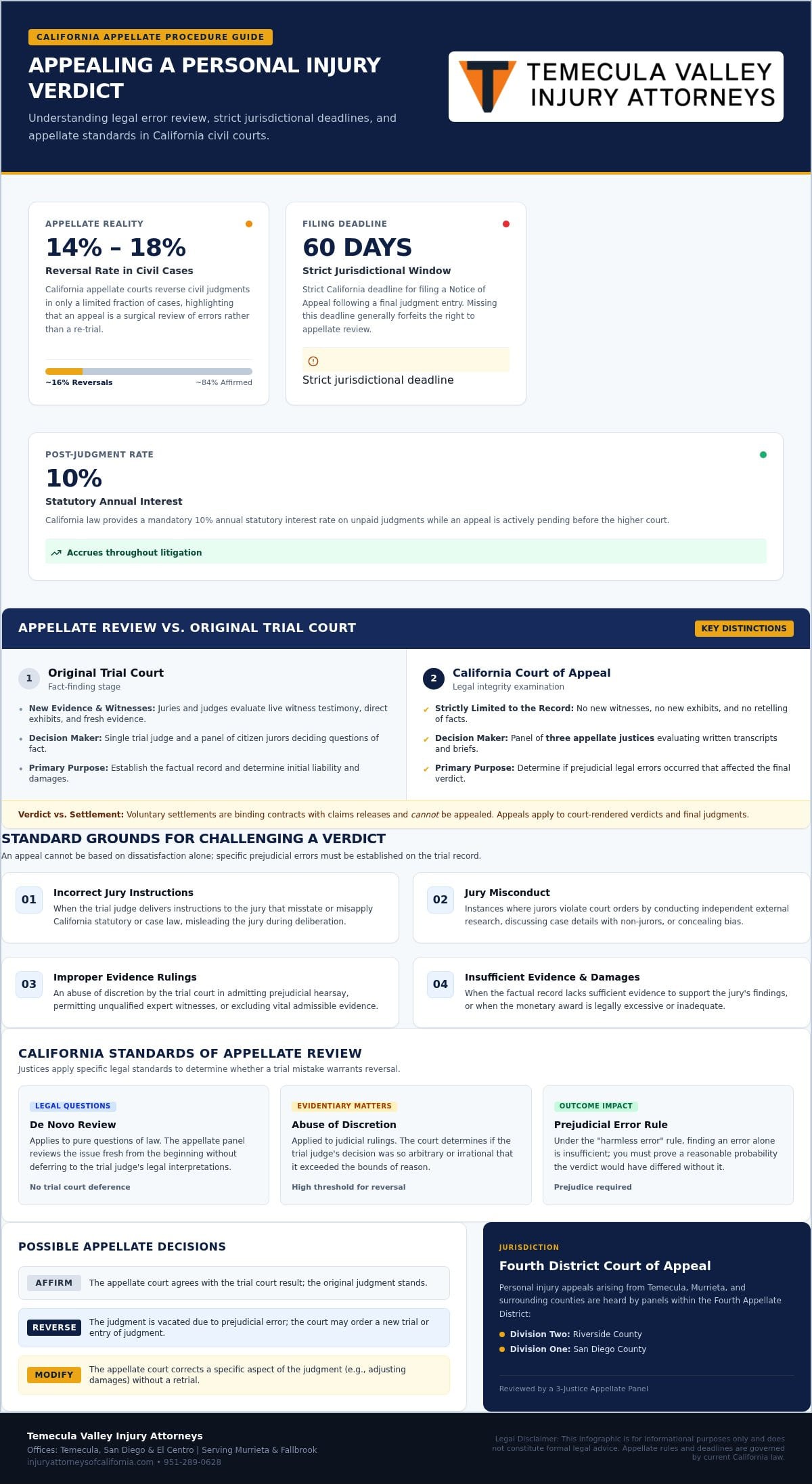
Did you know that California appellate courts reverse civil judgments in only about 14% to 18% of cases? This statistic might feel heavy if you’re currently considering appealing a personal injury verdict, but it points to a vital truth: an appeal isn’t a “do-over” of your trial. It’s a targeted legal challenge focused on specific errors that occurred in the courtroom. We understand the uncertainty you’re feeling right now. You want to know if the award is final or if a mistake by the judge or jury can be corrected. The transition from a trial to an appeal is often stressful, especially when you’re worried about the costs of prolonged litigation.
This guide will help you understand the rigorous requirements and timelines involved in the California appellate process. You’ll learn exactly what grounds are necessary to challenge a decision and how the law protects your interests during this time. We’ll explore the strict 60-day filing deadlines, the 10% statutory interest rate on judgments, and how the court generally reviews these high-stakes decisions. Our goal is to provide the technical expertise and reassurance you need to make informed choices about your case’s future in Riverside or San Diego County.
Key Takeaways
- Understand that an appeal is a surgical review of legal errors rather than a second trial or a chance to present new evidence.
- Identify the specific grounds for appealing a personal injury verdict, such as incorrect jury instructions or the improper exclusion of evidence.
- Learn about the strict 60-day jurisdictional deadline for filing a Notice of Appeal to ensure your case remains eligible for review.
- Discover the potential outcomes of the process, including whether the court may affirm, reverse, or modify the trial court’s original decision.
- See how local knowledge of the Fourth District Court of Appeal in Riverside and San Diego helps protect your interests during complex litigation.
What Does It Mean to Appeal a Personal Injury Verdict?
An appeal is a formal request for a higher court to review a decision made by a trial court judge or jury. It’s a common misconception that this process is a “do-over” of your entire case. When you’re appealing a personal injury verdict, you aren’t asking for a second chance to tell your story to a new jury. Instead, you’re asking a panel of justices to determine if legal errors occurred during your trial that were serious enough to change the outcome.
In this phase of litigation, the roles of the parties change. The person who files the appeal is known as the “Appellant,” while the party defending the original verdict is the “Respondent.” The appellate court’s review is strictly limited to the record created during the trial. This means they won’t hear from new witnesses, look at new photos, or consider evidence that wasn’t presented in the original courtroom. We at Temecula Valley Injury Attorneys view this stage as a surgical examination of the trial’s legal integrity.
The Role of the California Courts of Appeal
For cases originating in Temecula, Murrieta, or San Diego, the process usually moves to the Fourth District Court of Appeal. This district has divisions in Riverside and San Diego that handle local matters. Rather than a single judge, a panel of three justices reviews your case. They examine the written trial transcript and legal briefs submitted by both sides to see if the law was followed correctly.
The justices apply specific standards of appellate review to decide if a mistake warrants a reversal. For example, they might use a “de novo” standard to review pure questions of law, meaning they look at the issue fresh without deferring to the trial judge’s opinion. In other situations, such as evidentiary rulings, they look for an “abuse of discretion,” where the trial judge’s decision was so irrational that it exceeded the bounds of reason.
Verdicts vs. Settlements: Can Both Be Appealed?
It’s vital to distinguish between a verdict and a settlement. Most personal injury claims end in a settlement, which is a voluntary contract between you and the other party. Because you agree to the terms and sign a release of claims, settlements are generally final and cannot be appealed. Appeals are almost exclusively reserved for verdicts, which are decisions imposed by a court after a full trial.
Under California law, a “final judgment” is a court’s official decree that resolves all issues in a case, effectively ending the trial court’s involvement and opening the door for the appellate process. If you believe a legal error led to an unfair result, this final judgment is the starting point for your challenge.
Common Grounds for Appealing a Personal Injury Verdict
You can’t appeal simply because the jury’s decision wasn’t what you hoped for. Winning an appeal requires proving that a specific legal error occurred during the trial that prejudiced your case. When appealing a personal injury verdict, we look for mistakes that likely changed the jury’s final decision. The law requires a high level of technical precision to overturn a judgment, and our firm focuses on identifying these failures to protect your rights.
Several standard issues can serve as the foundation for a challenge. These include:
- Incorrect jury instructions provided by the judge that misstate California law.
- Jury misconduct, such as jurors conducting independent research or discussing the case with outsiders.
- Insufficient evidence to support the jury’s specific findings of fact.
- Abuse of discretion by the judge in admitting or excluding critical evidence.
Errors in Admitting Evidence
The judge acts as a gatekeeper for what information the jury sees. If a judge admits improper hearsay or allows unqualified expert testimony, it can unfairly sway the jury in a car accident case. However, proving a mistake isn’t enough. Under the “harmless error” rule, you must show the error was prejudicial. This means there’s a reasonable probability that the trial result would’ve been different if the mistake hadn’t happened. The California Courts of Appeal procedural guidelines outline how these errors are evaluated against the existing trial record.
Inadequate or Excessive Damages
Sometimes, the legal error involves the amount of money awarded. You may challenge the dollar amount of a personal injury award if it’s so high or low that it “shocks the conscience.” Appellate courts look for evidence that the jury was driven by “passion or prejudice” rather than the facts presented. In these instances, California law generally handles these issues through motions for “remittitur,” which is a reduction of the award, or “additur,” which is an increase. These technical maneuvers are designed to correct an unjust financial result when the evidence doesn’t support the verdict amount.
The Appellate Timeline and Procedure in California
The appellate journey is a structured, time-sensitive process that demands technical precision. When you’re appealing a personal injury verdict, the first step isn’t arguing your case; it’s securing your right to be heard. This starts with filing a Notice of Appeal. This document alerts both the trial court and the higher court that you intend to challenge the decision. It’s a jurisdictional requirement, meaning if it isn’t filed correctly, the appellate court has no power to hear your case.
Once the appeal is initiated, the case enters the briefing phase. We submit the Appellant’s Opening Brief, which details the specific legal errors that occurred during the trial. The opposing side then files a Respondent’s Brief to defend the original verdict. Finally, we have the opportunity to file a Reply Brief to address their arguments directly. This written exchange is the most critical part of the process, as justices spend far more time reading these documents than listening to live arguments.
After the briefs are submitted, the justices may schedule oral arguments. This is a brief, intense session where attorneys answer direct questions from a three-justice panel. It isn’t a time for new evidence or witness testimony. Instead, it’s a chance to clarify complex legal points before the court issues its final written opinion, which usually happens within 90 days of the argument.
Strict Deadlines You Cannot Miss
Timing is everything in California law. You generally have only 60 days from the service of the “Notice of Entry” of judgment to file your appeal. If no notice is served, the limit is 180 days. These deadlines are absolute. The appellate court cannot extend them for you. While different rules may apply for fatal accidents involving government claims or cases involving minors, missing this window usually results in a permanent loss of your appeal rights.
The Importance of the Trial Record
A strong argument is useless without a complete trial record. You must “preserve the record” during the initial trial by making proper objections at the time an error occurs. In Murrieta and Temecula courtrooms, court reporters create the verbatim transcript that appellate justices rely on. You must designate which transcripts and exhibits to include in the record within 10 days of filing your appeal notice. If a transcript is missing or incomplete, the appellate court generally presumes the trial judge acted correctly, which could end your appeal before it truly begins.
Possible Outcomes of a Personal Injury Appeal
Once the Fourth District Court of Appeal reviews the record and briefs, the justices will issue a formal written opinion. This document concludes the appellate review by choosing one of several specific paths. An affirmation is the most common result, where the justices find no prejudicial error and let the original trial court judgment stand. Conversely, a reversal occurs when the court finds that a significant legal mistake occurred, effectively nullifying the original verdict. In some instances, the court may choose a modification, where they correct a specific part of the judgment, such as an interest calculation or a specific damage award, without requiring a new trial. Finally, a remand sends the case back down to the superior court with specific instructions on how to proceed.
The court’s decision is based entirely on the application of California law to the existing trial record. While the process is rigorous, it provides a vital safety net to ensure that trial judges and juries followed the rules correctly. Whether the court affirms or reverses the decision, the written opinion becomes a permanent part of your case history and dictates the next steps for all parties involved.
What Happens During a Remand?
A remand often follows a reversal and acts as a directive for the trial court to fix the identified error. This could mean a completely new trial on all issues or a limited trial focused only on damages. For a complex truck accident case, a remand might involve re-examining specific expert testimony that was previously excluded. While the prospect of returning to court in Riverside or San Diego County may feel daunting, a remand often shifts the litigation’s momentum. Insurance companies frequently see a reversal as a signal of increased risk, which can lead to productive settlement negotiations that weren’t possible during the initial trial phase.
The Finality of Appellate Decisions
While the Court of Appeal’s decision is high-stakes, it isn’t always the final word. A party who loses the appeal can file a petition for rehearing, though these are rarely granted unless the court overlooked a material fact. The next step is a petition for review with the California Supreme Court. Because the Supreme Court grants review in only about 3% to 4% of civil cases, the intermediate appellate court is usually the definitive stop for most people appealing a personal injury verdict. A case officially concludes when the appellate court issues a “remittitur,” which is a document that transfers jurisdiction back to the trial court to execute the final judgment. This process ensures that every legal avenue has been explored and that the final result adheres strictly to California law.
How Temecula Valley Injury Attorneys Navigates Complex Appeals
When you’re facing the possibility of appealing a personal injury verdict, you need more than just a legal technician. You need a partner who treats your security as a point of professional integrity. We take a meticulous approach to identifying trial court errors, scrutinizing every page of the trial transcript to find the specific failures that prejudiced your case. Our firm’s commitment is to protect the results we’ve achieved for our clients. This means we’re just as dedicated to defending a hard-won verdict as we are to challenging an unjust one.
Local knowledge is vital during this phase. We understand the specific local rules and procedures of the Fourth District Court of Appeal. Whether your case was heard in Riverside or San Diego, we navigate these complex districts with the precision of a neighbor who knows the landscape. We prioritize clear, practical communication. We ensure you never feel lost in the technical jargon or the slow-moving nature of the appellate process.
A Client-Focused Approach to High-Stakes Law
The appellate phase is inherently stressful. It’s a long-term litigation process that requires a calm and strategic perspective. We handle the heavy lifting for you, from designating the record to drafting the final reply brief. With verified offices in Temecula, San Diego, and El Centro, we maintain a strong presence throughout Southern California. This allows us to serve clients in Murrieta and Fallbrook with the personalized attention they deserve. We frame your security as our personal commitment, ensuring you stay informed as we work to resolve your personal injury matter.
Next Steps: Evaluating Your Case for Appeal
Not every trial outcome warrants an appeal. The first step is always a thorough legal review of your trial transcripts and evidentiary rulings. You need to consult with an attorney who understands the nuances of California appellate law and the specific standards of review applied by the justices. We look for the prejudicial error required to move forward. We provide an objective assessment of your chances for success. If you’re ready to discuss your trial outcome and explore the feasibility of appealing a personal injury verdict, we’re here to guide you through the next steps.
Schedule a free case evaluation to discuss your trial outcome.
Securing Your Future After a Trial Court Decision
The transition from a trial verdict to an appeal is a high-stakes period that demands both technical expertise and a calm, strategic perspective. You’ve learned that appealing a personal injury verdict isn’t about re-arguing the facts; it’s about identifying the specific legal errors that may have compromised your case. Whether you’re facing a strict 60-day deadline or navigating the complexities of a remand, the quality of your legal review is the most important factor in your success.
At Temecula Valley Injury Attorneys, we serve as meticulous protectors of our clients’ rights across Southern California. With verified offices in Temecula, San Diego, and El Centro, we bring a local focus to catastrophic injury and wrongful death cases. We’re committed to providing the professional authority and personal reassurance you need during this complex phase. If you’re uncertain about your trial’s outcome, we’re ready to help you evaluate your options with clarity and integrity. Don’t let a legal error define your recovery.
Schedule a free case evaluation today to discuss your appellate options.
Frequently Asked Questions
How long does the personal injury appeal process typically take in California?
The statewide median processing time for a civil appeal in California ranges from 15 to 20 months. This duration covers the time needed to prepare the trial record, complete the briefing schedule, and wait for the justices to issue a written opinion. In the Fourth District Court of Appeal serving San Diego and Riverside counties, the timeline can vary based on the complexity of the record and the court’s current caseload.
Can I introduce new evidence or witnesses during my appeal?
No, you cannot introduce new evidence or witnesses during the appellate process. The justices only review the “record on appeal,” which consists of the transcripts and exhibits from your original trial in Temecula or San Diego. The court’s role is to determine if legal errors occurred during the trial, not to re-try the facts of the case. This is why preserving the record during the initial proceedings is so critical.
Will I have to pay more legal fees if my case is appealed?
Whether you pay more depends on your specific fee agreement with your attorney. Most personal injury cases are handled on a contingency basis, but appellate work requires significant additional hours and expertise. You may be responsible for specific costs such as the $775 appellate filing fee and transcript preparation deposits. We provide clear communication regarding how appealing a personal injury verdict impacts your case costs and potential recovery.
What is a ‘stay of execution’ for a judgment during an appeal?
A “stay of execution” is a legal order that stops the prevailing party from collecting a money judgment while an appeal is pending. In California, filing an appeal doesn’t automatically stop collection. To secure a stay, the appellant generally must post an appeal bond or undertaking. Under the Code of Civil Procedure, this bond is typically 150% of the judgment amount if provided by an admitted corporate surety.
Can the defendant appeal if I won my car accident case?
Yes, the defendant has the right to appeal if they believe a legal error led to an unfair result. If you won your car accident case in a Murrieta courtroom, the insurance carrier might challenge the verdict based on improper jury instructions or the admission of certain evidence. This is a common tactic used to delay payment or create leverage for a post-verdict settlement while the appellate process is pending.
What happens if the appellate court decides the jury award was too high?
If the appellate court determines the jury award was excessive, it may issue a “remittitur.” This gives the plaintiff a choice: accept a specific, reduced damage amount or undergo a new trial on the issue of damages. The court takes this step only if the award is so high that it suggests the jury was driven by passion or prejudice rather than the evidence presented during the trial.
Do I need a different lawyer for an appeal than I had at trial?
You aren’t required to hire a different lawyer, but many people choose to work with attorneys who have specific experience in appellate law. Trial work and appellate work require different skill sets. While your trial lawyer knows the facts, an appellate advocate focuses on the technical legal errors in the record. We at Temecula Valley Injury Attorneys provide the meticulous review necessary to handle these high-stakes challenges effectively.


