

If the unthinkable happens, does California law recognize your right to seek justice, or are you legally sidelined? Losing a loved one is an overwhelming emotional burden, and the sudden loss of household income only adds to that weight. You want to hold the responsible parties accountable, but the legal system often feels like a maze of complex statutes. It’s natural to feel confused about who can sue for wrongful death in California when you’re already dealing with profound grief.
We understand that you need clear answers and a protective partner to help secure your family’s stability. This guide identifies exactly who has the legal standing to file a claim and how the state’s hierarchy of claimants works. We’ll explain the specific requirements of California Code of Civil Procedure 377.60, helping you identify the correct person to lead the legal action. By the end of this article, you’ll have a practical understanding of your rights and the “one action rule” that governs these sensitive cases in 2026. You deserve the peace of mind that comes from knowing your family’s future is protected.
Key Takeaways
- Learn how California Code of Civil Procedure 377.60 defines legal standing and determines who can sue for wrongful death in California.
- Understand the strict priority ladder that places surviving spouses, domestic partners, and children first in line for legal action.
- Discover the specific requirements for stepchildren and putative spouses to prove financial dependence and secure their right to a claim.
- Identify the critical differences between a wrongful death claim and a survival action to ensure you seek the correct damages for your family.
- Stay informed about high-stakes deadlines, including the standard two-year statute of limitations and the significantly shorter window for claims against government entities.
Understanding Standing Under California Code of Civil Procedure 377.60
Standing is your legal “ticket” into the courtroom. It doesn’t measure the depth of your grief; it measures your legal relationship to the deceased. California Code of Civil Procedure 377.60 serves as the definitive rulebook for who can sue for wrongful death in California. This statute ensures that legal actions are organized and that the right people receive the protection they need. At Temecula Valley Injury Attorneys, we treat standing as the foundation of your case. If the foundation isn’t solid, the entire claim is at risk. By establishing standing early, we protect your right to seek accountability and prevent the court from dismissing your case on a technicality.
The Legal Basis for a Wrongful Death Claim
A wrongful death claim arises when a person dies due to the “wrongful act or neglect” of another. This legal standard covers a wide range of tragic events, from distracted driving to dangerous premises. It’s a civil remedy, not a criminal one. While the state might file criminal charges to punish a wrongdoer, a civil lawsuit is your path to securing your family’s financial future. Standing is the first hurdle your attorney must clear. We must prove you are a person the law specifically authorizes to seek damages.
The “wrongful act” can be intentional, like an assault, or it can be a “negligent act,” such as a failure to follow safety protocols. In many fatal accidents, the claim focuses on the failure to exercise reasonable care. Proving this neglect is essential, but it only matters if you have the standing to bring the evidence forward. We help families navigate this distinction so they can focus on healing while we handle the technical legal requirements.
Why Only Certain People Can Sue
The state limits who can bring a claim to prevent duplicative litigation and protect the judicial process. Imagine if every cousin, friend, or distant relative could file a separate lawsuit for the same death. The courts would be overwhelmed, and the defendant would face endless trials for the same event. By narrowing the field to specific family members, the law ensures a single, comprehensive action. This is often referred to as the “one action rule.”
This approach protects the estate and ensures a fair distribution of any recovery. The law generally looks to “heirs,” which are the people who would inherit the deceased’s property under California’s intestate succession laws. This legislative intent is to support those who were most likely to suffer a direct financial or emotional loss. It’s a structured system designed to provide certainty during a time of chaos, ensuring that the legal process remains focused on those with the most significant stakes.
The Hierarchy of Claimants: Who Has Priority to Sue?
California law doesn’t allow just anyone to file a claim. It follows a strict “priority ladder” that dictates the order of legal standing. This structure ensures that those most impacted by the loss have the first opportunity to seek justice. Understanding your position on this ladder is essential for moving forward. When we represent families at Temecula Valley Injury Attorneys in fatal accidents, we carefully verify these relationships. This ensures the court accepts the filing without delay and protects your family from unnecessary technical hurdles.
Direct Lineal Descendants and Spouses
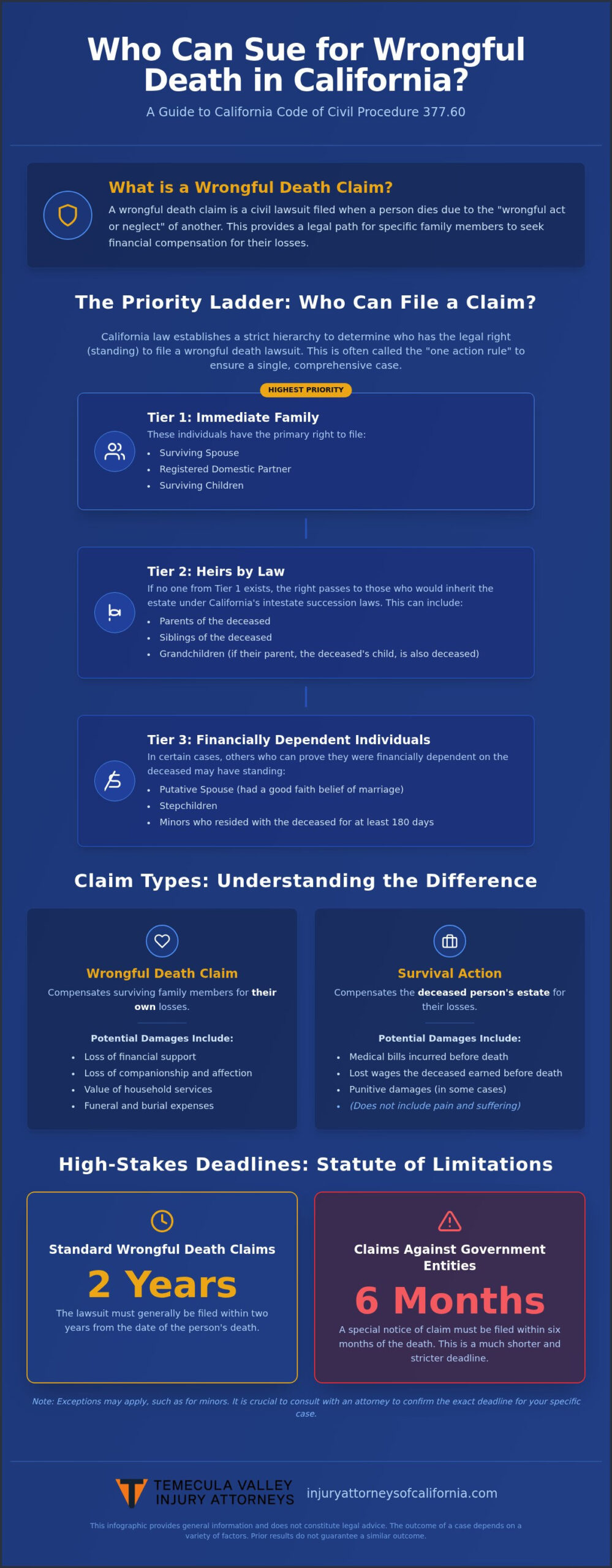
The law prioritizes the immediate family unit above all others. Under California Code of Civil Procedure 377.60, the primary right to file belongs to the surviving spouse or registered domestic partner. If the deceased had children, they also hold this primary standing and generally share in any eventual recovery. It’s important to know that grandchildren aren’t automatically included if their parents are still alive. However, if a child of the deceased has already passed away but left behind their own children, those grandchildren may step into their parent’s shoes. This protects the direct bloodline and ensures that who can sue for wrongful death in California remains focused on the closest survivors.
When There Are No Direct Heirs
If there’s no surviving spouse, domestic partner, or children, the right to sue moves to those who would inherit the deceased’s assets through “intestate succession.” This legal term refers to the order of inheritance when someone dies without a valid will. Usually, the parents of the deceased are next in line. If the parents are no longer living, siblings may then have the standing to file. In rarer cases, even more distant relatives like nieces or nephews could bring a claim if they’re the next legal heirs according to the state’s probate rules.
Proving your status in this hierarchy can be difficult, especially when family records are incomplete or relationships are non-traditional. You shouldn’t have to navigate these legal hurdles alone while you’re grieving. If you’re unsure where you stand or if you have the right to lead a claim, you can schedule a free case evaluation with our team. We’ll help you determine your “rung” on the ladder and ensure your rights are fully protected from the start.
Proving Standing for Non-Traditional Family Members
California’s legal system recognizes that modern families don’t always fit into traditional boxes. While the priority ladder covers spouses and biological children, the law extends standing to others who relied on the deceased. Determining who can sue for wrongful death in California becomes more complex when non-traditional relationships are involved. At Temecula Valley Injury Attorneys, we specialize in documenting these bonds to ensure every rightful claimant is heard. We act as a protective partner, helping you navigate the technical requirements of proving a legal relationship that the court will recognize.
Putative Spouses and Financial Dependence
A putative spouse is someone who believed, in good faith, that their marriage to the deceased was legally valid, even if it was actually void or voidable. This often happens due to technical errors in previous divorces or marriage licenses. To establish standing, you must provide evidence of this good faith belief. This might include joint bank accounts, shared property titles, or tax returns filed as a married couple. We help you gather the necessary documentation to prove your status to the court.
Financial dependence serves as a critical gateway for these claims. This resource explains wrongful death cases and how dependency impacts legal rights. Generally, if you can prove you relied on the deceased for essential financial support, you may be granted the right to seek damages. This protection ensures that those who shared a life and a home aren’t left behind by rigid legal definitions. We analyze your financial records to build a clear case for your standing.
Stepchildren and Other Household Members
Stepchildren don’t have an automatic right to sue unless they were legally adopted. However, they can gain standing by meeting the “50% support” rule. You must demonstrate that the deceased provided at least half of your financial support at the time of their death. This requires a thorough review of household finances, tuition payments, and daily living expenses. It’s a high bar, but it’s a vital path for children who lost a parental figure. Understanding who can sue for wrongful death in California involves looking closely at these specific financial contributions.
California law also protects minors who lived in the decedent’s household for at least 180 days before the death. If the minor was dependent on the deceased for at least 50% of their support, they may have standing to file. This rule often applies to children in long-term foster care or extended family arrangements. We understand how high the stakes are for these young survivors. Our team works meticulously to prove these residency and dependency requirements. If you are navigating a wrongful death claim involving a non-traditional family structure, we’re here to provide the technical expertise you need.
Wrongful Death vs. Survival Actions: Which One Do You File?
When a fatal accident occurs, families often assume there is only one way to seek compensation. In reality, California law provides two distinct pathways: a wrongful death claim and a survival action. While they are often filed together, they serve different purposes. A wrongful death claim is designed to compensate the survivors for their personal losses. Conversely, a survival action allows the deceased person’s estate to recover damages the decedent could have claimed if they had lived. Understanding who can sue for wrongful death in California is the first step, but knowing which claim to file ensures no part of your family’s loss is overlooked.
Damages Available in a Wrongful Death Lawsuit
The primary goal of a wrongful death claim is to address the void left in the lives of the survivors. Economic damages include the loss of financial support the deceased would have provided and the value of household services they performed, such as childcare or maintenance. Non-economic damages are equally vital. These cover the loss of love, companionship, comfort, and guidance. It is a common misconception that heirs can recover for their own emotional grief or sorrow. California law focuses strictly on the loss of the relationship and the tangible support the deceased provided to the family unit.
The Survival Action and Punitive Damages
A survival action focuses on the losses suffered by the deceased before they passed away. This claim “survives” the person’s death and is brought on behalf of the estate. It typically covers medical bills related to the final injury and lost wages from the time of the accident until death. You should be aware of a significant legal shift in 2026. As of January 1, 2026, California law has reverted to its previous standard following the expiration of SB 447. This means damages for a decedent’s pre-death pain, suffering, or disfigurement are generally no longer recoverable in survival actions.
Despite this change, survival actions remain a powerful tool for accountability. Unlike wrongful death claims, survival actions may allow the estate to seek punitive damages if the defendant’s conduct was particularly malicious or reckless. While heirs file for wrongful death, a survival action must be brought by the estate’s personal representative. If no representative has been appointed, a successor in interest may step in. We frequently consolidate these two claims into a single legal proceeding to maximize the protection of your family’s interests. If you are struggling to identify the right legal path, schedule a free case evaluation with Temecula Valley Injury Attorneys today.
Taking the Next Steps with Temecula Valley Injury Attorneys
Deciding to take legal action is a heavy choice. While you focus on honoring your loved one’s memory, the legal clock is already ticking. Understanding who can sue for wrongful death in California is only part of the battle; you must also act within the state’s strict timeframes. At Temecula Valley Injury Attorneys, we serve as your local guide through this process. We ensure that the technical requirements of your case are met with precision so your family doesn’t lose the right to seek accountability.
Navigating Deadlines and Legal Hurdles
The standard statute of limitations for a wrongful death claim in California is two years from the date of the death. If you miss this window, the court will generally bar you from filing a lawsuit. However, this timeline shrinks significantly if a government entity is involved, such as a city-owned vehicle or a dangerous public road. In these cases, you must file an administrative claim within six months. Exceptions may apply for minors, but these are complex and require immediate professional review. Missing a deadline is a risk that could permanently sideline your case.
Our team acts quickly to identify every potential defendant. This includes individual drivers, corporations, or public agencies. Using our fatal accidents and wrongful death resources helps you understand the different layers of liability. We also handle the critical task of gathering evidence. We secure police reports from agencies like the CHP or local police departments, collect medical records, and interview witnesses before memories fade. This thoroughness is the cornerstone of our professional integrity.
How Our Firm Supports Grieving Families
We provide a calm, professional environment where you can discuss your options without pressure. Our offices in Temecula, San Diego, and El Centro allow us to remain deeply connected to the communities we serve. We take over all communication with insurance companies. This prevents them from using your grief to settle for less than your family needs. We’re committed to protecting the residents of Fallbrook, Murrieta, and the surrounding regions with the technical expertise they deserve. Our local presence means we understand the specific courts and procedures that will impact your claim.
You don’t have to carry this burden alone. Our role is to provide the protective care and rigorous legal support your family deserves. We focus on the legal complexities so you can focus on healing. If you have lost a loved one and need to know who can sue for wrongful death in California in your specific situation, we’re here to help. If you have lost a loved one, schedule a free case evaluation with Temecula Valley Injury Attorneys today.
Secure Your Family’s Legal Future
Determining who can sue for wrongful death in California is a technical process governed by strict priority rules. We’ve explored how California Code of Civil Procedure 377.60 establishes a hierarchy that typically begins with surviving spouses and children. You’ve also learned the vital distinction between wrongful death claims for your own losses and survival actions for the deceased’s estate. Missing a deadline, especially the six-month rule for government claims, can end your case before it begins.
Temecula Valley Injury Attorneys provides the professional expertise and protective care you need during this difficult time. With local offices in Temecula, San Diego, and El Centro, we’re your neighbors and your advocates. We handle the complex legal requirements so you can focus on healing and honoring your loved one’s legacy. Our team is deeply invested in your family’s security and well-being.
Don’t let legal confusion stand in the way of justice. Schedule a free case evaluation with Temecula Valley Injury Attorneys today. We’re ready to listen and help you move forward with confidence.
Frequently Asked Questions
Can siblings sue for wrongful death in California?
Siblings can sue only if the deceased left no surviving spouse, domestic partner, children, or parents. Under the hierarchy of standing, siblings aren’t in the primary tier of claimants. They typically gain standing if they’re the next legal heirs through intestate succession. If you’re a sibling in Temecula or Murrieta unsure of your rights, we can review the family structure to determine if you’re the correct person to lead the legal action.
What happens if the deceased had no spouse or children?
If there’s no spouse or children, the right to file generally passes to the parents of the deceased. If the parents are also deceased, the right moves to siblings and then to more distant relatives like nieces or nephews. This follows the state’s probate rules for inheritance. We help families in San Diego and El Centro identify their rank on this priority ladder to ensure the claim is filed correctly.
How long do I have to file a wrongful death claim in California?
You generally have two years from the date of death to file a wrongful death lawsuit in California. However, this deadline is much shorter if you’re filing against a government entity, which requires an administrative claim within six months. Minors may have different timelines depending on their specific circumstances. Missing these dates can permanently bar your recovery, so it’s vital to consult with us early to protect your family’s rights.
Can more than one person sue for the same wrongful death?
Only one wrongful death lawsuit can be filed for a single death due to California’s “one action rule.” This means all eligible heirs must join together in a single legal proceeding. The court won’t allow defendants to face multiple separate trials for the same incident. We coordinate with all family members to ensure everyone with standing is represented and that the recovery is distributed fairly among the heirs.
Do I need to be the executor of the estate to file a lawsuit?
You don’t need to be the executor to file a wrongful death claim, as this action belongs to the heirs personally. However, if you’re filing a survival action to recover the deceased’s medical bills or lost wages, that claim must be brought by the estate’s personal representative or executor. We often handle both types of claims simultaneously for families in Fallbrook and Temecula to ensure every avenue for compensation is pursued.
Can a common-law spouse sue for wrongful death in California?
California doesn’t recognize common-law marriages established within its borders, so these partners generally don’t have standing. However, if your common-law marriage was legally established in another state that recognizes it, California may honor your right to sue. Alternatively, you might qualify as a “putative spouse” if you had a good faith belief the marriage was valid. We can evaluate your relationship history to see if you have legal grounds to proceed.
What damages can be recovered in a California wrongful death case?
Survivors can recover both economic and non-economic damages. Economic damages include lost financial support, funeral expenses, and the value of household services. Non-economic damages cover the loss of love, companionship, comfort, and guidance. It’s important to remember that heirs can’t recover for their own emotional grief or sorrow. Our team works to document the full impact of the loss on your household to protect your family’s financial future.
What if the death was caused by a government employee or vehicle?
If a government employee or vehicle caused the death, you must follow the California Tort Claims Act. This requires filing a formal administrative claim within six months of the incident. This applies to city, county, and state agencies, including local police or transit departments in San Diego and Temecula. These claims involve strict procedural hurdles that differ from private lawsuits. We have the technical expertise to manage these high-stakes government claims effectively.


