

The other driver says you caused the crash, but your account is different. If you’re wondering how to prove fault in a car accident in California, you’ll need evidence connecting each driver’s actions to the collision and your injuries. One person’s account may not resolve a dispute. A clear timeline supported by independent details can help explain what happened.
It’s understandable to worry that an insurer may assign you some or all of the blame, especially when memories differ and you’re also dealing with injuries, bills, or missed work. California follows a pure comparative fault rule, so an injured person’s compensation may be reduced by their share of responsibility. However, partial fault doesn’t automatically prevent recovery.
This article explains what evidence may support or challenge your account, how California’s fault rules can affect a claim, and what steps to take when responsibility is disputed. Photos, witness accounts, collision records, vehicle damage, and medical documentation can each help tell a consistent story. An attorney may also help organize that evidence and respond to questions about fault.
Key Takeaways
- California car accident claims rely on evidence connecting a driver’s conduct to the collision and resulting harm.
- California’s comparative fault rule may reduce compensation based on your share of responsibility, but disputed blame does not automatically end a claim.
- Compare photos, vehicle damage, witness accounts, video, and relevant records to build a clearer picture of what happened.
- Keep original evidence, note where it came from, and organize your timeline and witness information when accounts conflict.
- When fault is disputed or injuries are significant, an attorney may help assess the evidence, identify gaps, and communicate with insurers.
How California Fault Is Proven After a Car Accident
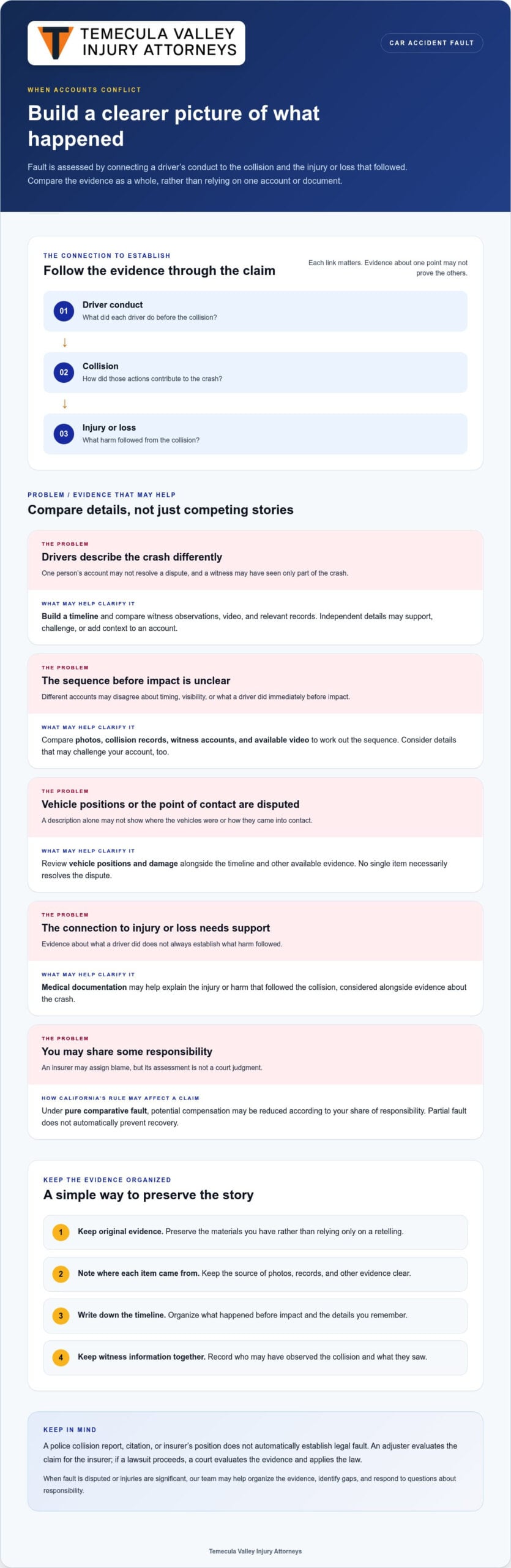
Fault is assessed by examining what each person did, whether that conduct contributed to the collision, and whether the crash caused harm. In a California injury claim, proving fault usually means connecting those points rather than relying on one document or one person’s account. Put simply, proving fault means supporting a clear connection between a driver’s conduct, the collision, and the injury or loss that followed.
That connection matters when you’re facing medical bills or missed work and the other driver disputes what happened. Evidence may help show not only that a driver acted carelessly, but also whether that conduct caused the crash and resulting harm. The relevant details depend on the circumstances of each collision.
What does it mean to prove negligence in a California car accident?
Negligence is a failure to use reasonable care. California Civil Code section 1714 generally makes a person responsible for injuries caused by a lack of ordinary care or skill. In a car accident claim, the usual questions are whether the driver owed a duty of care, breached that duty, caused the injury, and whether the injured person suffered harm.
For example, evidence might show that a driver changed lanes without checking and struck a vehicle already in that lane. The lane change may help explain the driver’s conduct, but the claim also needs evidence connecting that conduct to the collision and showing resulting injury or loss. A traffic rule violation can be relevant, but the violation alone doesn’t necessarily establish that it caused the claimed harm.
These questions are related but distinct. Evidence that helps establish what a driver did doesn’t always establish why the collision happened or what harm followed. California’s Civil Code section 1714 provides the general duty-of-care foundation. The evidence needed depends on the circumstances.
Who evaluates fault, and why can conclusions differ?
An insurance adjuster evaluates a claim for the insurer. That assessment can affect how the insurer responds to a demand, but it isn’t a court judgment and doesn’t settle legal responsibility for every purpose. If a lawsuit proceeds, a court evaluates the evidence and applies the law to the disputed issues.
Conclusions can differ when accounts conflict, witnesses saw only part of the crash, or records leave gaps. One person may focus on a driver’s action immediately before impact; another may interpret the same detail in light of visibility, timing, or vehicle positions. The California Supreme Court explained the state’s comparative negligence approach in Li v. Yellow Cab Co., while the facts and applicable law guide how responsibility is assessed in an individual claim.
A police collision report may record observations, statements, or other information, but it doesn’t automatically establish legal fault. A citation or an insurer’s position also isn’t, by itself, a final ruling. To understand how to prove fault in a car accident in California, examine how the evidence fits together, including details that may challenge your account. Our car accident legal guidance explains issues that may arise in an injury claim.
How California Comparative Fault Can Affect a Car Accident Claim
California follows a pure comparative fault system. If you share responsibility for a crash, your potential recovery may be reduced according to your share of fault rather than automatically barred. The California Supreme Court adopted this approach in Li v. Yellow Cab Co. The key point is simple: shared fault may reduce a claim, but it does not automatically prevent recovery under California law.
Any fault allocation or recovery analysis depends on the evidence, the facts of the collision, and applicable law. An insurer may offer its own assessment, but that isn’t the same as a court deciding disputed issues. Don’t treat an early fault percentage as a final legal determination.
Can you bring a claim if you were partly at fault?
Possibly. Your contribution to a collision doesn’t, by itself, end the inquiry. If responsibility is shared, California’s comparative fault rule may allow a claim to proceed with damages reduced in proportion to the injured person’s assigned share of fault. The circumstances matter, and no particular result can be assumed before the evidence is evaluated.
For example, imagine two drivers give different accounts of a collision during a lane change. One says the other vehicle moved into the lane suddenly; the other says the first driver had time to respond. Evidence about vehicle positions, timing, and available records may help assess both accounts. It may also show that more than one action contributed to the impact. The point isn’t to settle responsibility based on one detail, but to consider how the facts fit together.
How do conflicting accounts affect fault allocation?
When accounts differ, details can be compared. A timeline can help establish what happened before impact, while vehicle positions and damage may help assess where contact occurred. Independent records or witness observations may support, challenge, or add context to a driver’s version. No single item necessarily resolves the dispute.
Consider an account that a vehicle stopped before entering an intersection. A witness may recall seeing it move, while a nearby recording could clarify when each vehicle entered the area. Those details may help establish the sequence, but they need to be considered alongside the rest of the available evidence. A consistent timeline supported by independent information can be more useful than an isolated statement or image.
Understanding how to prove fault in a car accident in California includes examining evidence that supports and challenges each driver’s account. Avoid assigning blame before reviewing the available information. Keep track of what each source actually shows, and separate confirmed details from assumptions when assessing a disputed claim.
What Evidence Can Help Prove Fault in a California Car Accident?
Useful evidence helps answer specific questions: What did each driver do? When did it happen? Where did the vehicles make contact? Could either driver see or respond to the other? What harm followed? No single item necessarily answers all of them. Evidence corroborated by independent details usually gives a fuller picture than an isolated assertion.
When insurers, or a court if a lawsuit is filed, evaluate a California car accident claim, they may consider evidence in context. A photo might show where a vehicle stopped, while a witness account or recording could help explain how it got there. The goal is to understand how the details fit together, not to treat one image or statement as conclusive.
How do photographs, witnesses, and collision reports help?
Scene photographs can preserve details that may change after vehicles move or the area is cleared. If you can do so safely, take images of vehicle positions, visible damage, traffic signals, signs, road conditions, lighting, and sight lines. Include wider views for context as well as close-ups of relevant details. Note what each photo depicts and when it was taken.
Vehicle damage can help show where contact occurred and may be compared with the drivers’ descriptions. On its own, it doesn’t necessarily establish speed or fault. Witnesses may add an independent account of what they saw, such as a vehicle’s direction or whether it stopped. Record their names and contact information if available, and distinguish what a witness personally observed from what someone else told them.
A collision report may contain observations, statements, and other details useful for understanding the event. It is one source of information, not an automatic decision about civil responsibility. Compare it with photographs, witness accounts, and other available records, and note any gaps or differences that need context.
When can video or vehicle data add useful detail?
Dashcam footage or video from a nearby camera may capture part of a collision or the moments before it. The view may be limited, and not every crash has usable footage. If a recording exists, preserve the original file when possible and note who provided it and when. Don’t edit the original; use a separate copy for review.
Some vehicles may record event-related information, but what exists and what it can show depends on the vehicle and circumstances. Don’t assume a particular data point was recorded or that it will resolve fault. Keep relevant vehicle and repair records, and note who has handled the vehicle or files since the crash.
Medical records and bills can document evaluation and treatment after the collision, while employment records may help document time missed from work. These materials generally speak to resulting harm, not by themselves to which driver caused the crash. Keep copies with dates and sources so they can be compared with the collision timeline and other evidence.
How to Organize Evidence When Fault Is Disputed
When accounts conflict, an organized evidence file can help you explain what you remember and show how other information supports or challenges it. You don’t need to resolve every inconsistency yourself. Start by keeping materials intact and organizing them so the sequence of events is easier to review.
How can you build a clear timeline from the evidence?
Begin with a written account of what you personally remember. Separate what you saw or heard from what you learned later, and mark uncertain details as uncertain. Don’t fill gaps with guesses. Then arrange available materials around the events before, during, and after impact.
A simple timeline might include when you first noticed the other vehicle, what happened just before impact, where the vehicles came to rest, and what occurred afterward. Compare your notes with photographs, witness observations, recordings, and relevant documents. If a detail conflicts, record the difference and where each version came from. A discrepancy deserves review, but it doesn’t automatically prove that one person is at fault.
Keep original photographs, videos, and digital files when possible. Avoid editing or renaming original files in ways that remove useful information. For each item, note its source, the date it was created or received, and what it appears to show. Store copies in an organized folder and keep a separate list of missing or damaged materials. Be candid about limitations. A partial recording or unclear image can still provide context, but don’t describe it as showing more than it does.
What should you do when an insurer disputes your account?
Keep a claim file with copies of communications and documents you’ve sent or received, along with notes of conversations, dates, and the names of people involved. Save the insurer’s reasons for disputing fault and identify the specific evidence it relies on. You can then compare that position with your timeline and source materials instead of responding from memory alone.
Be accurate and measured in your communications. If you don’t know an answer, don’t guess. Avoid accepting a fault conclusion simply because an adjuster presents it as settled, but don’t overstate evidence or conceal information that conflicts with your account. Correcting an honest mistake and clearly distinguishing facts from assumptions can make your explanation easier to assess.
Organizing the evidence can also help identify questions that need follow-up, such as a time gap in a recording or a witness’s uncertain vantage point. If a disagreement affects your car accident claims, our team can review the records, identify potential evidence gaps, and explain how the information may relate to the fault dispute. Information about reaching our team is available on the Temecula Valley Injury Attorneys contact page.
When Legal Help May Clarify Fault in a California Car Accident
Legal help may be useful when the other driver or insurer disputes your account, key records conflict, or your injuries make the claim harder to evaluate. You don’t need to know exactly how to prove fault in a car accident California claim before asking questions. An attorney may help you understand what the evidence shows, what remains uncertain, and how California’s comparative fault rules could apply.
This can matter when a fault assessment affects an injury claim involving ongoing care, medical bills, or time away from work. Getting help doesn’t guarantee that an insurer will change its position or that a particular outcome will follow. It can help you assess the issues and make informed decisions about next steps.
What can an attorney review in a disputed-fault claim?
An attorney may review available collision reports, photographs, witness information, video, vehicle records, medical documentation, and communications with insurers. Considering these materials together can help identify which details support the timeline, where accounts differ, and whether a key question remains unanswered.
Depending on the circumstances, counsel may consider whether additional records or witness information could clarify the sequence. Further investigation has limits: evidence may be unavailable or inconclusive, and no review can promise that an insurer or court will reach a particular conclusion.
What should you expect from an initial case discussion?
A clear account can make the discussion more productive. Be ready to describe what you remember, identify details you’re unsure about, and share records you already have, such as insurer correspondence or photographs. You don’t need to resolve inconsistencies in advance. It helps to distinguish what you personally observed from what you learned later.
Our team may discuss the available information, explain potential questions about fault, and outline how those issues relate to your injury claim. For broader context about issues that can arise after an injury, our California personal injury claim information may also be useful. Each claim turns on its own facts, and general information isn’t a substitute for legal advice about your specific circumstances.
If fault remains disputed or you’re unsure what your records mean, Temecula Valley Injury Attorneys can discuss your situation and help you understand potential next steps.
Take the Next Step With a Clearer Plan
Uncertainty about responsibility can make it harder to focus on recovery and decisions about your claim. You don’t have to resolve every disputed detail on your own. A conversation with an attorney can help you understand what questions remain, what information may matter, and how to approach the next stage of your claim.
If you’re still unsure how to prove fault in a car accident California insurers are reviewing, bring the timeline and records you have. You can also note what you don’t know yet. A careful discussion can help put the dispute in perspective without assuming what the evidence will ultimately show.
Temecula Valley Injury Attorneys represents people in car accident injury claims. We can discuss your situation and help you consider potential next steps based on the information available. Discuss your situation with Temecula Valley Injury Attorneys when you’re ready to talk through your concerns. You deserve clear guidance as you decide how to move forward.
Frequently Asked Questions
Does a police report determine who is at fault in a California car accident?
No. A police report may document statements, observations, and scene details, but it isn’t a final civil-liability ruling. Its usefulness depends on what it records and how that information compares with other evidence. Review it for factual errors, such as an incorrect vehicle description or misunderstood statement. If a disputed detail affects your injury claim, consider getting legal guidance before relying on the report alone.
Can I recover compensation if I was partly at fault in a California car accident?
Possibly. California generally applies pure comparative negligence, so a person’s share of responsibility may reduce damages but doesn’t automatically prevent a claim. The evidence and circumstances determine how fault may be allocated, and an insurer’s assessment isn’t necessarily the final word. Don’t assume you have no options based only on an accusation or initial fault decision. This general information can’t predict the result of your specific claim.
What if there were no witnesses to my car accident?
No witness doesn’t automatically mean you can’t support your account. A California car accident fault dispute may still be assessed using available records and physical details. For example, a diagram of vehicle positions and sight lines may help clarify what each driver could see. Organize what’s available, note what you personally remember, and leave gaps unresolved rather than guessing. The full circumstances matter.
Is a traffic ticket proof that the other driver caused the accident?
A ticket alone doesn’t guarantee that the other driver caused the crash or establish the outcome of an injury claim. The underlying conduct, its connection to the collision, and the other available evidence may all matter. For example, a citation may identify an alleged driving action, while other records help show whether that action contributed to the impact and resulting harm. Don’t treat a ticket as the entire fault analysis.
How long do I have to file a California car accident injury claim?
Generally, California allows two years from the crash to file a personal injury lawsuit, but exceptions may apply. Claims involving a public entity can require a government claim within six months, and rules involving minors or delayed discovery may affect timing. A lawsuit deadline is different from insurance notice or policy requirements. Because the applicable deadline depends on the circumstances, seek case-specific legal guidance promptly.
Can dashcam footage prove fault in a California car accident?
It may help, depending on what the camera captured. Footage could show vehicle movements, signals, timing, or part of the impact, but it may miss important angles or context. Keep the original file, note who recorded or provided it, and avoid editing or overstating what it shows. Consider the footage alongside other available information. It may clarify some questions without resolving every issue in the claim.


