

A fleeing driver can leave you dealing with injuries, medical bills, missed work, and uncertainty about who may be responsible. The driver’s disappearance does not automatically determine whether you have an insurance option or an injury claim. A hit and run accident lawyer San Diego residents consult can help review the available evidence, your policy, and possible next steps.
If you don’t know who caused the crash, start by prioritizing safety, reporting the collision, and recording what you remember. Your own uninsured motorist coverage may be relevant, depending on the facts and policy terms. Reporting and claim requirements can involve specific deadlines, so it’s important to understand which rules apply to your situation.
At Temecula Valley Injury Attorneys, we help injured people understand their options after a collision. This article explains practical reporting steps, insurance questions that may arise when the other driver is unidentified, and evidence that could help clarify a claim. It also covers when speaking with a San Diego attorney may be useful.
Key Takeaways
- Prioritize safety and medical care, then report the crash and write down what you remember. Don’t pursue the driver.
- An unidentified driver doesn’t automatically rule out an injury claim. Your uninsured motorist coverage may be relevant, depending on the circumstances and policy terms.
- Scene details, witness information, available video, medical records, and insurance documents may help clarify what happened and what coverage could apply.
- A hit and run accident lawyer San Diego residents speak with can review insurance questions, evidence, and potential deadlines without predicting an outcome.
- Preparing details about the collision, your injuries, and insurer communications can make a case evaluation more focused.
What to do after a hit-and-run accident in San Diego?
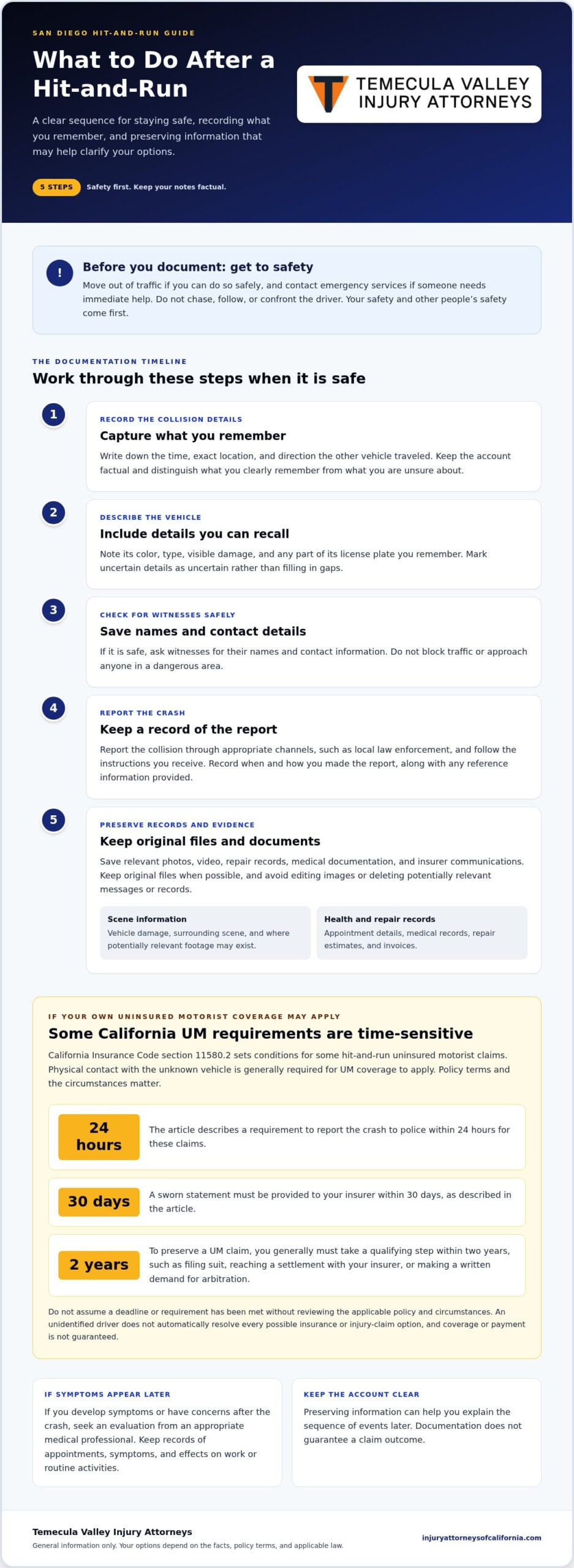
After a driver leaves the scene, focus first on safety and any urgent injuries. Move out of traffic if you can do so safely, and contact emergency services if someone needs immediate help. Once you’re safe, report the collision through the appropriate channels, such as local law enforcement, and follow any instructions you receive. Don’t chase, follow, or confront the other driver. That could put you and others at risk.
When you’re able, write down what you remember. Details can fade after a stressful collision, and a clear record may help when you speak with law enforcement, your insurer, or a hit and run accident lawyer San Diego residents consult. Documentation does not guarantee a claim outcome, but it can help preserve information about what happened.
- Record the time and exact location of the collision, along with the direction the other vehicle traveled.
- Describe the vehicle as specifically as you can, including its color, type, visible damage, and any part of its license plate you recall. Separate clear memories from details you’re unsure about.
- If it’s safe, ask witnesses for their names and contact details. Don’t block traffic or approach anyone in a dangerous area.
- Report the crash and keep a record of when and how you made the report, along with any reference information you receive.
- Save relevant photographs, video, repair records, and medical documentation. Keep original files and documents, and avoid editing images or deleting potentially relevant messages or records.
Keep your notes factual. Distinguish what you directly observed from what you’re uncertain about, and preserve information in its original form when possible. This can help you explain the sequence of events later without relying on memory alone.
What information and evidence should you preserve?
Photograph the vehicles, visible damage, and surrounding scene only if you can do so safely. Save any video you already have, and note where potentially relevant footage may exist. Keep repair estimates and invoices, medical records, appointment details, and insurer communications. Preserving original records can help retain their context.
Should you seek medical care if symptoms appear later?
Injuries may not be obvious immediately. If you develop symptoms or have concerns after the crash, seek an evaluation from an appropriate medical professional. Keep records of appointments, symptoms, and how they affect daily activities, including work or routine tasks. A car accident claim may involve questions about medical documentation, but only a qualified professional can assess your health.
This section provides general information, not individualized legal or medical advice. The right next steps depend on your circumstances and the information available.
Can you pursue a California injury claim if the hit-and-run driver is unknown?
Possibly. Not knowing the driver’s identity does not, by itself, settle every potential insurance or injury-claim option. Your own uninsured motorist (UM) coverage may be relevant, but whether it applies depends on the policy, evidence, and California law. An insurance claim does not guarantee payment or establish that another person is legally responsible.
California law sets specific conditions for some UM claims involving hit-and-runs. Under California Insurance Code section 11580.2, physical contact with the unknown vehicle is generally required for UM coverage to apply. A crash caused when a vehicle swerves nearby without contact may raise a different coverage question. The law also sets time-sensitive requirements, including reporting the crash to police within 24 hours and providing your insurer with a sworn statement within 30 days. To preserve a UM claim, you generally must take a qualifying step within two years, such as filing suit, reaching a settlement with your insurer, or making a written demand for arbitration. Policy terms and circumstances matter, so don’t assume a deadline or requirement has been met without reviewing the details.
California’s traffic safety information and statistics provide broader roadway-safety context, but they cannot determine whether a specific policy covers your losses. For information about accident claims, see our car accident information.
How might your own insurance policy affect your options?
Start with your declarations page, which summarizes your coverages, and the full policy language. Look for UM bodily injury coverage, reporting instructions, and provisions addressing unidentified drivers. Keep copies of notices and insurer communications, and note when you sent them. These documents can help you identify questions, but coverage depends on the policy wording, facts, and applicable law. A hit and run accident lawyer San Diego residents consult can help assess those issues without promising a particular result.
What if the driver is later identified?
Identifying the driver may provide new information, such as the driver’s insurer or vehicle details, but it does not automatically establish fault or show that coverage is available. The collision evidence and circumstances still matter. Identification may change which insurance questions need review, while your own policy may remain relevant. Keep new information and insurer communications together so the claim can be evaluated as it develops.
If you’re unsure how policy language or deadlines apply, we at Temecula Valley Injury Attorneys can discuss the collision, available records, and insurance questions with you. Our contact page provides a way to reach our team.
What insurance and evidence issues make a San Diego hit-and-run claim difficult?
A hit-and-run claim can involve two separate questions: what the evidence shows about the collision, and which insurance policy, if any, may apply. If the driver is identified, you may have information about that person and their insurer, but fault and available coverage still need to be assessed. If the driver remains unknown, your own policy may become more important, including whether uninsured motorist coverage applies. Neither option guarantees payment.
Insurers may ask for records, a description of the crash, and information about your injuries. They may also dispute how the collision happened, whether the evidence supports your account, or whether a policy covers the claimed losses. Broader personal injury claim considerations can include how evidence relates to injuries, expenses, and other claimed losses. Each issue depends on the available facts and policy terms.
What evidence can help clarify how the crash happened?
Evidence is most useful when considered together. A witness may describe the other vehicle’s movement, while photographs show damage that may be consistent with part of that account. Neither item necessarily answers every question about responsibility or coverage. Preserve original records and relevant communications, including messages with witnesses, repair documents, medical records, and insurer correspondence. Avoid editing or deleting material that may help explain the timeline.
- Scene details: Notes or photographs may help establish the collision location, conditions, and vehicle positions.
- Witnesses: Accounts from people who saw different parts of the event may add context or identify gaps in what is known.
- Video: Available recordings may show vehicle movement or timing, though the view may be partial or unclear.
- Medical records: Visit records and related documents can help insurers evaluate reported injuries and their connection to the crash.
- Policy documents: Your declarations page, full policy, and insurer letters can help identify coverage language and claim requirements.
What should you know before speaking with an insurer?
You can ask what information the insurer needs, why it’s being requested, and how to submit it. Keep copies of letters, emails, and forms, as well as notes of calls that include dates and the names of people you spoke with. Give accurate information and distinguish what you remember from what you’re unsure about. Whether to provide a recorded statement can depend on the circumstances and the policy, so there isn’t one answer for every claim. If you’re uncertain about a request, a hit and run accident lawyer San Diego residents consult can review the situation and explain possible considerations. That discussion does not guarantee coverage or a particular result.
When may a hit-and-run accident lawyer in San Diego be able to help?
Legal guidance may be useful if you’re dealing with serious injuries, mounting medical bills, missed work, a disputed insurance decision, or uncertainty about a claim deadline. These concerns can be harder to sort through when the driver hasn’t been identified and you don’t know which policy may apply. Speaking with a hit and run accident lawyer San Diego residents can consult may help you understand what questions to ask and what information could matter.
An attorney can review the facts you have, available evidence, insurance communications, and potential deadlines. That review may clarify possible paths to consider, but it can’t guarantee coverage, payment, or a particular outcome. Your options depend on your circumstances, applicable law, and the terms of any relevant policy.
What can you prepare for a case evaluation?
Gather what’s available, but don’t delay a discussion just because something is missing. Helpful materials may include a police report or report details, insurance policy documents, letters or emails from insurers, photographs, repair records, and medical records. Keep originals when possible, and note when you received or sent important communications.
- Write down questions about medical bills, missed work, and insurance requests.
- Note which information is confirmed and what remains uncertain.
- Prepare a timeline of key events, such as when you reported the collision and when an insurer contacted you.
Incomplete records don’t establish whether you have a claim. A lawyer can discuss what may be obtained or clarified next.
How can an attorney help you understand next steps?
During a case evaluation, an attorney may review the collision details, available documentation, insurer positions, and potential coverage issues. You can ask how different deadlines might affect your situation and what further information could help assess your options. Legal guidance should be based on your specific facts and current law.
Deadlines deserve attention. In California, a personal injury lawsuit is generally subject to a two-year deadline under Code of Civil Procedure section 335.1, but exceptions may apply. A claim involving a government entity can require an administrative claim first, with a much shorter deadline in some circumstances. Uninsured motorist claims may have separate requirements as well. Don’t rely on a general time limit to determine the deadline for your specific claim.
Organizing your questions and available information can help you approach decisions with greater clarity. The next steps depend on your circumstances and the law that applies.
How can you discuss a hit-and-run injury claim with Temecula Valley Injury Attorneys?
Even after considering reporting, insurance, and evidence questions, you may want help understanding how they apply to your situation. At Temecula Valley Injury Attorneys, we can discuss the collision, the injuries you know about, your insurance contacts, and what concerns you now. You don’t need to have every document or answer before starting that conversation.
What questions should you ask about your situation?
Bring the questions that matter most to you. For example, you might ask whether your policy’s uninsured motorist coverage could be relevant, what evidence may help clarify the crash, or which deadlines could apply. A hit and run accident lawyer San Diego residents consult can review those concerns in light of the facts you share, but a general explanation cannot determine the outcome of your individual claim.
- Which parts of my insurance policy may be relevant, and what terms should I understand?
- What evidence do I have, and what information may still be useful to locate?
- Are there deadlines or reporting requirements that could affect my options?
- How should I organize bills, missed work, and communications from insurers?
- What should I do if an insurer’s position or request is unclear?
You can also explain what you don’t know. You may have an insurer’s letter but be unsure what it means, or have medical bills while still collecting records. Missing information doesn’t establish whether you have a claim. It gives the conversation a clear starting point.
What should you expect from the next conversation?
We can listen to your account, review the materials you have, and discuss questions about evidence, insurance, and possible deadlines. You may want to prepare a short timeline, including when the collision occurred, when you reported it, and any contact you’ve had with insurers. If details are uncertain, say so rather than guessing. Distinguishing what you remember from what you’re still trying to confirm can help keep the discussion grounded.
The conversation can also address practical concerns. Tell us if medical expenses are accumulating, you’ve missed work, or you’re unsure how to respond to an insurer. We can explain potential next steps based on the information available and applicable law. Any legal advice depends on the specific facts and current law, and a discussion does not promise representation, coverage, compensation, or a particular result.
This article provides general information, not individualized legal advice. Your situation may require a fact-specific review.
Choose a clear next step for your claim
You don’t have to resolve every question about your claim before seeking guidance. If you’re weighing whether to speak with a hit and run accident lawyer San Diego residents can consult, consider what would help you feel more informed: understanding an insurer’s position, identifying relevant documents, or clarifying questions about your next steps.
A conversation with Temecula Valley Injury Attorneys gives you space to explain what’s happening and ask questions about your circumstances. You can share what you know, raise concerns about bills or missed work, and discuss what remains unclear. The goal is to help you understand potential options, not to promise a particular result.
Contact Temecula Valley Injury Attorneys to discuss your situation. We can listen to your concerns and discuss possible next steps.
Frequently Asked Questions
What should I do immediately after a hit-and-run in San Diego?
First, get to a safe place and seek an appropriate medical evaluation for injury concerns. Report the collision through the proper channels, and ask how to obtain a copy or reference number for the report. Write down what you remember and save evidence you can access safely. Don’t follow or confront the driver. Reporting duties depend on the circumstances, so verify current requirements with California authorities. This is general information, not individualized legal or medical advice.
Can I make an injury claim if the hit-and-run driver is never found?
Possibly. The driver’s identity alone doesn’t determine whether an insurance option exists. Your policy may include uninsured motorist coverage, but its language, the evidence, the collision circumstances, and applicable California rules all matter. Review your policy and keep insurer letters together so you can ask focused questions about what may apply. A policy review or legal discussion can help assess your specific facts, but neither establishes coverage or guarantees compensation.
Does uninsured motorist coverage apply after a California hit-and-run?
It may, depending on the policy and legal requirements. California Insurance Code section 11580.2 generally requires physical contact between the unknown vehicle and your vehicle or person for this type of uninsured motorist claim. The statute also includes reporting and claim procedures. Review the current California Insurance Code and current agency guidance before relying on a requirement or deadline. Evidence and policy terms still affect the analysis.
What evidence should I keep after a hit-and-run accident?
Keep a written vehicle description, the time and location, witness contact details, photographs, and any video you already have. Save medical records and insurer communications as they become available. Preserve original files and documents when possible, including messages that may establish when information was shared. Don’t enter traffic or approach an unsafe area to collect evidence. No single record proves fault or guarantees an insurance claim; the full circumstances matter.
How long do I have to file a hit-and-run injury claim in California?
The deadline depends on the type of claim, the parties involved, and the circumstances. A personal injury lawsuit is generally subject to a two-year limit, but exceptions may apply. Claims involving a government entity can require an earlier administrative filing, and other circumstances may affect timing. Check current statutes and authoritative California sources for applicable exceptions. If you’re unsure which deadline applies, seek legal guidance promptly rather than relying on a general rule.
Should I talk to an insurance adjuster after a hit-and-run?
An insurer may request information about the collision, your injuries, or your policy. You can ask what is being requested, why it’s needed, and how to provide it, then keep copies of communications and notes of calls. A recorded statement may raise different considerations depending on the request, policy, and claim facts. There isn’t one response that fits every situation. If you’re uncertain, consider getting advice specific to your circumstances before responding.
When should I contact a hit-and-run accident lawyer in San Diego?
Consider discussing your situation with an attorney if injuries are serious, coverage is unclear, evidence or responsibility is disputed, or you’re uncertain about a deadline. A case evaluation can help review the facts you have, identify unanswered questions, and discuss potential next steps without predicting an outcome. To talk with Temecula Valley Injury Attorneys, contact our legal team. This information is general, not individualized legal advice.


