

A brain injury claim is rarely explained by one scan or accident report. Symptoms may change over time, and understanding how they relate to an accident can require a careful review of medical records, witness accounts, and other evidence. A traumatic brain injury lawyer San Diego families consult can review available information and explain what may matter to a claim.
If you’re unsure what to document or how to handle insurance discussions while your family focuses on recovery, those concerns are understandable. Evidence may need to show how the accident happened, how the injury was assessed, and how it affects daily life and work. Each claim depends on its specific facts.
This article explains how traumatic brain injury claims are assessed, what records and other evidence may help show the injury’s cause and effects, and what to consider when seeking legal guidance in San Diego. You’ll also learn what happens during a free, no-obligation case evaluation with Temecula Valley Injury Attorneys. Consulting us does not commit you to legal action.
Key Takeaways
- A traumatic brain injury claim may depend on how the injury, the accident circumstances, and the effects on daily life fit together.
- Medical records, accident reports, witness details, and information about work impacts may help clarify what happened and how the injury affects you.
- A traumatic brain injury lawyer San Diego residents consult can review available information and discuss possible legal options without guaranteeing a result.
- Before a legal discussion, note key dates, gather records you already have, and write down your questions. Don’t delay necessary medical care while organizing information.
- Temecula Valley Injury Attorneys offers a free, no-obligation case evaluation by phone, online form, or in person, with personalized attention and compassionate support.
What makes a traumatic brain injury claim in San Diego different?
A traumatic brain injury claim calls for a careful look at medical information, the circumstances of the incident, and the effects on the injured person. A traumatic brain injury lawyer San Diego residents consult may review available information and discuss possible legal options, but only a medical professional can assess or diagnose an injury. No two claims are exactly alike: symptoms, records, recovery experiences, and the facts surrounding an incident can differ.
A traumatic brain injury (TBI) is a change in how the brain functions after an external force, such as a blow or jolt to the head. The term describes a broad category of injuries, not a diagnosis of your particular condition. For general medical information about TBI, including possible effects and diagnosis, see the NIH Traumatic Brain Injury Fact Sheet. If an incident caused a broader personal injury, the legal questions may also relate to our personal injury services.
Why a brain injury may be difficult to evaluate
People can report different effects after similar incidents, and those effects may change over time. Medical findings and a person’s account need to be understood in context, including their health history, reported symptoms, and daily functioning. An initial scan or examination may not show every concern, so the absence of a particular finding alone may not explain the full picture. A medical provider assesses and documents the injury; legal information cannot replace that evaluation.
For a claim, there may be more to understand than a single record or symptom. Difficulty concentrating, for example, could affect work or routine tasks, while another person may face different challenges. These examples are not a way to diagnose yourself. They show why individual medical assessment and clear documentation matter. This is general information, not a medical opinion or individualized legal advice.
How the accident and the injury relate to the claim
A claim may require an examination of whether the reported injury is connected to the incident and whether another party may be legally responsible. Those questions depend on evidence, not assumptions. The timing of symptoms, medical records, incident details, and accounts from people who witnessed what happened may help clarify the sequence of events. A lawyer can review available evidence and discuss potential options, but cannot determine medical causation or promise a result.
For people in San Diego, the key is to consider the full set of facts: what happened, what was reported afterward, what medical providers documented, and how the injury may have affected daily life. A traumatic brain injury claim can be fact-specific even when the incident seems straightforward. Reviewing these connections can help identify unanswered questions and information that may be useful as you consider next steps.
How medical and accident evidence can clarify a San Diego TBI claim
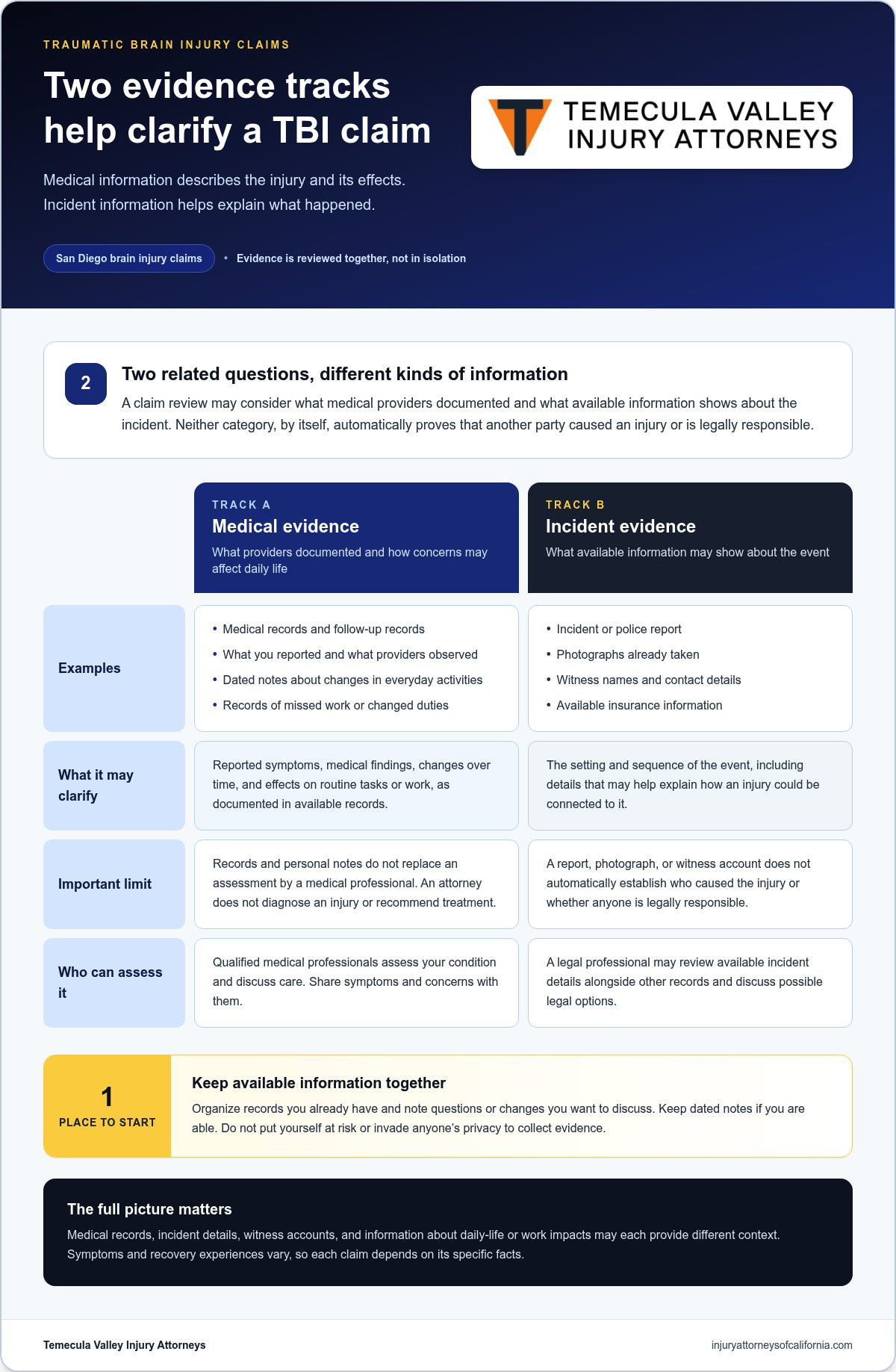
Evidence can help answer two related but separate questions: what injury and effects medical providers documented, and what available information shows about how the incident occurred. A traumatic brain injury lawyer San Diego residents consult may review records and incident details together to discuss possible legal options. That review does not replace a medical assessment or establish fault by itself.
Medical records and documented effects
Medical records can show what you reported, what providers observed, and how your concerns were documented over time. Follow-up records may add context if symptoms or their effects change. The NIH Traumatic Brain Injury Fact Sheet offers general medical information, but your providers are the right people to assess your condition and discuss care.
If you’re able, keep dated notes about changes you notice in everyday activities, such as difficulty completing usual tasks or needing help with a routine responsibility. These notes don’t replace provider records, but they may help you recall when an effect began and how it interfered with daily life. Records of missed work or changes in duties may also help describe practical effects. Share symptoms and concerns with qualified medical professionals. An attorney doesn’t diagnose an injury or recommend treatment.
Accident information and the connection to the injury
Information about the incident can help establish its setting and sequence. Depending on what happened, potentially relevant material may include an incident or police report, photographs already taken, witness names and contact details, and available insurance information. For a vehicle collision involving an injured passenger, you may wonder whether you can sue the driver of the car you were in, records related to car accident claims may help explain the circumstances surrounding the impact. Don’t put yourself at risk or invade anyone’s privacy to collect evidence. Preserve information you already have and let a legal professional discuss appropriate next steps.
Each source has a different role. A provider’s notes may document reported symptoms and medical findings, while a report, photograph, or witness account may describe the event. Together, these materials may help assess whether the injury could be connected to the incident. None automatically proves that another party caused the injury or is legally responsible. Those questions depend on the full facts and applicable law.
Keeping records in one place can make your questions easier to discuss. You might organize available medical documents, incident details, witness information, and work records by date, while noting what you don’t yet have. If you have questions about how available evidence may relate to your situation, you can discuss them with our team. Any legal guidance depends on the specific facts, and medical decisions should remain between you and your providers.
When might a San Diego brain injury lawyer help with claim questions?
You may be able to gather general information and keep track of your records on your own. A legal discussion may be useful if it’s unclear how the injury relates to the incident, an insurer questions the claim, or responsibility is disputed. Speaking with a traumatic brain injury lawyer San Diego residents can consult doesn’t mean you must pursue a claim. It can help you understand what questions to ask and what information may be relevant.
An insurance company’s position on part of an incident or claim may not resolve every concern. Questions about ongoing effects, missing documentation, or how an insurer views the available evidence may remain. Whether those questions call for legal help depends on your circumstances.
Questions that may make a legal discussion useful
Consider speaking with counsel if you’re uncertain how medical records relate to the incident, what to do with insurance communications, or how a disagreement about responsibility could affect your options. You might also want help identifying what information is still needed to assess the claim. These concerns don’t establish that you have a claim, but they can be useful topics for an initial conversation.
For example, an insurer may have acknowledged the accident while still asking for more information about the reported effects or when they began. The insurer’s position may not answer every question. Keep communications and documents you already have, and consider getting guidance before making decisions you don’t understand.
What a lawyer can and cannot determine from an initial discussion
A lawyer can listen to your concerns, review information you provide, identify issues that may need closer attention, and discuss possible next steps. An initial conversation is not a medical assessment and cannot establish a diagnosis. Nor can it guarantee that a claim will succeed or predict a specific outcome.
Any evaluation depends on the individual facts, available evidence, applicable law, and available insurance coverage. A conversation may help clarify what remains uncertain, including whether the records and incident details support further review. It can also help you decide whether you want legal assistance, without assuming that representation is necessary in every situation.
| Handling questions independently | Discussing questions with a lawyer |
|---|---|
| You may prefer to collect available records, track insurer communications, and seek general information when the circumstances and next steps seem clear to you. | A legal discussion may help if you face disputed responsibility, unclear links between the incident and reported effects, confusing insurance requests, or uncertainty about what evidence matters. |
Use this comparison as a starting point, not a rule. If a question feels difficult to answer with the information you have, discussing it with a traumatic brain injury lawyer San Diego families turn to may help you understand potential options. The decision is yours, and any guidance should be based on the details of your situation.
What to prepare before discussing a traumatic brain injury claim in San Diego
You don’t need a complete file to ask questions about a possible claim. A few notes and records you already have can make a conversation with a traumatic brain injury lawyer San Diego residents consult more focused. Don’t delay necessary medical care while gathering information for a legal discussion. Your health comes first, and a lawyer cannot diagnose an injury or recommend treatment.
Information that can help organize the conversation
A simple timeline can help you describe what happened and what followed, without trying to diagnose yourself. Include dates you remember, when you first noticed concerns, and when you spoke with a medical provider. If you’re uncertain about a date, say so rather than guessing.
Before a discussion, gather what’s available and write down what you’d like clarified:
- Basic details about the incident, such as its date and how it occurred
- Medical records or appointment information you already have
- Insurance letters, emails, or other claim communications
- Names or contact details for people who may have witnessed the incident
- Questions about symptoms, daily activities, missed work, or next steps
This is a practical starting point, not a legal requirement or a checklist for proving that you qualify for a claim. You may not have every record, report, or witness detail. Missing documents don’t automatically prevent you from asking questions. An attorney can discuss what you have and whether additional information may be useful.
Deadlines and questions about what happens next
Ask whether a filing deadline may apply and how the circumstances could affect it. Timing questions can depend on the applicable law and specific facts. Different rules or exceptions may matter in situations involving government claims, an injured minor, or symptoms discovered later. Discuss the timing of your situation with a lawyer before relying on a general estimate.
Useful questions may include: What information would help clarify the possible connection between the incident and the reported injury? What should I understand before responding to an insurer? Are there timing concerns I should address? What would happen if I decide to pursue legal guidance? You don’t need to know the legal answers in advance. The goal is to explain what you know and identify what remains uncertain.
Keep the process manageable. Put available documents together, note key dates, and write down the questions you most want answered. If some information is missing, make a note of what you don’t have rather than delaying a discussion until your records feel complete. This can keep the conversation focused on your concerns and the next steps that may apply to your circumstances.
How Temecula Valley Injury Attorneys supports San Diego brain injury clients
A brain injury can raise legal questions while you’re still trying to understand its effects and manage daily responsibilities. Temecula Valley Injury Attorneys provides personalized attention and compassionate support as we review the circumstances and available information with you. We offer aggressive representation and a relentless pursuit of full and fair compensation. No attorney can promise a particular result, and each situation requires an individual review.
What the free case evaluation offers
You can use a free case evaluation to discuss the incident, your concerns, available records, and questions about possible next steps. The evaluation is available by phone, online form, or in person, and it carries no obligation to take legal action. You can ask what information may help clarify the situation, how insurance communications fit into the picture, and what issues may require further review.
A discussion can help identify legal questions, but it doesn’t replace medical advice or determine a diagnosis. We won’t promise that a claim will be accepted or that you’ll receive compensation. Any assessment depends on the facts, evidence, applicable law, and available coverage. You can take time to consider the information and decide whether you want to move forward.
San Diego access and next steps
Our San Diego office is at 13520 Evening Creek Dr. N., Suite 380, San Diego, CA 92128. You can reach the office at (619) 291-1235. We provide service in English and Spanish. Se habla español.
Before speaking with us, you may want to note the incident date, gather records you already have, and write down the questions you most want answered. You don’t need every document to begin a conversation. A traumatic brain injury lawyer San Diego residents speak with can review available information and discuss potential legal options without deciding medical issues or guaranteeing an outcome.
Choose a next step that feels right for you
You don’t have to resolve every legal question before deciding whether to seek guidance. Start with the issue that matters most to you, whether that’s understanding your options, clarifying an insurance conversation, or knowing what information to keep. A focused question can make an initial discussion more useful and help you decide what support, if any, fits your needs.
If you’re considering a traumatic brain injury lawyer San Diego, look for a conversation that addresses your circumstances clearly and gives you room to make an informed choice. General information can help you prepare, but it can’t replace legal guidance based on your specific facts. You remain in control of what you choose to do next.
Temecula Valley Injury Attorneys is here to listen and discuss your questions with care. Schedule a free case evaluation to talk through your situation and consider possible next steps. The evaluation carries no commitment to take legal action.
Frequently Asked Questions
Can you have a traumatic brain injury without losing consciousness?
Yes. A person can sustain a traumatic brain injury without losing consciousness. Not fainting after an incident doesn’t, by itself, confirm or rule out an injury. If you notice concerns after an accident, tell a qualified medical professional what happened and what you’re experiencing. A provider can assess your situation; an online description or legal discussion can’t diagnose you.
What if traumatic brain injury symptoms appear days after an accident?
Tell a qualified medical professional about new or changing symptoms, even if they began days after the accident. Note when you first noticed them and what was happening at the time, without trying to decide what caused them. That timeline may help your provider assess your concerns. If you later discuss a claim, keep the timing in your notes and share it accurately.
Can a normal CT scan rule out a traumatic brain injury?
No. A normal CT scan does not necessarily rule out every form of traumatic brain injury or explain every symptom. Imaging results are one part of a medical assessment, and a qualified provider can interpret them alongside your history and examination. If concerns continue despite a normal result, discuss them with your provider rather than treating the scan as a complete answer.
Can a family member contact a lawyer for someone with a brain injury?
Yes. A family member can contact a lawyer to ask general questions or explain why the injured person may need support communicating. Whether the family member can make decisions or act on the person’s behalf depends on the individual circumstances and any applicable authority. The lawyer can explain what information may be discussed and who would need to participate in further steps.
Do I need a lawyer if the insurance company has accepted fault?
Not necessarily. An insurer’s acceptance of fault may not resolve questions about the injury, its effects, available coverage, or the terms of a proposed settlement. You may want legal guidance if the insurer disputes particular losses, requests documents you don’t understand, or presents paperwork you’re unsure about. A traumatic brain injury lawyer San Diego residents consult can review the situation and discuss possible options, without guaranteeing an outcome.
How long can a traumatic brain injury claim take to resolve?
There’s no set timeline that applies to every claim. The process may depend on how much information is available, whether responsibility or injury effects are disputed, and how the insurer responds. Some claims require further discussion or formal legal steps. Before signing a settlement, understand what claims the document addresses and whether it resolves them. A lawyer can explain the terms based on your circumstances.


