

Lane splitting is legal in California, but that does not automatically make a rider or driver blameless after a crash. A motorcycle lane splitting accident lawyer in California can assess how each person’s actions, the available evidence, and the circumstances of the collision may affect a claim.
If you were injured while riding between lanes, you may wonder whether your position on the road could be used against you, especially when medical bills, missed work, or an insurance dispute add to the uncertainty. California Legislative Information states that personal injury lawsuits generally have a two-year filing period, while a claim involving a government entity may have a much shorter deadline.
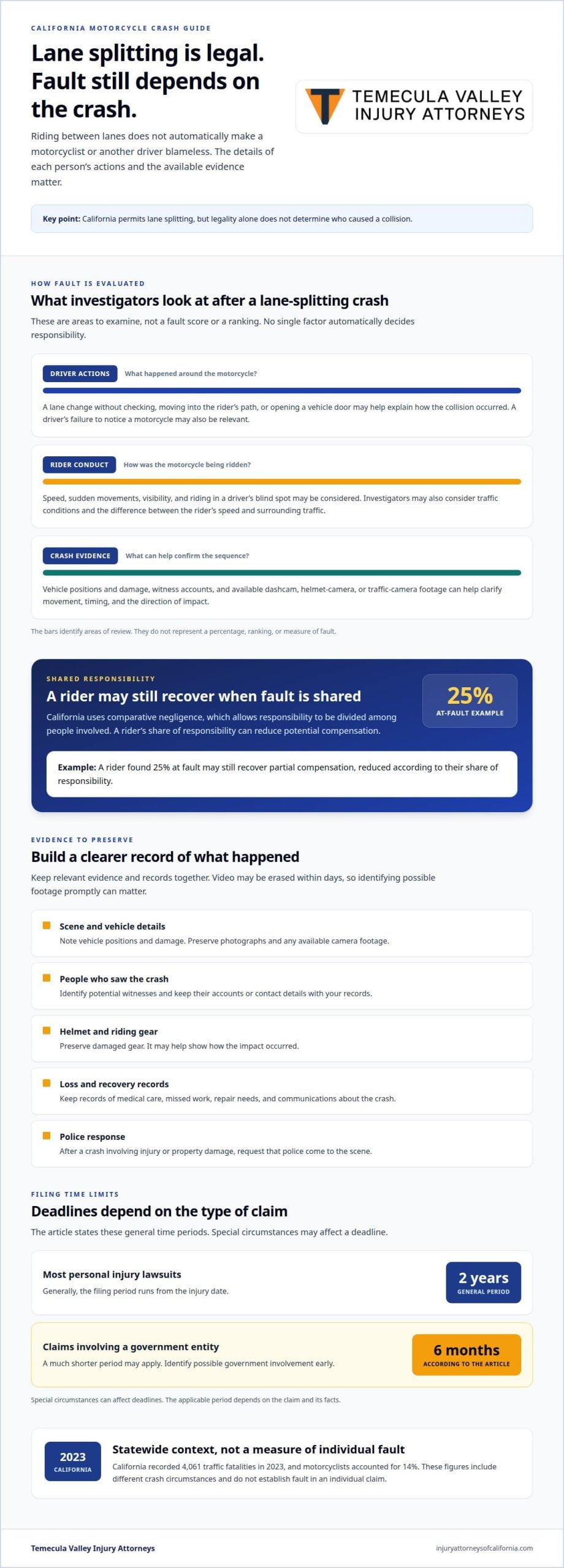
This article explains when lane splitting is permitted, how fault may be shared, and what evidence can help clarify how a collision happened. It also covers filing deadlines and how legal representation may help you understand your options after a lane-splitting crash.
Key Takeaways
- A driver’s lane change, a rider’s speed, or a failure to notice a motorcycle can help explain how a lane-splitting crash happened.
- Fault may be shared, and a rider’s share of responsibility can affect how much compensation they may recover.
- Vehicle positions, damage, witness accounts, and available camera footage can help clarify what happened.
- Preserve damaged riding gear and act promptly to preserve video, which may be erased within days.
- Filing deadlines depend on the type of claim, so identify whether a government entity is involved as early as possible.
Motorcycle Lane Splitting: Is It Legal for Motorcycles to Split Lanes?
Yes. California permits motorcycle lane splitting, which means riding between rows of vehicles moving in the same direction. Vehicle Code section 21658.1 addresses lane splitting, but legality alone doesn’t decide who caused a collision. A rider must still account for traffic conditions, visibility, and the actions of nearby drivers.
Crashes can happen when a driver changes lanes without noticing a motorcycle, opens a vehicle door, or moves into the rider’s path. A rider’s speed and the difference between that speed and surrounding traffic can also affect collision risk. In reported lane-splitting crashes from 2012 to 2013, a common scenario involved a rider traveling too fast when a passenger-vehicle driver changed lanes. That example shows why investigators examine both people’s actions, not simply the motorcycle’s position.
An injured motorcyclist may seek compensation for medical bills, lost wages, and motorcycle damage when another party’s actions caused the crash. California uses comparative negligence: responsibility can be divided among people involved. A rider found 25% at fault may still recover partial compensation, reduced according to their share of responsibility. The evidence matters. Vehicle damage, final positions, witness accounts, and available camera footage can help explain how the collision occurred.
California recorded 4,061 traffic fatalities in 2023, and motorcyclists accounted for 14%. These figures include different crash circumstances, so they don’t establish fault in an individual claim. They do underscore why safety guidelines focus on visibility and speed. The California Highway Patrol advises that collision risk rises as a rider’s speed and speed difference from surrounding traffic increase. On a highway or another congested road, a driver’s blind spot or a sudden lane change may leave little room to react.
After a crash involving injury or property damage, request that police come to the scene. Preserve your helmet and riding gear, since damage may help show how the impact occurred. Identify potential witnesses and video sources promptly, because footage may be erased within days. Keep records of medical care, missed work, repair needs, and communications about the crash. These details can document both your losses and the sequence of events.
California Legislative Information states that most personal injury lawsuits generally have a two-year filing period from the injury date. A claim against a government entity may require action within six months, according to California Legislative Information. Special circumstances can affect deadlines. A personal injury claim depends on the facts, evidence, and applicable rules, so timely legal guidance can help you understand the next steps.
Fault and liability in lane-splitting accidents
Fault depends on how each person’s driving contributed to the collision, not simply on the motorcycle’s position. California’s comparative negligence rule allows responsibility to be divided, which can affect an injured rider’s recovery.
Rider Conduct and Insurer Arguments
Rider conduct means the choices a motorcyclist made before and during the crash. Insurers may argue that speed, sudden movements, or riding in a driver’s blind spot contributed to the collision. They may also consider whether traffic was stopped or moving and how quickly the rider approached. These arguments matter because shared responsibility may reduce compensation.
A driver’s actions also need scrutiny. For example, a driver who changes lanes without checking may have contributed, even if the rider was moving faster than surrounding traffic. An insurer’s position does not decide fault. An injury lawyer can compare that position with the available evidence and explain how California’s fault rules may apply.
Insurance Coverage and Shared Fault
Insurance coverage identifies which policy may respond to a motorcycle passenger injury claim in San Diego, while shared fault addresses how responsibility is allocated. These are related but separate questions. A rider may pursue a claim against a responsible driver’s coverage, but disputed fault can affect how the insurer evaluates payment.
If both people contributed, California’s comparative negligence system can reduce a rider’s recovery in proportion to their share of responsibility. The policy involved, evidence of each person’s conduct, and documented losses all matter. Do not assume an insurer’s initial decision accurately reflects everyone’s contribution.
Evidence for Fault Determinations
Evidence helps reconstruct the sequence of events and compare each account with what happened. Vehicle positions and damage may indicate the direction of impact, while witness descriptions can help establish whether a driver was changing lanes or traffic had stopped. Available dashcam or traffic-camera footage may clarify timing and movement.
Preserve relevant photographs, messages, and records, and note who may have witnessed the collision. Avoid guessing about speed or the sequence of events when speaking with an insurer; inaccurate details can complicate a claim. Video may be erased within days, so prompt preservation efforts can matter.
How an attorney can help preserve and gather evidence, including footage and witness accounts
An attorney can coordinate evidence collection, organize records, and assess how the materials fit together. This work helps build a documented account of the crash and the losses connected to it.
Dashcam and Helmet-Camera Footage
For a lane-splitting claim, an attorney can identify who controls a recording and preserve the original file before it becomes unavailable. Keeping the unedited file matters because trimming, converting, or sharing it through apps may remove useful details. The attorney can also assess whether the device’s clock matches the time shown in other records.
Footage has limits. A camera may not capture the entire road or show what happened outside its frame. An attorney can assess whether the recording offers a clear view, whether its timing is consistent, and what questions remain unanswered. This helps prevent a short clip from being treated as a complete account.
Police Response and Evidence
When police respond to a crash involving injury or property damage, an attorney can obtain and review the resulting report. The review can distinguish an officer’s direct observations from statements attributed to people at the scene. That distinction matters: a report may preserve useful information, but it may not resolve every disputed detail.
An attorney can also consider whether supplementary records exist, such as later corrections or materials gathered during the response. These records may add context or reveal gaps that need follow-up. Their value depends on what they document, when the information was recorded, and whether it aligns with the other evidence.
Evidence collection extends beyond the crash scene. An attorney can organize medical records to connect treatment to the reported collision and gather employment documents to support missed-work claims. Repair records can describe motorcycle damage and related work. Each record serves a different purpose, so dates, descriptions, and amounts should be consistent throughout the claim file.
Witness accounts also need careful handling. An attorney can record what a person recalls, separate direct observations from assumptions, and compare accounts for differences. Witnesses do not need to remember events identically. A careful review identifies which details are consistent, which remain uncertain, and whether another source can clarify them.
Our team can organize these materials into a coherent claim file and identify where the record supports your account or leaves questions unanswered. That preparation helps you understand what the evidence shows before responding to an insurer’s evaluation or deciding how to proceed.
California lane-splitting legality
In a California injury claim, the word “legal” answers only part of the question. It describes whether the riding practice is permitted; it does not, by itself, explain who caused a collision or establish whether another person is responsible for your injuries. Those are separate questions that depend on the specific events.
This distinction matters when an insurer focuses on the rider’s position between vehicles. That fact alone does not establish carelessness. The claim still needs to be evaluated in context: what each person did, what they could see, and how events unfolded. A driver’s account and a rider’s account may describe the same moment differently, so the legal label cannot replace a full assessment.
Likewise, a driver cannot establish liability simply by saying lane splitting was happening. The relevant issue is how the driver responded and whether that conduct contributed to the collision. A claim may involve questions about both the rider’s decisions and the driver’s actions. California’s permission for lane splitting does not resolve those questions in either person’s favor.
When reviewing an insurer’s explanation, separate its conclusions from the facts supporting them. For instance, an adjuster might call a rider’s conduct unsafe without explaining which action created the risk. Ask what specific facts support that position and whether it accounts for the other person’s conduct. Assess a conclusion against the incident details rather than accepting it solely because it appears in a claim decision.
This distinction also helps keep a claim focused. The question is not simply whether lane splitting occurred, but how everyone’s conduct relates to the collision and resulting losses. A useful review connects each conclusion to a specific action and the circumstances surrounding it. If an explanation overlooks an important part of the sequence, address that gap before deciding how to respond.
For an injured motorcyclist, understanding the limits of the legality question can prevent two assumptions: that permitted riding automatically proves another party’s fault, or that riding between vehicles automatically defeats a claim. Neither conclusion follows from legality alone. The circumstances and evidence must support any assessment of responsibility.
California’s lane-splitting rules provide a framework, not a ready-made answer for every collision. Keeping permission, conduct, and responsibility distinct makes it easier to understand what an insurer’s position actually addresses and what questions remain about your claim.
Is lane splitting legal in California, and what rules apply?
Yes. California law permits motorcycle lane splitting, but permission does not guarantee that every maneuver is safe or that a rider is free from fault after a crash. The practical question is how the rider and nearby drivers acted under the traffic conditions at the time.
California Vehicle Code section 21658.1 addresses lane splitting. The California DMV states that it neither allows nor prohibits the practice. Read together, these points mean lane splitting is permitted, while the DMV does not treat it as a blanket endorsement of any particular riding choice. A crash claim still turns on the conduct and circumstances involved.
California sets no specific lane-splitting speed limit or minimum following distance. That does not remove the need to ride safely. The basic speed law, VEH § 22350, may apply when a rider’s speed is unsafe for the conditions. A rider moving between slow vehicles, for example, needs to account for the traffic’s pace, available space, and nearby vehicles that may change lanes.
The California Highway Patrol does not recommend or promote lane splitting. Its safety tips include avoiding excessive speed relative to traffic and watching for blind spots and large vehicles. The CHP also advises that collision risk rises as a rider’s speed and speed difference from surrounding traffic increase. These factors can help explain why a collision occurred, but they do not automatically determine liability.
Lane splitting also has limits as a description. It means passing other vehicles traveling in the same direction. It does not include riding on the shoulder, which is illegal in California. California has no lanes designated specifically for lane splitting, so a rider cannot treat a marked motorcycle-only passage as permission to use the shoulder or ignore other roadway conditions.
Lane sharing is a different practice: two motorcycles ride side by side in one lane. California law does not address lane sharing, and it is generally considered legal. This distinction matters when accounts describe a crash imprecisely. Whether one motorcycle passed traffic between lanes or two motorcycles traveled together can affect how witnesses and insurers understand the movements before impact.
For an injury claim, the key distinction is between legal conduct and careful conduct. Lane splitting’s legal status does not establish that a driver caused a collision, nor does it make the rider automatically responsible. A driver’s lane change, the rider’s speed, visibility, and the available evidence all inform the liability analysis. These details help explain how the law applies to your situation.
If you’re unsure how California’s lane-splitting rules affect your injury claim, discuss the circumstances with our team.
Temecula Valley Injury Attorneys: Motorcycle Accident Attorney
We can assess a lane-splitting injury claim when fault is disputed, evidence needs review, or an insurer questions your account. If you’re looking for a motorcycle lane-splitting accident lawyer in Temecula, Murrieta, San Diego, El Centro, Fallbrook, or the surrounding communities, our team can review how the collision happened and explain how the available evidence may affect your options.
Share relevant details, such as the crash report, photographs, witness information, and insurer communications. A qualified motorcycle accident attorney on our team can explain how these materials relate to your claim and identify questions about deadlines or documented losses. You do not need to resolve every uncertainty before seeking guidance.
If you’d like to discuss your situation, contact our team.
Make Your Next Claim Decision With Clarity
The next step is turning uncertainty into a clear plan. Before responding to an insurer or considering a settlement, think about what you need answered: how fault may affect your claim, what documentation remains available, and how a proposed resolution would address your losses. A motorcycle lane splitting accident lawyer in California can help you assess these questions and understand your options based on the facts of your situation.
We represent people in motorcycle, car, and truck accident claims. If you’re weighing your next move, a conversation with our team can help you understand how those services may relate to your circumstances. You can decide what feels right after you’ve discussed the relevant facts and your questions.
Contact Temecula Valley Injury Attorneys to discuss your situation. A thoughtful next step can help you move forward with greater confidence.
Frequently Asked Questions
Can I recover if I was going faster than traffic while lane splitting?
Yes, you may still recover even if you were traveling faster than surrounding traffic. Your speed can affect how responsibility is assigned, especially if it left little time to respond to a vehicle’s movement. California’s basic speed law may also be relevant. Investigators may compare your speed with traffic conditions and the other driver’s actions rather than treating speed alone as proof that you caused the crash.
How Do Lane Splitting Accidents Occur?
Lane-splitting crashes can occur when a driver moves into a motorcycle’s path or a rider enters a narrowing gap with little room to react. Congested traffic can create sudden stops, while larger vehicles may block a driver’s view of a motorcycle. A collision may involve several events in quick succession, such as a car changing lanes as the rider approaches. The sequence and timing help show what contributed.
What should you look for when choosing a motorcycle accident attorney?
Look for an attorney who can explain how they assess motorcycle claims, address disputed fault, and communicate about case developments. Ask how they would review facts specific to lane splitting rather than relying on general assumptions about riders. You can also ask what information they need to assess your situation. Consulting an attorney does not commit you to legal action.
How do I know if I have a claim?
A claim may be worth evaluating if you suffered an injury or other loss and evidence suggests another person’s actions contributed. Relevant details include the crash sequence, available witness or video accounts, medical records, missed work, and damage to your motorcycle. A documented injury and a driver’s recorded lane change, for example, may provide useful starting points. These facts help assess liability and potential losses, but do not guarantee a result.
How long will my case last?
There is no single timeline for a lane-splitting case. The time involved can depend on whether the parties dispute fault, how quickly evidence becomes available, the course of your injuries, and whether negotiations resolve the claim. Unresolved questions about a driver’s lane change, for example, may require additional investigation. An attorney can explain which issues affect progress and what steps remain, helping you make informed decisions as the claim moves forward.
How much is my case worth?
A claim’s value depends on documented losses and the evidence connecting those losses to the crash. Relevant factors may include medical expenses, lost income, motorcycle damage, and the effect of the injury on daily activities. Each person’s share of responsibility can also affect recovery. An estimate should account for your records and circumstances, not rely on another rider’s settlement or an unsupported online average.
Who is liable when a motorcycle lane-splitting accident happens in California?
Liability depends on whose conduct contributed to the collision; lane splitting alone does not decide it. A driver may have contributed by moving into a motorcycle’s path, while a rider’s choices may also be considered. The evidence may point to shared responsibility. Insurers may offer their own assessment, but their position is not the only account of what happened. The circumstances and supporting records guide the liability analysis.
How does California comparative negligence affect a lane-splitting motorcycle accident claim?
California comparative negligence allows an injured person to seek compensation even when they share some responsibility. Any recovery is reduced by that person’s share of fault. If the evidence shows both a rider and driver contributed, for instance, the rider’s responsibility may reduce the amount recoverable rather than automatically ending the claim. Disagreement over that allocation can make the evidence and each person’s account especially important.


