

If an uninsured driver injures you, you may be able to seek benefits through your own auto insurance policy. The uninsured motorist claim process California drivers face generally starts with notifying the insurer and reviewing the policy. You’ll then need to provide information about the crash and your losses. Disputes about fault, coverage, or injuries can make the process more involved, especially when you’re also dealing with medical bills or missed work.
The exact steps depend on your policy and the facts of the collision. Start by confirming what coverage you selected, reporting the crash, and keeping records that support your account. Your insurer may request documents or question parts of the claim, so an organized file can help you track what has been provided and what remains in dispute.
This guide explains the typical claim sequence, which policy documents and accident records to keep, and what to consider if fault, coverage, or damages are disputed. It also explains how legal guidance may help you understand your options.
Key Takeaways
- The uninsured motorist claim process California drivers follow generally starts with reviewing policy language and promptly reporting the crash to the insurer.
- Keep accident reports, photos, witness details, insurer communications, and records of medical care and missed work together.
- UM and UIM claims address different circumstances. Review how your policy treats an uninsured driver, an underinsured driver, and a hit-and-run.
- If the insurer disputes fault, coverage, or your losses, organized evidence can help clarify the issues that need to be addressed.
- Legal guidance may help you understand policy terms and possible next steps when a claim is contested.
What an Uninsured Motorist Claim Means for Riverside Drivers
If an uninsured driver injures you, you may be able to seek benefits through your own auto insurance policy. A UM claim asks your insurer to determine whether your uninsured motorist coverage applies to the crash and your injuries. Payment is not automatic. The policy language, evidence about the collision, and applicable California law all matter.
Uninsured motorist (UM) coverage is protection under your own auto policy that may pay for covered injuries when an at-fault driver has no applicable liability insurance. It is separate from a claim against that driver’s liability insurer. Even though you make the claim with your own insurer, you may still need to show how the crash happened, who was at fault, and which losses the policy covers. Those questions can shape the uninsured motorist claim process California policyholders follow.
UM coverage differs from the other driver’s liability insurance. If the at-fault driver has liability coverage, that policy may be the basis for a claim against the driver. A UM claim instead asks your insurer to assess benefits under your own policy. If you were hurt in a car accident, keep this distinction in mind as you review insurance information and crash records, and consider consulting Temecula Valley Injury Attorneys for guidance.
When uninsured motorist coverage may apply
UM coverage may apply when another driver caused the crash and has no applicable bodily injury liability insurance. A hit-and-run may also qualify in some circumstances. California law generally requires physical contact with the insured vehicle or person, a report to law enforcement within 24 hours, and a sworn statement to the insurer within 30 days. Policy terms and the specific facts can affect how these requirements apply.
Fault still matters. Your insurer may review evidence about how the collision happened and whether your injuries fall within the coverage. A hit-and-run or missing insurance information does not, on its own, establish that benefits are owed. Report what happened promptly and preserve available records so the insurer can assess the claim.
How UM differs from UIM and other coverage
Underinsured motorist (UIM) coverage is a separate type of protection that may apply when the at-fault driver has liability insurance, but the available coverage may not be sufficient for your losses. Its requirements can differ from UM, including how the other driver’s policy limits must be addressed. Do not assume the two coverages work identically.
Collision coverage generally concerns damage to your vehicle, while medical payments coverage may help pay certain medical expenses under your policy, subject to its terms. Check your declarations page, which summarizes key coverages and limits, and read the full policy for definitions, exclusions, and claim conditions. The summary alone may not tell you whether a particular crash or loss is covered.
Use the declarations page as a starting point, not the final word. Compare it with the full policy and the facts of the accident. If the language or your insurer’s explanation is unclear, an individual review from Temecula Valley Injury Attorneys may help you identify the questions to raise.
How to Follow the Uninsured Motorist Claim Process in California
A clear sequence can help you keep track of next steps while you recover. The uninsured motorist claim process in California depends on your policy and the circumstances, but these practical steps can help you report the collision, preserve records, and respond to the insurer’s investigation.
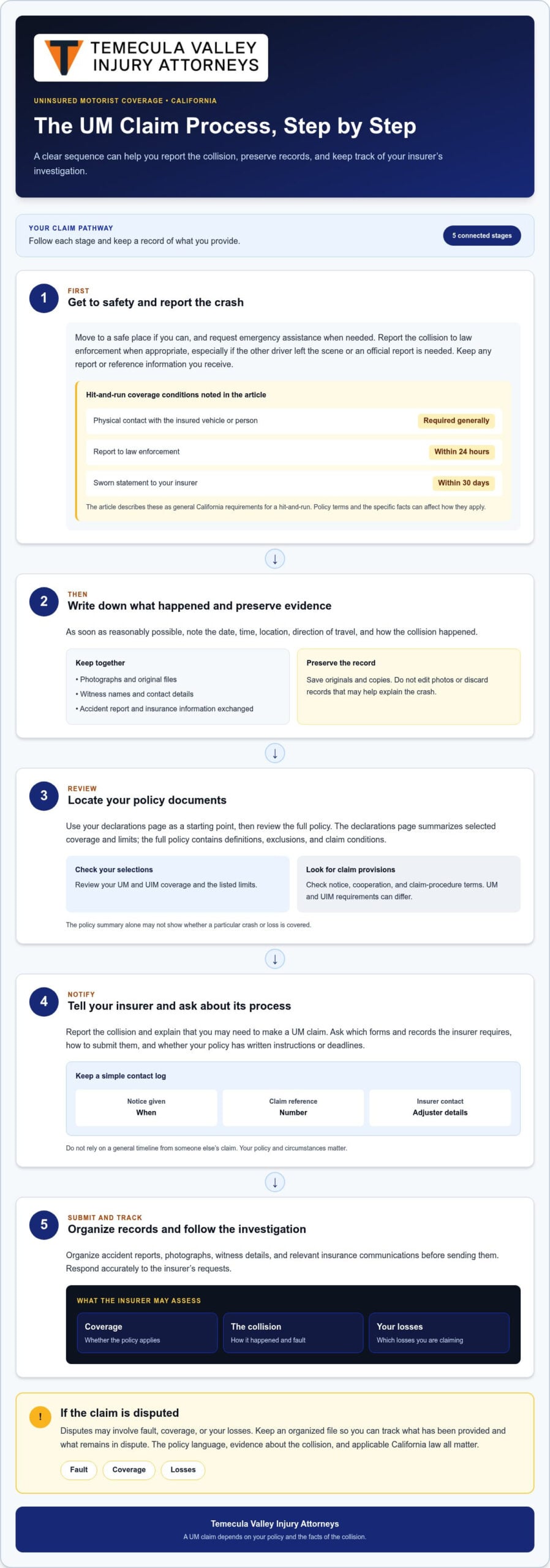
- Address safety and report the crash. Move to a safe place if you can, and request emergency assistance when needed. Report the collision to law enforcement when appropriate, especially if the other driver left the scene or an official report is needed. For a hit-and-run, California law has specific reporting conditions that may affect UM coverage. Keep any report or reference information you receive.
- Write down what you remember and preserve available evidence. As soon as reasonably possible, note the date, time, location, direction of travel, and how the collision happened. Keep photographs, witness names and contact details, the accident report, and any insurance information exchanged. Save original files and copies. Do not edit photos or discard records that may help explain the crash.
- Locate your policy documents. Find your declarations page, which summarizes selected coverage and limits, along with the full policy. Review your UM/UIM selections and any provisions about notice, cooperation, or claim procedures. The California Department of Insurance’s California Uninsured/Underinsured Motorist Coverage page provides general information, but your policy and circumstances determine what applies.
- Notify your insurer and ask about its process. Report the collision and explain that you may need to make a UM claim. Ask which forms and records the insurer requires, how to submit them, and whether your policy has written instructions or deadlines. Do not rely on a general timeline from someone else’s claim. Record when you gave notice, your claim number, and the adjuster’s contact details.
- Submit information and track the investigation. Organize accident reports, photographs, witness details, and relevant insurance communications before sending them. The insurer may investigate whether coverage applies, how the crash happened, and what losses you are claiming. Respond accurately, distinguish what you know from what you are unsure about, and keep copies of everything you submit. After calls, note the date, who you spoke with, and any requested follow-up.
Early notice and organized records can help you track what the insurer needs and preserve a clear account of the crash. These steps do not guarantee a claim outcome, and policy requirements can vary. If a coverage issue has arisen or you are unsure how to respond, you can discuss your claim with our team and get an individual review of your circumstances.
Compare UM and UIM Claims, Policy Limits, and Other Potential Options
Start by asking whether the other driver had applicable insurance. If not, your own UM coverage may be relevant. If the driver was insured but the available liability coverage may not cover your losses, UIM may be relevant instead. A hit-and-run raises separate questions, including whether your policy and California law allow a UM claim in the specific circumstances.
| Situation | Coverage that may be relevant | What needs review |
|---|---|---|
| The at-fault driver has no applicable liability insurance | Uninsured motorist (UM) | Your UM selection, policy terms, evidence of fault, and covered losses |
| The at-fault driver has insurance, but available limits may be insufficient | Underinsured motorist (UIM) | Available liability coverage, your UIM terms, and rules for addressing the other policy |
| The at-fault driver leaves the scene | UM coverage may be considered | Policy language, evidence identifying what happened, and applicable hit-and-run requirements |
This comparison is a starting point, not a coverage decision. Policy wording, accident facts, and applicable California law can change the analysis. A hit-and-run claim, in particular, may have specific proof and reporting conditions. Keep information about the other vehicle, witnesses, and reports so the insurer can assess what happened.
UM versus UIM: which situation are you facing?
UM generally concerns a driver with no applicable liability insurance. UIM concerns a driver whose available liability insurance may be insufficient. For example, if another driver has a policy but it may not cover all your documented losses, your insurer may need to evaluate whether your UIM coverage applies. Eligibility and any potential payment calculation depend on the policies, evidence, and legal requirements, not simply on the size of your losses.
How your policy can shape the claim
Your declarations page can show selected coverage and limits, but the full policy contains definitions, exclusions, and conditions that may affect the result. A policy limit is the maximum stated amount available for a covered loss under that coverage, subject to its terms. Review how the policy treats UM and UIM, and do not assume that a listed limit is automatically payable.
Depending on the facts, another applicable policy or a claim involving another potentially responsible party may warrant review. Neither is guaranteed to apply. Keep the documents together and note what each insurer says about coverage. Our car accident claim guidance can help you understand related accident issues, while an individual review can address how your particular policies fit the facts.
The uninsured motorist claim process California drivers face can turn on details that are not obvious from a coverage summary. Compare your declarations page with the full contract, and seek clarification if a policy term or the insurer’s position is unclear.
Evidence to Gather and Handling a Disputed UM Claim
An organized file can make it easier to see what the insurer has reviewed and where you disagree. Keep records that help establish how the crash happened, what coverage may apply, and what losses you are claiming. The most useful evidence depends on the facts and the insurer’s specific concerns.
Build a clear record of the crash and your losses
Keep original documents when possible, and store copies in one secure place. Do not alter photographs or rewrite records in a way that could make their accuracy unclear. A dated log can help you track insurer calls and emails, who contacted you, what they requested, what you sent, and any response or follow-up date.
Records that may be relevant include:
- Your declarations page, full policy, and communications about coverage or claim requirements.
- Accident or police reports, photographs, video, witness names and contact details, and information exchanged at the scene.
- Medical records and bills related to the injuries you attribute to the crash.
- Wage records or employer documentation that may show time missed from work or reduced earnings.
- Letters, emails, forms, and notes of conversations with the insurer.
Medical and wage records can help document claimed losses, but they do not establish every issue by themselves. Keep information accurate and relevant, and be thoughtful about sharing sensitive records. If you are unsure what a request covers, ask the insurer to explain what it needs and why. Do not guess at details or make your account sound more certain than you are.
If the insurer disputes coverage, fault, or value
Identify the specific issue the insurer is raising. A coverage dispute concerns whether the policy applies or what its terms provide. A fault dispute concerns how the collision happened and who was responsible. A damages dispute concerns the injuries or losses being claimed. Ask the insurer to explain its position and identify the policy language or evidence it relies on, then keep the response with your claim records.
California uninsured motorist disputes may involve arbitration under California Insurance Code section 11580.2, but which issues are subject to arbitration and what steps to follow depend on the law and policy. Deadlines can also vary with the type of claim and circumstances. Do not assume a general timeline applies to your case. Review the current statute and your policy, and get individualized guidance if you are uncertain about preserving your rights.
Organized evidence cannot guarantee that an insurer changes its position, but it can help you understand what is supported and what remains contested. If you are facing a dispute over policy coverage, fault, or documented losses, contact Temecula Valley Injury Attorneys to discuss your claim. We can review the circumstances and explain possible options without promising a particular outcome.
When a California UM Claim May Benefit from Legal Guidance
Legal guidance may help if your insurer disputes whether coverage applies, challenges who caused the crash, questions your claimed losses, or sends communications you are unsure how to answer. A review can clarify the issues and possible next steps, but it cannot guarantee a particular result.
The process depends on your policy wording, the evidence, and the circumstances of the collision. Getting help does not mean you must take legal action. It may help you understand what your insurer is asking and what options may be available.
Questions an attorney may help you assess
An attorney can review your policy and available records to help assess whether exploring a UM claim may make sense. An attorney can also help identify what the insurer is disputing and whether relevant evidence may address that concern, such as records documenting your injuries or details that clarify how the crash happened.
Deadlines and claim procedures deserve careful attention. An attorney may help identify which requirements could apply based on the type of claim, policy, and current California law. Do not assume a general deadline or process applies to your situation. A case-specific review can help you understand what to verify and what questions to raise with the insurer.
Discuss your situation with Temecula Valley Injury Attorneys
At Temecula Valley Injury Attorneys, we can review the circumstances, policy language, insurer communications, and records you have gathered, then explain possible options. We provide personalized attention, aggressive representation, and compassionate support. Our personal injury claim guidance may also help you understand how an injury claim fits alongside your UM questions.
We serve clients in English and Spanish. Se habla español. Guidance about your claim should be based on its specific facts and applicable policy terms. Understanding the issues can help you make informed decisions about what to do next.
Take the Next Step With a Clear Plan
Your next move does not have to answer every question at once. Start by identifying what remains unclear, whether it is the insurer’s coverage position, a request for records, or a deadline you need to understand. Keep the relevant policy documents and claim communications together so you can explain the issue clearly when seeking guidance.
The uninsured motorist claim process California drivers face can depend on details that a general checklist cannot resolve. An individual review may help you understand how your policy and the facts of your crash affect possible next steps. Any guidance should be based on your circumstances, and no outcome can be promised.
If you would like to discuss your situation, schedule a free case evaluation with Temecula Valley Injury Attorneys. The evaluation is an opportunity to ask questions and consider your options, with no obligation to take legal action. Speak with our team to discuss your circumstances and possible next steps.
Frequently Asked Questions
Does California require drivers to carry uninsured motorist coverage?
No. California insurers generally must offer uninsured and underinsured motorist coverage with an auto liability policy, but drivers are not required to buy it. If you are unsure what you selected, check your declarations page and any written coverage rejection in your policy records. A liability policy’s required coverage does not automatically mean your policy includes UM coverage. The policy documents and circumstances determine what protection may be available.
Can I file an uninsured motorist claim after a hit-and-run in California?
Possibly, if the policy and circumstances meet California’s hit-and-run requirements. Generally, the collision must involve physical contact between the hit-and-run vehicle and your vehicle or you. California law also generally requires a report to law enforcement within 24 hours and a sworn statement to your insurer within 30 days. Keep any report details and ask your insurer how to submit the required statement. Individual facts can affect coverage.
How long do I have to report an uninsured motorist claim in California?
Notify your insurer promptly, but the deadline to give notice may depend on your policy. Do not confuse that notice requirement with the general two-year period to preserve a UM claim. Within that period, the injured person generally must file suit against the uninsured driver, reach a settlement with the insurer, or make a written demand for arbitration. Exceptions or policy terms may affect timing, so get case-specific guidance about deadlines.
What evidence should I send with an uninsured motorist claim?
Send materials that respond to the insurer’s requests and support the issues in your claim. A scene photo, for example, may help clarify vehicle positions, while a witness account may address what happened before impact. Medical records and bills can document treatment and expenses, and wage records may help show income lost during recovery. Keep copies of what you submit and note when you sent it. Do not alter original records or images.
Can my insurer deny an uninsured motorist claim?
Yes. An insurer may deny or dispute a claim if it concludes that coverage does not apply, the evidence does not establish the other driver’s fault, or the claimed injuries or losses are not supported. Request the insurer’s explanation in writing, including the policy terms or evidence it relied on. A denial is not necessarily the final word, but review options and response deadlines depend on the policy and circumstances.
Does uninsured motorist coverage pay for vehicle damage?
Not necessarily. Bodily injury UM coverage and uninsured motorist property damage coverage are different. California insurers must offer UMPD, which may cover up to $3,500 in vehicle damage caused by a confirmed uninsured driver if you do not have collision coverage. Whether it applies depends on your coverage selection and the facts. Check your policy for the applicable property damage protection, limits, and conditions.
Will making an uninsured motorist claim increase my insurance rates?
There is no guaranteed answer for every policy or renewal. A rate decision may depend on your insurer, policy, claim history, and how the collision is classified. Ask your insurer how filing a UM claim could affect your premium and request an explanation of any proposed change. Keep the response with your policy records. If you believe a rate increase was handled improperly, you can ask the California Department of Insurance about consumer options.


