

If you’re wondering when to hire a car accident lawyer in Temecula, consider whether injuries, questions about fault, or insurance communications make it difficult to assess your claim. You don’t have to wait until you know the full extent of the situation to ask for guidance.
It’s understandable to want to handle things yourself while managing appointments, missed work, and calls from insurance adjusters. But symptoms may become clearer over time, an early settlement offer may not address all the losses you’ve documented, and responsibility may be disputed. Getting information can help you understand your options before making important decisions.
This guide explains when legal support may be useful, how to weigh your options, and what information to gather before discussing a claim. A free case evaluation can give you an opportunity to ask questions. Consulting does not commit you to legal action.
Key Takeaways
- Consider injury uncertainty, disputed fault, and complicated insurance communications when deciding whether to hire a car accident lawyer in Temecula.
- Compare how clear your injuries, responsibility, and insurer communications are before deciding whether to manage the claim yourself.
- Gather the crash date, involved parties, insurer correspondence, photographs, and available incident documents before discussing your claim.
- A free case evaluation can help you understand possible next steps. Consulting does not commit you to legal action.
When to Hire a Car Accident Lawyer in Temecula: Signs Legal Guidance May Help
Consider speaking with a lawyer when injuries, questions about responsibility, or insurance communications make it hard to decide what to do next. The right choice depends on the facts. A crash with limited damage and no apparent injury may be manageable on your own. Ongoing symptoms, missed work, conflicting accounts, or pressure to settle can make a closer review useful. You can ask questions before deciding whether to take further action.
Situations that can make legal guidance more useful
Injuries can raise questions that aren’t easy to answer immediately. If symptoms continue, change, or interfere with daily activities, you may be unsure how to document their effects or explain when they began. A lawyer can discuss how injury-related information may fit into a claim without diagnosing you or predicting your recovery.
Work disruptions can add another layer. If you’ve missed shifts or don’t know whether you’ll need more time away, keep records of time missed and any related work communications. These details may help you identify what questions to ask before deciding whether to settle.
Responsibility may also be unclear. Drivers can give different accounts of the same collision, and more than one person or party may be involved. In those situations, an attorney can help you consider what evidence may matter and how conflicting accounts could affect a claim. Our car accident legal support includes reviewing the circumstances and helping you understand possible next steps, without assuming fault before the facts are considered.
Take care when an insurer asks you to give a recorded statement, sign documents, or accept a settlement while important questions remain unanswered. Read requests and proposed terms carefully, and make sure you understand them before responding. An initial conversation with our team can help you identify issues to consider. Consulting does not commit you to legal action.
When a crash seems minor at first
A vehicle’s appearance alone doesn’t establish whether someone was injured or resolve every question about a claim. Symptoms may become noticeable later, and visible damage may not show how the collision affected you. Don’t judge the importance of a claim only by how the vehicle looks at first.
Start by keeping the information you already have. Save photographs, exchange details, insurer messages, and available incident documents. If you notice symptoms, note when they began and how they affect your routine, and discuss health concerns with a qualified medical professional. These steps can help you describe what happened more accurately if questions arise.
If the situation is straightforward, you may feel comfortable handling communications yourself. If uncertainty grows, an evaluation can help you weigh the facts, possible complications, and available choices. The question of when to hire a car accident lawyer in Temecula isn’t answered by visible vehicle damage alone. Consider what the injury information, evidence, and claim process show.
How Injuries, Fault, and Insurance Issues Affect When to Hire a Temecula Lawyer
Several questions can make a claim difficult to assess at once: What losses can you document? What do the available records say about the collision? What does an insurer’s letter or offer mean? If you can’t confidently answer these questions, legal guidance may help you understand what needs attention before you make decisions.
Injuries, treatment, and financial effects
The effects of an injury may not be clear at the outset. Records created over time can help show what you reported, what care you received, and how the situation affected your day-to-day activities. Keep copies of bills, visit summaries, work absence records, and communications about missed time. Don’t try to interpret medical records on your own or assume they establish a particular outcome.
Documentation can also help separate what’s known from what remains uncertain. For example, you may have missed work but not yet know whether you’ll need additional time away. That uncertainty can make it harder to evaluate a proposed resolution. You can ask what information an offer considers and whether it addresses losses you’ve documented. If the answer isn’t clear, consider getting advice before deciding how to respond.
Disputed fault and insurance communications
When accounts differ, an early allegation about who caused a crash isn’t the same as a proven conclusion. Photos, vehicle damage, witness accounts, and incident documents may provide context, but they need to be considered together. In California, a person’s share of responsibility can affect a potential recovery under the state’s comparative negligence rule. The details matter, and a disagreement over fault doesn’t by itself resolve the issue.
Insurance communications also deserve careful attention. A letter may request information, explain an insurer’s position, or present an offer. Read it closely, note any response date stated in the document, and keep a copy. If you don’t understand a request or how an offer accounts for your documented losses, ask for clarification rather than assuming what it means. An insurer’s position is not necessarily a final determination of legal responsibility.
Organize records as you receive them to keep a clearer timeline. Save original messages and documents, note when conversations occur, and distinguish what you personally observed from what someone else told you. This can help you identify missing information or conflicting details if questions arise.
The decision about when to hire a car accident lawyer in Temecula may become more pressing when injury records, disputed responsibility, and insurer requests overlap. If you’d like help understanding the issues in your situation, you can contact our legal team to discuss your questions.
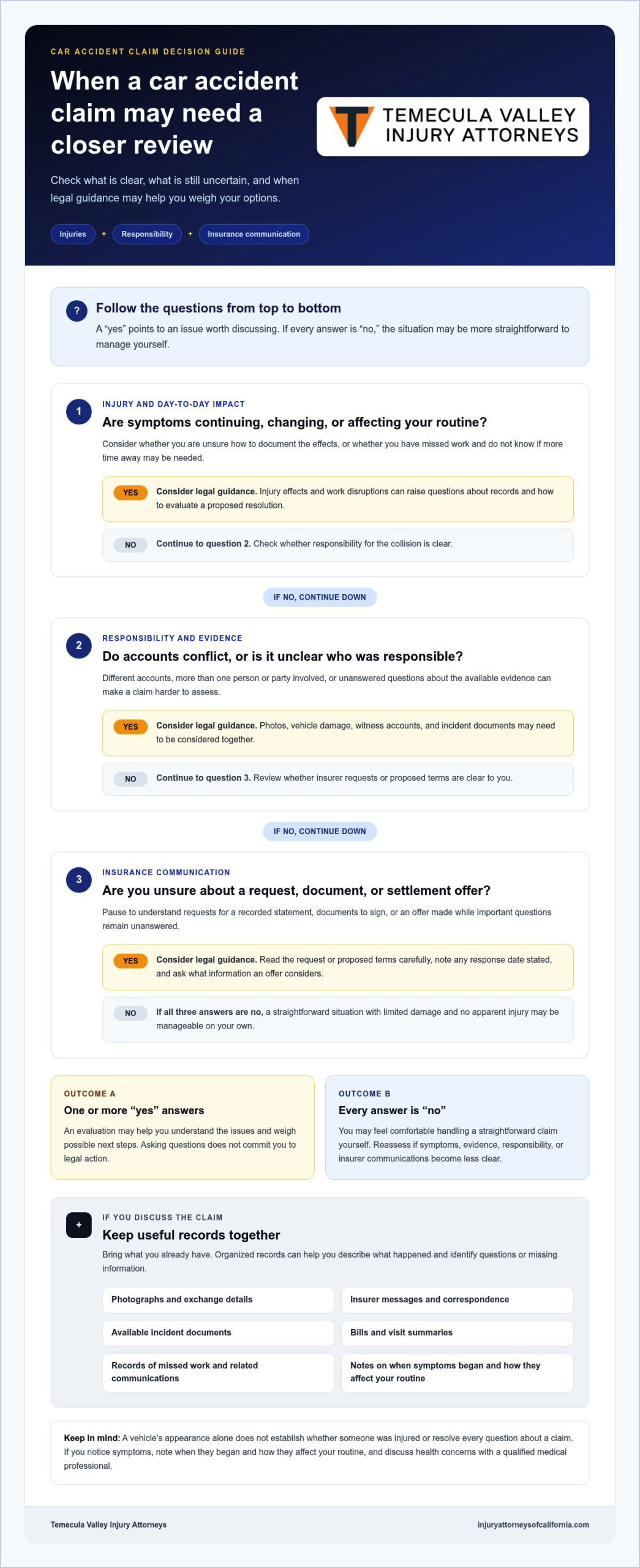
Can You Handle a Temecula Car Accident Claim Yourself or Should You Hire a Lawyer?
You may be able to manage a claim when the facts are clear, documented losses are limited, and you understand the insurer’s communications. Legal guidance may be useful if important details remain unsettled. No single factor automatically means you need to hire a lawyer. The question of when to hire a car accident lawyer in Temecula depends on how the circumstances affect your ability to assess and manage the claim.
| Claim factor | Handling it yourself may feel more manageable when… | Legal input may help when… |
|---|---|---|
| Injuries | Your condition and related records are relatively clear. | Injuries are significant, symptoms continue, or the impact is still uncertain. |
| Fault | The accounts and available information are consistent. | Responsibility is disputed or the evidence is difficult to interpret. |
| Insurance | You understand the insurer’s position and its requests. | You’re unsure what a request or offer means, or how to respond. |
| Claim details | Your losses and supporting records are straightforward to organize. | Missed work, unresolved losses, or multiple involved parties add complexity. |
Factors that may support getting legal input
Consider whether disputed responsibility, significant injuries, unclear losses, or confusing claim communications are affecting your decisions. These issues can overlap. You might understand an insurer’s letter but still be unsure whether it accounts for missed work or an injury being documented over time. One concern may be enough to ask questions, and several unresolved concerns can make a fuller discussion especially helpful.
These factors don’t determine whether you have a legal claim or whether you should sue. They’re practical prompts for deciding whether you feel equipped to evaluate the next step. A personal injury claim can involve evidence about what happened and information about how an injury affected you. The specific facts and available documentation matter.
Questions to consider before deciding
Before you choose how to proceed, ask yourself:
- Do I understand the insurer’s position and what information supports it?
- Have I recorded injury-related effects and missed work as clearly as I can?
- Are any important facts, losses, or responsibilities still disputed?
- Do I understand what I’m being asked to provide, sign, or decide?
If you can answer these questions and the claim feels straightforward, you may prefer to continue handling it yourself. If you’re uncertain, identify the unanswered question that matters most. That gives you a practical starting point for organizing your thoughts and deciding whether you’re comfortable managing the next steps on your own.
What to Prepare Before Speaking With a Car Accident Lawyer in Temecula
You don’t need a complete file to have a useful conversation. A few records and a short timeline can help explain what happened and identify what remains unclear. Don’t put off urgent medical care or a time-sensitive legal question to gather paperwork. Start with what’s available, and note anything you haven’t been able to locate.
Documents and details that may help explain the crash
Start with a brief outline, then collect supporting items you can access. Your notes don’t need to be polished or complete. A clear account of what you currently know can help keep the discussion focused.
- Write down the basics. Note the crash date, the people involved, and a short description of what you remember. Mark uncertain details as uncertain instead of guessing.
- Gather available records. Save photographs, contact details, insurance letters or messages, and any incident or exchange documents you have. Keep originals when possible, and group digital files in one place.
- Make a simple timeline. Include when you reported symptoms or other effects, any work you missed, and when important communications arrived or were sent. Record dates and the names of people involved in those conversations, if known.
- Note what’s missing. List documents you don’t have, questions you haven’t answered, or information you’re waiting for. Explain those gaps rather than trying to resolve everything in advance.
As you organize your notes, you may find it useful to review our car accident guidance about practical steps after a crash. Use it to identify details you may want to include in your timeline.
Questions to raise during a case evaluation
Prepare questions about how your circumstances may affect possible next steps. You could ask what information might clarify an insurer’s position, which records would be useful to organize, and whether any deadlines may apply. If you received a letter or offer you don’t understand, bring it or describe its contents. The answers may depend on the specific facts and documents.
You can also ask how to address an incomplete record or an uncertain date in your timeline. You don’t need to know which documents matter most before speaking with a lawyer. Focus on what you know, what you’re unsure about, and which decisions are coming up. That gives the conversation a practical starting point without requiring you to assemble a perfect file first.
How Temecula Valley Injury Attorneys Can Help You Decide What Comes Next
A conversation with our team can help you focus on the questions that matter most in your situation. Describe the crash, explain what remains unclear, and ask about possible options. We offer case evaluations by phone, through an online form, or in person, so you can choose how to begin.
What happens when you request a case evaluation?
You can share the information you have and ask how particular circumstances may affect your next steps. You don’t need to arrive with every document or a final decision. If you need an in-person visit but cannot easily travel, you can request a visit at your home or hospital.
Local support and a clear next step
Our Temecula office is located at 27349 Jefferson Ave, Suite 107, Temecula, CA 92590. You can also call (951) 289-0628. We provide service in English and Spanish. Se habla español.
Temecula Valley Injury Attorneys provides personalized attention and aggressive representation, with a relentless pursuit of full and fair compensation. If you’re considering legal guidance, choose a contact option that feels comfortable and bring the questions you want addressed. The discussion can help you understand possible next steps and decide what feels appropriate for your circumstances.
Take One Clear Step Toward Your Next Decision
You don’t need every answer before asking for guidance. Start with the question weighing on you most. Is it whether the available information supports the insurer’s position, how to account for ongoing effects, or what a document asks you to do? Writing down that question can help focus a conversation on the decision in front of you.
The right time to hire a car accident lawyer in Temecula depends on your circumstances. Seeking information doesn’t commit you to a particular course of action. Give yourself room to understand your options and decide what feels right for your situation.
If you’re ready to talk through your concerns, schedule a free case evaluation. A conversation can help you approach your next decision with more clarity, one step at a time.
Frequently Asked Questions
When should I hire a car accident lawyer after a crash in Temecula?
Consider getting legal guidance when missing or disputed information makes a decision difficult. If you’re asking when to hire a car accident lawyer in Temecula, consider whether you can explain the insurer’s position, identify which losses remain uncertain, and understand what you’re being asked to decide. You can request an evaluation before choosing representation. Seeking information doesn’t mean you must file a lawsuit.
Is it worth hiring a lawyer for a minor car accident?
It depends on what “minor” means in your situation. A collision with little visible damage and no ongoing concerns may be manageable without a lawyer. But a changing repair estimate, disagreement about who will pay, or a new concern about how the crash affected you can make a claim less straightforward. Consider whether your questions are resolved instead of relying only on the vehicle’s appearance.
Can I contact a car accident lawyer before I finish medical treatment?
Yes. You can ask questions while you’re still receiving care; you don’t have to wait until treatment ends to discuss your circumstances. An early conversation can help you understand what claim-related information may be useful as it becomes available. It won’t replace guidance from your healthcare professional, and you don’t need to predict your recovery before asking a lawyer about your options.
What if the insurance company has already contacted me?
You can still seek legal guidance after an insurer reaches out. Keep the message or letter, note when it arrived, and identify any response date or requested action. If you’ve already replied, write down what you remember saying and when. Sharing that history can help an attorney understand the status of communications and discuss possible next steps based on the documents.
How long do I have to file a car accident claim in California?
For a personal injury lawsuit against a private party, California generally allows two years from the accident date. A lawsuit for property damage alone generally has a three-year deadline. A claim involving a government entity may require an administrative claim within six months. These deadlines can vary with the circumstances, so don’t assume the general period applies to your situation. An insurance claim and a court lawsuit are not the same step.
Does a free case evaluation mean I have to hire the lawyer?
No. A free case evaluation doesn’t require you to hire the lawyer or take legal action. You can use the discussion to explain your concerns, ask what options may be available, and consider whether you want further help. You decide what to do after the conversation. Bring any documents or questions you have, but you can request an evaluation without having every detail organized.


