

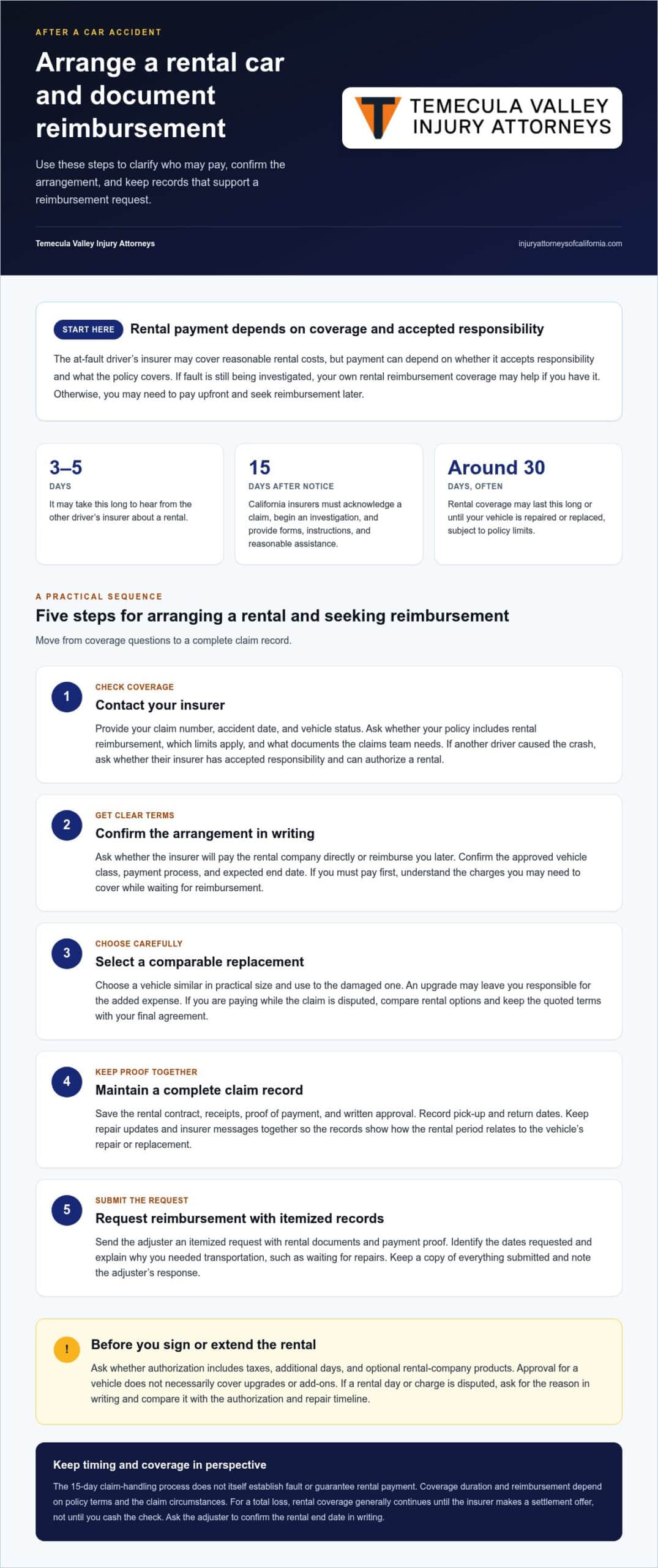
Getting a rental car after an accident in Temecula may be covered by the at-fault driver’s insurer, but payment can depend on whether fault is accepted and what the applicable policy covers. Rental coverage often lasts around 30 days or until your vehicle is repaired or replaced, subject to the policy’s limits. The wait for answers can matter: it may take 3-5 days to hear from the other driver’s insurer about a rental.
It’s understandable to expect a replacement car while your damaged vehicle is off the road. But while fault is still under investigation, you may need to use rental reimbursement coverage under your own policy, if you have it, or pay upfront and seek reimbursement later.
This article explains how rental timing and coverage limits work, what to consider when arranging a car, and what may happen while insurers investigate fault. You’ll also learn how rental costs may be handled if your vehicle is repaired or declared a total loss, so you can make informed decisions as your claim moves forward.
Key Takeaways
- Rental coverage depends on fault, policy terms, and whether the damaged car is being repaired or declared a total loss.
- California insurers must acknowledge a claim, begin an investigation, and provide forms, instructions, and reasonable assistance within 15 days after receiving notice, according to the California Department of Insurance.
- Ask which rental coverage applies and what records you need before arranging a vehicle.
- Keep rental agreements, receipts, repair updates, and insurer communications together to support a reimbursement request.
- When the other insurer has not accepted responsibility, understand your own coverage and possible upfront-payment responsibilities before renting.
How Long Will Insurance Pay for a Rental Car?
Rental coverage usually lasts for a reasonable repair period or until a total-loss settlement offer. Whether you qualify depends on fault, your policy terms, and whether an insurer accepts responsibility. A personal auto policy or credit card may cover damage to a rental car, but protection depends on the specific terms and coverage.
Rental Coverage After a Total Loss
A total loss means the insurer considers repairing the damaged vehicle impractical compared with its value. In that situation, rental coverage generally continues until the insurer makes a settlement offer, not until you cash the check. Since arranging a replacement car takes planning, ask the adjuster to confirm the rental end date in writing. Keep the offer and rental records together.
Coverage and Rental Eligibility
Rental eligibility depends on the coverage available and who accepts responsibility for the collision. If the other driver’s insurer accepts liability, it may cover reasonable rental costs while your vehicle is repaired or replaced. Your own policy may also include rental reimbursement, which can help while fault is disputed. Check your declarations page and ask your insurer which coverage applies.
A personal auto policy may cover damage to a rental vehicle, but terms, exclusions, and limits vary. Credit-card rental coverage often focuses on damage to the rental car and may be secondary to personal auto insurance, meaning it may apply only after other relevant coverage. Read the card’s rental terms before relying on it, and ask the card issuer about its requirements.
Rental Reimbursement When You Are at Fault
If you caused the crash, your insurer generally covers a rental through rental reimbursement only if your policy includes that coverage. It’s usually an optional add-on, not a benefit to assume you have. Check your policy for the daily and total limits, any deductible, and when coverage ends. These details determine how much of your rental period your insurer will cover.
Supplemental liability coverage and personal accident coverage address different risks. Rental companies aren’t required to include liability coverage in a standard agreement. Supplemental liability coverage concerns claims for harm to others, while personal accident coverage concerns occupants’ medical expenses. A collision damage waiver or loss damage waiver concerns damage to or theft of the rental vehicle, not injuries. Review each agreement’s terms before accepting or declining an option.
When the at-fault insurer handles the rental, ask whether it has accepted liability and approved arrangements. You may need to pay upfront if fault is unresolved or the insurer hasn’t accepted responsibility. California Fair Claims Settlement Practices Regulations require insurers to acknowledge a claim, start an investigation, and provide forms, instructions, and reasonable assistance no later than 15 days after receiving notice of a claim, according to California Department of Insurance. That process timeline doesn’t itself establish fault or guarantee rental payment. Keep the claim number and written rental instructions.
Steps for arranging a rental and seeking reimbursement
You can arrange a rental through an insurer or rent independently and submit a reimbursement request. An insurer may authorize a rental or arrange direct billing. A repair shop can coordinate around when your vehicle is available for repair, but it doesn’t decide insurance coverage. Before signing, ask who will pay so you know whether you may owe rental charges.
- Contact your insurer. Give your claim number, accident date, and vehicle status. Ask whether your policy includes rental reimbursement, which limits apply, and what documents the claims team requires. If another driver caused the crash, also ask whether their insurance company has accepted responsibility and can authorize a rental.
- Confirm the arrangement in writing. Ask whether the insurer will pay the rental company directly or reimburse you later. Get the approved vehicle class, payment process, and expected end date. For example, if you must pay first, keep enough funds available for the rental period before relying on later reimbursement.
- Choose a comparable replacement. Select a vehicle similar in practical size and use to the damaged one. An upgrade may leave you responsible for the additional expense. If you pay yourself while a claim remains disputed, compare rental options and save the quoted terms alongside your final agreement.
- Keep a complete claim record. Save the rental contract, receipts, proof of payment, and written approval. Record the dates you picked up and returned the vehicle. Keep repair updates and insurer messages together; those documents connect the rental period to the vehicle’s repair or replacement.
- Request reimbursement promptly. Send the claims adjuster an itemized request with the rental documents and payment proof. Identify the dates requested and explain why you needed transportation, such as waiting for the damaged vehicle to be repaired. Keep a copy of everything submitted and note the adjuster’s response.
If an insurer arranges your rental, ask whether the authorization covers taxes, additional days, and optional rental-company products. Don’t assume that approval for the vehicle also covers upgrades or add-ons. If the insurer disputes a rental day or charge, ask for the reason in writing and compare it with the authorization and repair timeline.
Rental logistics are separate from injury claims. Keep medical records, missed-work details, and rental receipts organized separately, even when they relate to the same collision. A personal injury claim may involve different losses and evidence than a request for replacement transportation. If uncertainty about fault or compensation complicates your claim, you can discuss your car accident claim with our team.
Pick-up arrangements and required documentation
For pickup in Temecula, arrange the rental through the insurer handling payment or directly with a rental agency. Before traveling to the counter, get the claim number, authorization details, and payment arrangement from the insurance company.
Which rental car companies in Temecula offer accident replacement vehicles? For direct billing, start with the insurer’s approved rental partner. Ask the adjuster which company can honor the authorization and what vehicle class it covers.
Are there local transportation or rental options near Temecula repair shops? Ask your repair shop whether it can coordinate rental pickup or share information about nearby transportation. Confirm any arrangement with the insurer before relying on direct payment.
At pickup, bring the documents required by the rental company and the insurer’s written authorization. Make sure you have your driver’s license, payment method, rental agreement, and claim details. Requirements vary by company, so confirm them before setting out.
Review the rental agreement before signing. Confirm the authorized vehicle class, pickup and return dates, approved payment method, and who is responsible for charges beyond the authorization. If the insurer arranged direct billing, ask which charges remain yours. Keep a copy of the signed agreement and pickup receipt.
Tell the rental company that the vehicle is a replacement after an accident, and confirm the return process. An insurer’s approval may end when your vehicle is repaired or the claim reaches a specified stage. Before the authorized period ends, ask the adjuster how extensions work. Save each extension approval in writing.
- Before pickup: Match the claim number, authorized dates, and vehicle class against the insurer’s instructions.
- At the counter: Read the agreement and ask about charges that direct billing does not cover.
- After pickup: Keep receipts, approval messages, and repair updates together for reimbursement records.
If the other driver is considered responsible, rental charges may be part of a property-damage claim. Keep the rental period connected to repair records, such as the shop’s estimate and completion notice. If the insurer disputes a charge, provide those records and ask for a written explanation. An accident lawyer can assess how rental expenses relate to the broader claim, including personal injury issues. Clear records also help distinguish transportation expenses from other requested compensation.
Before returning the vehicle, check the repair shop’s notice and the insurer’s instructions. Return it promptly once the authorized need ends, and keep the return receipt. If repairs are delayed, request written approval for extra rental time before extending the agreement. This helps document who agreed to continued payment.
A repair shop may help arrange rental pickup or provide information about nearby transportation. Verify any arrangement with the insurer before relying on direct payment.
Rental reimbursement limits
Rental reimbursement coverage may have a daily cap and a maximum total benefit. These limits determine how much your insurer pays for a rental vehicle, even if you qualify for coverage. Review your policy declarations and ask the insurer how it applies the cap, deductible, and covered rental period before committing to an upgrade.
How much does a rental car cost per day in Temecula? There’s no single daily rate: the rental company, vehicle class, rental dates, and agreement all affect the price. Get a written quote showing the daily rate and additional charges, then compare it with your policy’s daily limit.
For example, if the approved rental rate exceeds your policy’s daily cap, you may owe the difference. A total-benefit limit can also run out before repairs are complete. Ask the adjuster whether taxes and other contract charges count toward the limit, and track the remaining benefit as rental days pass.
A comparable vehicle is generally the relevant standard for insurance-funded rentals. Choosing a luxury model or another upgrade may leave you responsible for the extra cost. If your damaged vehicle was electric, the replacement may not be electric unless your policy specifically provides for one. Confirm the covered vehicle class before booking.
Coverage also depends on why you need the rental. Rental reimbursement generally applies when a covered collision leaves your vehicle unavailable for repair or replacement, not for routine maintenance or a vacation. If your vehicle is ready for pickup, the insurer may stop paying. Return the rental promptly and keep the repair completion notice.
Other policies address different risks. A collision damage waiver or loss damage waiver covers rental-car damage or theft under its contract terms, but not injuries or medical expenses. Supplemental liability coverage concerns claims involving harm to others. Credit-card rental coverage often focuses on vehicle damage and may be secondary to personal auto insurance, with limits or rental exclusions.
- Check the cap: Find the daily and total limits, deductible, and coverage end point in your policy.
- Match the vehicle: Select a comparable rental and confirm any upgrade is your responsibility.
- Track expenses: Save the agreement, receipts, repair updates, and insurer decisions.
If another driver caused the collision, reasonable rental expenses may be part of a property-damage claim. California courts have generally recognized recovery of loss-of-use damages without requiring you to rent a vehicle. The measure is typically the reasonable rental cost of a comparable vehicle for a reasonable repair period. Keep records connecting your transportation need to the repair timeline, especially if the insurer disputes the period or amount claimed.
Rental-car timing while liability is investigated
When fault is disputed, the other driver’s insurer may wait to assess responsibility before approving a rental. It may take 3-5 days to hear from that insurer about rental arrangements. That delay doesn’t decide who ultimately pays, but it can affect your immediate transportation plans. Getting a rental car after an accident in Temecula may require weighing available coverage against the need to travel while the investigation continues.
If the insurance company delays rental approval, ask the adjuster what decision or evidence is still outstanding. Request a written status update and note when the insurer expects to review the next information. You can also ask your insurer whether your policy applies during the investigation.
Liability means legal responsibility for causing the collision. Before deciding who caused the crash, an insurer may review driver statements, vehicle damage, photographs, witness information, and a police report. If accounts conflict, the available evidence may not resolve responsibility immediately. For example, the insurer may consider photographs of the damage alongside each driver’s description of the collision.
Your options during the review depend on your insurance policy and ability to pay rental expenses upfront. If your policy includes rental reimbursement, ask how your insurer handles a claim while fault remains unsettled. Without that coverage, you may need to fund transportation yourself during the review. Track the expenses and the dates your vehicle is unavailable.
California follows a fault-based system. When another driver is responsible, their liability insurer may pay reasonable rental expenses after accepting responsibility. If the insurer disputes fault, it may not authorize payment during its review. California also applies pure comparative negligence, so a person’s share of responsibility can reduce compensation for losses, including eligible rental expenses.
Keep transportation records separate from injury-claim documents. A rental decision doesn’t determine whether you have injury-related losses or what compensation may apply. Save repair updates with transportation records, and organize medical bills separately. This makes it easier to show which documents relate to vehicle availability and which support injury-related losses.
If the other insurer denies responsibility, ask for its decision and reasoning in writing. Compare the explanation with the evidence and identify any information the adjuster may have overlooked. An initial position isn’t necessarily a final settlement agreement. Before accepting a settlement, make sure you understand which losses it covers, including whether rental expenses remain unresolved.
As the investigation proceeds, keep a dated record of insurer decisions and changes in your vehicle’s repair status. This timeline can show how the liability review overlapped with your transportation needs. It also provides a clear reference when reviewing the insurer’s position or considering what to do next.
Temecula Valley Injury Attorneys: Car Accident Attorney
Temecula Valley Injury Attorneys represents people injured in car accidents and helps them understand their options when insurers dispute fault, delay a claim, or question documented losses. If rental expenses are part of a broader injury claim, our team can review how the collision, repair records, insurance decisions, and injury-related evidence fit together.
Consider speaking with a car accident attorney if you’re unsure how to respond to an insurer, face a disputed liability decision, or need guidance before discussing a settlement. We can explain the claims process and help you make informed decisions about next steps. Contact Temecula Valley Injury Attorneys to discuss your situation.
Take your next step with a clearer plan
Getting a rental car after an accident in Temecula can affect how you manage work, family responsibilities, and other daily commitments. As the claim moves forward, consider which transportation arrangements are practical and what you need to know before making further decisions. A focused conversation can help clarify the choices in front of you.
Temecula Valley Injury Attorneys can discuss your situation and explain possible next steps. You can share your concerns, ask questions, and decide whether legal guidance is right for you. You don’t need to have every detail resolved before starting the conversation.
Contact Temecula Valley Injury Attorneys to speak with our team. We’re here to help you consider your options with care and clarity.
Frequently Asked Questions
I wasn’t at fault. Why should I have to pay for a rental?
Because the other insurer may not have decided responsibility yet, you might face rental charges before the claim is resolved. Ask your own insurer whether your policy can help, then keep the other claim open for any expenses that remain disputed. Paying upfront doesn’t mean you accept fault. Keep written communications and insurer decisions with your claim records.
Can I recover loss of use if I didn’t rent a car?
Possibly. To support a loss-of-use request without rental receipts, create a clear timeline showing when your vehicle became unavailable and when it became usable again. Save repair-shop updates and any notice explaining why the vehicle couldn’t be driven. These details can help distinguish time needed for accident repairs from days caused by unrelated maintenance or delays outside the repair process.
Can a Car Accident Lawyer Help with Rental Car Costs?
A lawyer can review whether your rental documentation supports the amount and period you’re claiming, and whether the insurer’s position matches the available records. Bring the rental agreement, repair timeline, and any written explanation for a denial or reduction. This review can also help identify whether rental expenses are being addressed separately from injury-related losses. No particular insurer decision or claim outcome is guaranteed.
Do I have to pay for the rental upfront?
Depending on the arrangement for your claim, you may need to pay upfront. Before accepting the keys, check the rental agreement for who may drive the vehicle, how extensions work, and what happens if you return it late. An unauthorized driver may affect rental-agency coverage. Keep the signed agreement and return confirmation in case questions arise about responsibility for charges.
How long can I keep the rental before I’m on the hook?
Check the insurer’s written authorization for the approved return date, and ask how to request an extension before then. Keep the repair shop’s latest completion estimate, since an updated timeline can explain why you still need transportation. Once the shop says your vehicle is ready, arrange pickup and return the rental promptly to avoid extra days becoming your responsibility.
Need a vehicle after an accident?
Before reserving, gather your claim number, the vehicle’s repair status, and any rental instructions from the insurer. Ask whether the authorization covers direct billing and whether you need to use a designated rental arrangement. At pickup, read the rental contract and confirm who can drive. Before signing, review the terms for any different vehicle or optional products you choose.
Does the at-fault driver’s insurance pay for a rental car in California?
The other insurer may pay reasonable rental expenses if its investigation supports responsibility and it accepts the claim. If it offers a settlement, review the written terms carefully to see whether rental-related losses are included or remain open. Keep rental-related discussions and any release documents together. Don’t assume that a payment for vehicle damage automatically resolves every separate expense from the collision.
How do I get rental car coverage through my own California auto insurance?
Ask your insurance agent whether rental reimbursement is already part of your policy or can be added. Request the coverage details in writing, including when it applies and how to submit a claim. If you recently changed or renewed your policy, review the current declarations page rather than relying on an older copy. Coverage choices and terms vary by insurer and policy.


