

Approximately one in five drivers on California roads is currently uninsured. When you are involved in a collision in Temecula, discovering that the other person lacks coverage adds a heavy layer of anxiety to an already traumatic situation. You are likely wondering what happens if the at-fault driver has no insurance in California and whether you will be left responsible for thousands of dollars in medical debt. It is a valid fear, especially when you have worked hard to protect your family and your finances.
You should not have to pay for someone else’s mistake. While the situation is complex, you have clear legal rights and options to secure compensation. We understand the stress of deciphering insurance jargon while trying to recover from an injury. This guide explains how Uninsured Motorist (UM) coverage functions as your primary safety net. We will also cover the 2025 changes to California liability limits, the impact of Proposition 213, and the practical steps you can take to get your bills paid. Understanding your policy is the first step toward regaining your peace of mind and financial security.
Key Takeaways
- Understand California’s mandatory minimum insurance requirements and how the state defines an uninsured motorist under the Insurance Code.
- Learn what happens if the at-fault driver has no insurance in California and how your own policy can act as a critical safety net for medical bills.
- Evaluate the practical reality of filing a personal lawsuit against an individual and whether they are considered judgment proof.
- Discover the five immediate steps you must take at the scene in Temecula to preserve evidence and document road conditions for your claim.
- See how localized legal expertise can help you conduct asset searches and manage communications with insurance adjusters to protect your recovery.
California Laws on Financial Responsibility and Uninsured Drivers
California law is clear. Every driver must prove they can pay for damages they cause while operating a vehicle. As of January 1, 2025, the state increased mandatory minimum liability requirements to better protect local families. Drivers must now carry at least $30,000 for the injury or death of one person, $60,000 for multiple people, and $15,000 for property damage. While these laws are in place to ensure safety, many people still choose to drive without any protection. If you are wondering what happens if the at-fault driver has no insurance in California, the legal consequences for that individual are significant. The DMV can suspend their license for up to four years, regardless of who caused the crash.
We also have to consider Proposition 213, often called the “no pay, no play” rule. This law creates a specific challenge for victims who were also driving without insurance at the time of the collision. If you were uninsured, you are generally barred from recovering non-economic damages, such as pain and suffering. You can still seek compensation for economic losses like medical bills and car repairs, but your total recovery is capped. This regulation underscores why maintaining your own policy is a point of professional integrity and personal security in Temecula.
The Minimum Insurance Gap in California
Even with the 2025 increase in limits, a $30,000 policy often fails to cover the true cost of a serious car accident. Hospital stays, surgeries, and specialized rehabilitation in Southern California quickly exceed these basic numbers. California Insurance Code §11580.2 defines an uninsured motorist as someone with no liability insurance or someone whose insurance company is insolvent. Because the I-15 and local Murrieta roads are frequently congested, the risk of encountering an uninsured driver is high. This is why Uninsured Motorist (UM) Coverage is the most critical part of your own insurance policy. It acts as a bridge, providing the funds the at-fault driver failed to secure.
Reporting the Uninsured Accident to the DMV
You have a legal duty to report the accident to the DMV using form SR-1 if anyone was injured or if property damage exceeds $1,000. This report must be filed within 10 days of the incident. It’s a separate requirement from your police report. When you submit this form, the DMV verifies the insurance status of everyone involved. If the other driver is confirmed to be uninsured, the state starts the license suspension process immediately. Don’t skip this step. Failing to file an SR-1 can lead to your own license being suspended, even if you did nothing wrong. It’s a procedural detail that protects your standing and ensures the state holds the at-fault party accountable.
Uninsured Motorist (UM) Coverage: Your Primary Path to Recovery
California law requires insurance companies to offer you Uninsured Motorist (UM) coverage. Unless you signed a specific written waiver to reject it, you likely have this protection. This coverage is designed for the exact moment you realize the person who hit you lacks financial responsibility. According to statistics on uninsured drivers, roughly 14 percent of motorists nationwide operate without insurance, and California remains a state with a high volume of these incidents. When you ask what happens if the at-fault driver has no insurance in California, the answer usually lies within your own policy documents.
Your insurance company effectively steps into the shoes of the at-fault party. They take on the liability that the other driver should have carried. This transition changes the nature of your claim from a third-party action to a first-party contractual dispute. It provides a reliable path to recovery, but it requires a careful approach to ensure you receive the full value of your policy. We view this coverage as your primary safety net against the negligence of others.
What Does UMBI and UMPD Cover?
Uninsured Motorist Bodily Injury (UMBI) is the most critical component for your physical recovery. It covers your medical expenses, lost income, and non-economic damages like pain and suffering. If you are involved in a hit-and-run where the driver is never identified, California law generally treats this as an uninsured motorist claim. This ensures you aren’t left footing the bill for a driver who fled the scene.
Uninsured Motorist Property Damage (UMPD) handles the repairs to your vehicle. It is important to know that UMPD is typically capped at $3,500 in California. If your car is totaled or requires extensive work, this amount may not cover the full cost. If you carry collision coverage, that will usually take precedence for the physical damage to your car. Understanding these caps helps you set realistic expectations for your property claim.
Navigating a Claim with Your Own Insurance Provider
Many people assume their own insurance company will be generous because they have paid premiums for years. The reality is often different. In a UM claim, your interests and your insurer’s interests are no longer aligned. They want to minimize the payout to protect their bottom line. They might question the severity of your injuries or suggest you were partially at fault for the crash. This adversarial shift can be confusing and stressful for victims.
Treating a UM claim with the same professional rigor as a lawsuit against a stranger is vital. You need to document every medical visit and preserve all evidence from the scene. Because this process can become complex, working with a car accident attorney ensures that your own provider treats your claim with the respect it deserves. If you feel overwhelmed by the paperwork or the pushback from an adjuster, you can schedule a free case evaluation to review your specific policy limits.
Can You Sue an Uninsured Driver Personally? The Reality of Civil Suits
You have the legal right to file a lawsuit against any driver who causes you harm. However, the practical reality of recovery is often more complicated than the legal right itself. When people ask what happens if the at-fault driver has no insurance in California, they are often looking for a way to hold the individual accountable. While a court may award you a judgment, collecting that money is a separate challenge that requires a strategic approach. We prioritize transparency, helping you understand whether a lawsuit is a productive path or a waste of your time and resources.
Many uninsured drivers are what legal professionals call “judgment proof.” This means they lack the income or assets required to pay a court-ordered award. If someone cannot afford a basic insurance premium, they likely do not have significant savings or equity in a home. Suing a person with no assets often results in a “paper judgment.” This is a legal victory that is virtually impossible to collect. Our role is to protect your interests by determining the viability of a suit before you invest in the process.
Identifying Seizable Assets
We don’t guess about a driver’s financial status. Our team conducts thorough investigations to identify seizable assets before recommending a civil suit. This process involves looking for specific financial markers that indicate a driver can actually pay for the damages they caused. These include:
- Non-exempt real estate holdings or secondary properties in the Temecula area.
- Non-exempt bank accounts and investment portfolios.
- Business interests or corporate affiliations that may share liability.
- High-value personal property, such as secondary vehicles or specialized equipment.
Wage garnishment is another potential avenue for recovery. If the driver is employed, California law may allow us to collect a portion of their earnings over time. This is often a long-term strategy; however, it ensures a level of accountability for the harm they caused you and your family.
When a Personal Lawsuit Is Worth the Effort
Sometimes, the driver is not the only responsible party. If an employee causes a crash while performing work duties, their employer might be liable for your injuries. Similarly, if the driver does not own the vehicle, the owner could share responsibility under California’s permissive use laws. These scenarios often involve commercial insurance policies or individuals with higher asset levels, making a personal injury lawsuit a much more viable path to full recovery.
You must also respect the legal clock. The statute of limitations for a personal injury claim in California is generally two years from the date of the accident. This timeframe is established within the same legal framework as California Insurance Code § 11580.2, which governs motorist protections. If you miss this deadline, you lose your right to seek compensation through the courts forever. We help you navigate these strict deadlines while investigating every possible source of compensation, ensuring no stone is left unturned.
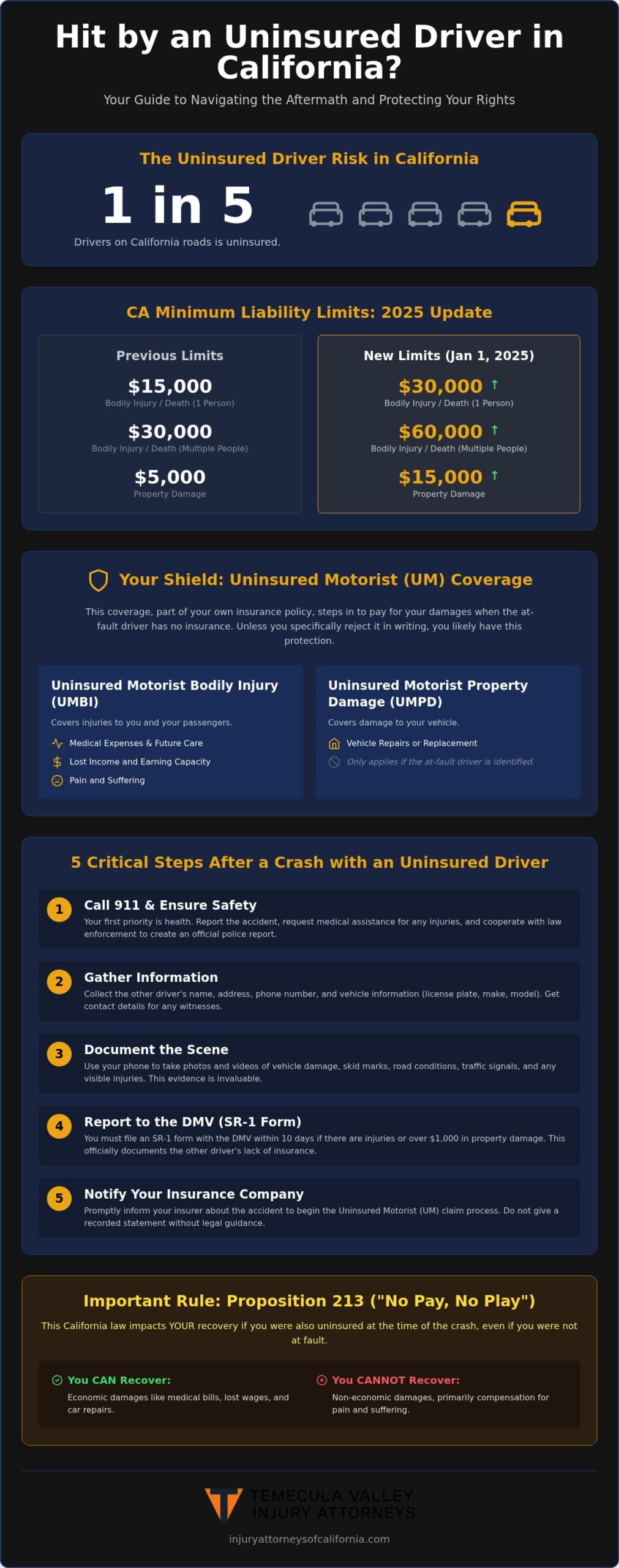
5 Critical Steps to Take After a Crash with an Uninsured Driver
The moments immediately following a collision are often chaotic. Your adrenaline is high, and your focus is likely on your physical safety. However, the actions you take at the scene determine your ability to recover compensation later. If you are worried about what happens if the at-fault driver has no insurance in California, following a strict protocol is your best defense against financial loss. Taking these steps helps us build a foundation for your Uninsured Motorist claim.
- Call the police or CHP: Always request an officer to the scene. An official record is the most persuasive evidence you can have.
- Document the scene: Use your phone to take photos of all vehicles involved. Capture the surrounding Temecula or Murrieta road conditions, traffic signs, and any skid marks.
- Request contact information: Even if the other driver admits they don’t have insurance, you still need their full name, phone number, and address.
- Identify witnesses: Look for bystanders who saw the crash. Ask for their contact details and, if possible, record a brief statement of what they witnessed on your phone.
- Contact an attorney first: Speak with a legal professional before you give any statements to an insurance adjuster. This includes your own insurance provider.
The Importance of the Police Report
A report from the California Highway Patrol (CHP) office in Temecula or San Diego serves as a neutral validation of your version of events. When the officer arrives, ensure they note that the other driver failed to provide proof of financial responsibility. This specific detail is vital for your insurance company to process a UM claim. Without a police report, your insurer might question whether the accident actually occurred as you described. A clear, factual record from law enforcement streamlines the entire process and prevents the at-fault driver from changing their story later.
Medical Documentation and Evidence
Seeking immediate medical care is essential for your health and your legal recovery. Even if you feel okay, some injuries don’t show symptoms for days. Linking your injuries directly to the collision requires a medical record that starts as close to the accident date as possible. Whether you visit an urgent care in San Diego or a hospital in El Centro, keep copies of every discharge paper and bill. We also recommend keeping a daily journal. Documenting how your injuries impact your daily life, such as missing work or being unable to care for your family, provides the “human” evidence needed for a successful claim. If you need help organizing this information, you can schedule a free case evaluation with our team today.
How Temecula Valley Injury Attorneys Protects Your Recovery
Discovering what happens if the at-fault driver has no insurance in California can feel like hitting a second wall after a collision. You need a partner who understands the technical complexities of insurance law and the emotional weight of your situation. We step in as your advocate, moving quickly to secure the compensation you deserve while you focus on healing. Our approach combines rigorous technical expertise with the protective care of a community-oriented neighbor.
We manage every interaction with your insurance company to prevent self-incrimination. Insurance adjusters often use recorded statements to find reasons to devalue your claim. We handle these communications for you, ensuring your words aren’t used against your interests. Beyond paperwork, our team conducts deep-dive asset searches. If a personal suit is a viable option for recovery, we identify the seizable assets that make a legal filing worthwhile. We don’t guess about your future; we use data and investigation to inform every decision.
Maximizing the value of your UM/UIM policy requires aggressive, informed negotiation. We understand the specific tactics Southern California insurers use to minimize payouts. Our firm holds these companies to their contractual obligations, ensuring they provide the full benefit of the coverage you’ve paid for over the years. We provide a calm, professional environment where your family’s security is our highest priority.
Personalized Legal Support for Southern California
Our localized expertise in the Temecula, Murrieta, and San Diego insurance markets allows us to anticipate challenges before they arise. We offer clear, no-fluff legal guidance tailored to the specific needs of local accident victims. Whether you are dealing with a complex multi-vehicle crash or a straightforward UM claim, we provide the specialized attention your case requires. You can learn more about our approach on our personal injury page. We believe that informed clients make the best decisions for their recovery.
Schedule a Free Case Evaluation Today
Understanding what happens if the at-fault driver has no insurance in California starts with a thorough review of your own policy. We offer a no-cost, no-obligation consultation to help you identify every available path to compensation. During this evaluation, we will:
- Review your insurance policy limits for UMBI and UMPD coverage.
- Analyze your options for immediate medical bill coverage.
- Discuss strategies for vehicle repair or total loss valuation.
- Determine if third-party liability, such as employer responsibility, applies to your case.
You don’t have to face the legal process alone. Call 951-289-0628 for immediate assistance in Temecula. We are ready to help you find certainty in an uncertain time. Schedule a free case evaluation to begin the process of securing your financial future.
Protect Your Right to Full Compensation
Dealing with the aftermath of a collision is difficult enough without the added weight of an uninsured at-fault party. You’ve learned that what happens if the at-fault driver has no insurance in California doesn’t have to be a financial dead end. By utilizing your Uninsured Motorist coverage and conducting meticulous asset investigations, we help you find the resources needed to pay for medical care and vehicle repairs. Our family-owned firm is built on professional authority and a deep commitment to Southern California community safety.
You don’t have to navigate complex insurance negotiations or the legal system on your own. We take the stress off your shoulders by handling all communication and fighting for the maximum value of your policy. We’re here to provide the clarity and reassurance you deserve during this challenging time. Schedule a free case evaluation with Temecula Valley Injury Attorneys to review your options and start your path toward recovery. You have the right to move forward with confidence and financial security.
Frequently Asked Questions
Is uninsured motorist coverage mandatory in California?
California law doesn’t require you to carry Uninsured Motorist coverage. However, insurance companies are legally obligated to offer it to you when you purchase a policy. If you choose to decline this protection, you must do so by signing a formal written waiver. Without that signed document, you may still have a path to recovery even if you don’t see UM listed on your insurance declarations page.
What happens if I get hit by an uninsured driver and I don’t have UM coverage?
If you lack UM coverage, your options for financial recovery are more limited but still exist. You can file a personal lawsuit against the driver, though we first investigate their assets to ensure they aren’t judgment proof. You might also rely on your own collision coverage for vehicle repairs or your health insurance for medical treatment. Understanding what happens if the at-fault driver has no insurance in California without UM coverage requires a careful review of all your available policies.
Will my insurance rates go up if I file an uninsured motorist claim in California?
Your insurance rates generally shouldn’t increase for filing a UM claim in California. State law protects drivers from premium hikes if they weren’t at fault for the collision. Because a UM claim is based on the other driver’s negligence, your insurer is prohibited from penalizing you for using the protection you’ve paid for. This allows you to seek the medical care you need without fear of long-term financial consequences.
Can I sue an uninsured driver for a hit-and-run in San Diego?
You can sue a hit-and-run driver in San Diego once law enforcement identifies them. If the driver remains unknown, your only path to recovery is typically through your own Uninsured Motorist policy. If the San Diego Police Department or CHP locates the individual, we can conduct an asset search to determine if a civil lawsuit is a viable way to secure additional compensation for your losses.
How long do I have to file a claim against an uninsured driver in California?
You generally have two years from the date of the accident to file a personal injury lawsuit in California. This deadline is strict; however, exceptions may apply if the claim involves a government entity or a minor. For government-owned vehicles, the filing window is often as short as six months. We recommend acting quickly to preserve evidence and ensure you don’t lose your right to seek justice through the courts.
What if the at-fault driver has insurance, but it’s not enough to cover my bills?
This scenario involves Underinsured Motorist (UIM) coverage, which usually comes bundled with your UM policy. If the at-fault driver carries the state minimum of $30,000 but your medical bills reach $50,000, your UIM coverage can bridge the gap. It provides the additional funds necessary to cover the remainder of your economic and non-economic damages up to your own policy limits, ensuring your family isn’t left with the debt.
Does my health insurance cover my injuries if the other driver is uninsured?
Your health insurance will likely cover your initial medical treatments and hospital stays. It’s a reliable way to get immediate care while your legal claim is pending. Be aware that most health insurance contracts include a subrogation clause. This means they may require reimbursement from any settlement or verdict you receive later. We manage these liens to ensure you keep as much of your recovery as possible for your future needs.
Can I get my car fixed if the at-fault driver has no insurance?
You can repair your vehicle through Uninsured Motorist Property Damage (UMPD) or your own collision coverage. UMPD is specifically designed for these situations but is generally capped at $3,500 in California. If your car requires extensive repairs or is a total loss, your collision coverage is the more effective option. Knowing what happens if the at-fault driver has no insurance in California helps you decide which part of your policy to activate first for your car repairs.


