

Most families believe a single lawsuit covers every loss after a fatal accident, but California law actually splits your recovery into two distinct paths. Understanding the nuances of a survival action vs wrongful death claim is the only way to ensure every loss, from unpaid medical bills to the loss of a parent’s guidance, is fully accounted for. It’s natural to feel overwhelmed by technical jargon while you’re grieving. You’re trying to protect your family’s financial future while navigating a probate and civil code that often feels like it was written in another language.
We understand the weight you’re carrying right now. At Temecula Valley Injury Attorneys, we believe that informed families are empowered families. This guide explains the critical differences between these two legal actions, including the 2026 updates to California Code of Civil Procedure sections 335.1 and 377.34. You’ll learn who has the right to file, what types of compensation are generally available, and how strict deadlines for government claims could impact your case. This overview provides a clear roadmap to help you secure the stability and justice your family deserves during this difficult time.
Key Takeaways
- Understand the legal distinction between a survival action vs wrongful death claim to ensure your family identifies every potential source of recovery under California law.
- Identify which family members or estate representatives have the legal standing to file under California Code of Civil Procedure (CCP) 377.60 and 377.30.
- Discover how recoverable damages differ, ranging from your family’s personal emotional loss to the estate’s right to pursue economic losses the deceased incurred before passing.
- Learn why California’s ‘one action rule’ generally requires families to join these claims together into a single legal proceeding for efficiency and legal compliance.
- Stay aware of critical filing deadlines, as missing the standard two-year window or specific government claim exceptions could permanently bar your right to recovery.
The Legal Framework: California CCP 377.60 vs. CCP 377.30
California law provides two distinct pathways for families seeking justice after a fatal accident. While they often appear in the same lawsuit, a survival action vs wrongful death claim serves different purposes and benefits different parties. Understanding the specific statutes within the California Code of Civil Procedure (CCP) is the first step toward securing your family’s future and ensuring the negligent party is held fully accountable.
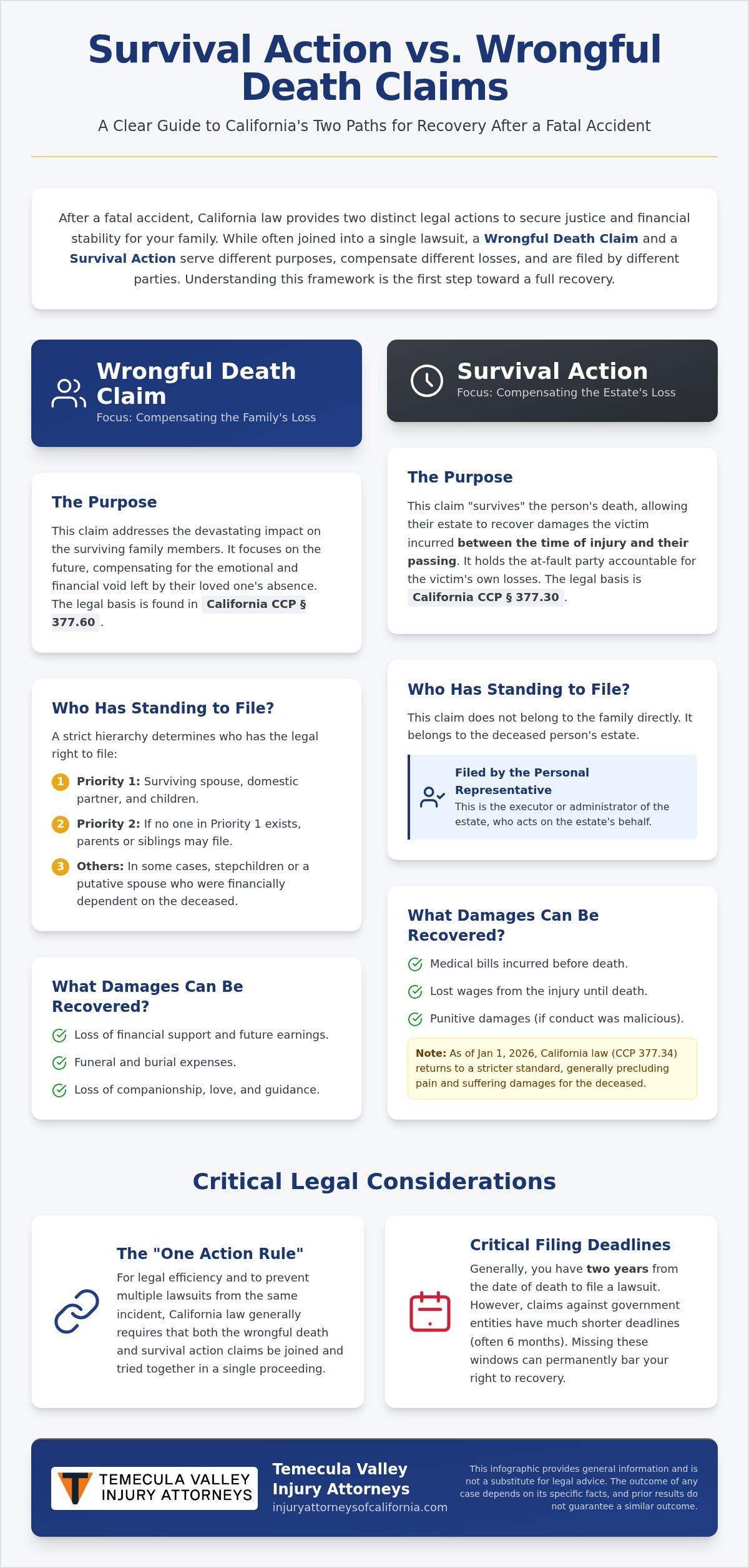
Under CCP 377.60, a wrongful death claim is a legal action brought by the surviving heirs. It focuses entirely on the losses you and your family suffer because your loved one is no longer here. Conversely, CCP 377.30 governs survival actions. These claims don’t belong to the family directly; they belong to the deceased person’s estate. A survival action “survives” the death, allowing the estate to pursue the same legal rights the victim would have had if they had lived. While a wrongful death claim technically begins at the moment of death, a survival action covers the period from the initial injury until the person passed away.
The Purpose of a Wrongful Death Claim
This claim addresses the hole left in your life. It’s designed to compensate the living for the emotional and financial devastation that follows a tragedy. When we handle fatal accidents and wrongful death cases, we focus on the future stability of the dependents. Distinguishing between a survival action vs wrongful death claim is essential because this specific filing aims to provide for your family’s long-term needs. Compensation generally includes:
- Loss of financial support and future earnings the deceased would have provided.
- Funeral and burial expenses incurred by the survivors.
- Loss of companionship, guidance, and emotional support for spouses and children.
California law recognizes that the impact of a death ripples through a family for decades. This claim aims to mitigate that long-term financial strain and acknowledge the profound personal loss you’ve experienced.
The Purpose of a Survival Action
Survival actions look backward at the window of time between the injury and the moment of death. It ensures a negligent driver or corporation isn’t rewarded with a smaller bill just because the victim didn’t survive. Even if that window lasted only minutes, the estate could recover economic damages the deceased person incurred before they died.
As of January 1, 2026, California law regarding survival action damages has returned to a stricter standard. Under the current CCP 377.34, the estate can generally recover:
- Medical bills incurred by the victim before they passed.
- Lost wages from the time of injury until the moment of death.
- Punitive damages, if the defendant’s conduct was malicious or oppressive.
By filing both claims, you ensure the person responsible is held accountable for the harm done to the victim and the lasting pain caused to your family. This meticulous approach protects the estate’s assets while securing your household’s financial health.
Who Has Standing to File in California?
California law is strict about who can walk into a courtroom. In the context of a survival action vs wrongful death claim, the “Real Parties in Interest” are the only ones permitted to seek damages. While these claims often proceed together, the law views the “plaintiff” differently for each. It’s common for a grieving spouse to feel confused about which hat they’re wearing during a legal proceeding, but identifying your role is the first step toward a successful recovery.
California’s Hierarchy of Heirs for Wrongful Death
Wrongful death claims belong to the people who were closest to the deceased. Under California CCP 377.60, there’s a specific hierarchy that determines who has the legal right to file. Priority 1 includes the surviving spouse, domestic partner, and children. If no direct descendants exist, Priority 2 allows parents or siblings to file. Special cases also exist for putative spouses or stepchildren who can prove they were financially dependent on the deceased at the time of the accident.
The Role of the Personal Representative in Survival Actions
A survival action is different because the claim technically belongs to the estate, not the family members. The person who files this claim is the “personal representative.” This individual is usually named in a will, but if no will exists, a California probate court will appoint an administrator. Their duty is to act as a fiduciary for the estate. This means they’re fighting for the estate’s interests, and any recovery is distributed according to the decedent’s will or California’s intestate succession laws. In many Southern California cases, the same person fills both roles, acting as the lead heir for one claim and the estate representative for the other.
The distinction between these roles is vital for case valuation. For example, if a loved one was injured in a motorcycle accident and survived for several days, the personal representative pursues the medical bills and lost wages from that specific window of time. These funds become part of the estate’s assets, which might be used to settle estate debts before reaching the heirs. In contrast, wrongful death damages go directly to the family to compensate for their personal emotional and financial loss.
Identifying your legal standing requires a meticulous review of both family history and probate status. If you’re unsure where you fit in this hierarchy, scheduling a free case evaluation can provide the clarity you need to protect your family’s future.
The distinction between a survival action vs wrongful death claim is most visible when calculating the financial recovery. While the two claims often travel together in a single lawsuit, the law treats them as separate buckets. California’s “one action rule” generally requires that all heirs and the estate representative join their claims into one case. This prevents the defendant from facing multiple trials for the same incident while ensuring the court sees the full scope of the tragedy.
Damages aren’t arbitrary. We look at the decedent’s life expectancy at the time of the accident and their potential earning capacity. If a provider was young and had a high-growth career, the loss of financial support is much higher than for someone near retirement. Our team uses actuarial tables and financial experts to project what that person would have contributed to their family over a lifetime, ensuring no future need is overlooked.
Wrongful Death Damages: Compensating the Living
Under California CCP 377.60, these damages focus on the hole left in your household. They generally include economic losses like the loss of financial support the deceased would have provided. However, the most significant part for many is the non-economic loss. This includes the loss of “care, comfort, and society.” You can’t put a price on a parent’s advice or a spouse’s companionship, but the law allows for a monetary value to be placed on that absence. Reasonable funeral and burial expenses are also recovered through this claim.
Survival Action Damages: Compensating the Estate
These damages address the period before your loved one passed. This includes medical expenses incurred between the injury and death and any lost wages during that same window. It’s important to note a major shift in the law. While a temporary pilot program (SB 447) once allowed for pre-death pain and suffering, as of January 1, 2026, California has reverted to stricter rules. These non-economic damages are generally no longer recoverable in survival actions for cases filed after that date.
However, survival actions remain the only way to pursue punitive damages. If the defendant’s conduct was particularly malicious, like in certain drunk driving accidents, punitive damages can be awarded to the estate to punish the wrongdoer. Understanding the financial split in a survival action vs wrongful death claim is essential for setting realistic expectations and protecting your family’s financial health.
Statute of Limitations and Critical Filing Deadlines
Timing is everything in a survival action vs wrongful death claim. In California, the law is unforgiving when it comes to deadlines. Generally, you have two years from the date of your loved one’s death to file a wrongful death lawsuit under California Code of Civil Procedure (CCP) § 335.1. However, the timeline for a survival action can be more complex. It must typically be filed by the later of two dates: six months after the person’s death or within the original statute of limitations that would have applied if they had lived. If you miss these windows, the court will likely dismiss your case regardless of how much evidence you have.
The “Discovery Rule” may occasionally shift the start date of this clock. This rule applies if the cause of death wasn’t immediately apparent or was hidden by the negligent party. While this can offer a narrow extension, you shouldn’t rely on it without a thorough legal review. Most fatal accident cases in Southern California are subject to the strict two-year rule, making early action essential for protecting your family’s rights.
Special Deadlines for Government Claims
Deadlines shrink dramatically if the responsible party is a government entity. If a city vehicle in Temecula or a San Diego County maintenance truck was involved in the accident, you generally have only six months from the date of death to file a formal administrative claim. This is a mandatory first step before you can even think about initiating a lawsuit. The process is technical and requires specific forms and notice requirements. Because these six months pass quickly while you’re grieving, we recommend you contact us for a free case evaluation as soon as possible to ensure these critical notices are filed correctly.
Exceptions and Tolling for Minors
California law provides certain protections for the youngest victims of a tragedy. When a child loses a parent, the statute of limitations may be “tolled,” or paused, until the minor reaches the age of 18. This ensures that a child’s right to seek justice isn’t lost because of their age. However, waiting years to file is rarely advisable. Early investigation is vital for:
- Preserving physical evidence from the scene before it’s destroyed.
- Securing witness statements while memories are still fresh.
- Obtaining digital data from vehicle “black boxes” or nearby surveillance cameras.
Missing a deadline generally results in a permanent loss of your right to sue. Whether you’re dealing with a fatal accident involving a private driver or a public entity, the clock starts moving the moment the tragedy occurs. Our team at Temecula Valley Injury Attorneys works quickly to identify every responsible party and meet every deadline, allowing you to focus on your family’s healing while we handle the legal pressure.
How Temecula Valley Injury Attorneys Protects Your Family’s Future
When you’re dealing with the aftermath of a fatal accident, you need more than a service provider; you need a protective neighbor who understands the local legal landscape. At Temecula Valley Injury Attorneys, we serve families from San Diego to El Centro with a blend of rigorous technical expertise and personal integrity. We recognize that the distinction between a survival action vs wrongful death claim isn’t just a matter of legal theory. It’s the mechanism that ensures your family remains financially secure after an unthinkable loss.
Our firm takes a meticulous approach to investigating fatal car, truck, and motorcycle accidents. We don’t just look at police reports; we work with accident reconstruction experts and digital forensic specialists to preserve data from vehicle black boxes. This thoroughness is essential when building a case that may involve both the family’s personal losses and the estate’s survival claims. We bridge the gap between complex probate requirements and civil litigation, ensuring that the personal representative and the heirs are aligned and protected throughout the process.
A Personalized Approach to Fatal Accident Claims
We prioritize direct communication. You won’t be passed off to a file clerk; you’ll have access to attorneys who understand the immense stress you’re under. Our team coordinates with medical experts and vocational specialists to calculate complex damages, ensuring that future earnings and loss of companionship are presented accurately. To better understand how we can support you, learn more about our fatal accident and wrongful death services.
Your Next Steps: Schedule a Free Case Evaluation
Deciding to pursue a legal claim is a significant step toward justice and stability. We operate on a structure where there are no attorney fees unless we win, and our initial consultations are always focused on providing you with clarity rather than a sales pitch. Professional counsel is especially important when dealing with the strict deadlines and technical filings required by California law. If you’re ready to discuss your options and protect your family’s financial future, call our Temecula office at 951-289-0628. You don’t have to navigate this complex process alone; we’re here to provide the watchful, detail-oriented partnership you deserve. Schedule a free case evaluation today to begin the path toward resolution.
Securing Justice for Your Family’s Future
Navigating the legal landscape after a loss is daunting, but identifying the right path is the first step toward recovery. You now understand that a survival action vs wrongful death claim represents two distinct ways to hold a negligent party accountable. While one focuses on your family’s personal emotional and financial void, the other protects the rights of the deceased person’s estate. Since 2018, Temecula Valley Injury Attorneys has provided dedicated support to families across Southern California; we ensure every technical detail of the California Code of Civil Procedure is managed with precision.
With verified offices in Temecula, San Diego, and El Centro, we’re your local partners in this fight. We possess deep expertise in California Code of Civil Procedure fatal accident litigation and handle the complex probate and civil deadlines so you can focus on healing. If you’re ready to gain clarity on your legal options, schedule a free case evaluation with Temecula Valley Injury Attorneys. Call us today at 951-289-0628 to take the first step toward protecting your family’s financial stability. You’ve been through enough; let us carry the legal burden for you.
Frequently Asked Questions
Can I file both a wrongful death claim and a survival action in California?
Yes, you can generally file both claims in a single lawsuit. This is common when an accident leads to a period of injury followed by death. While a wrongful death claim addresses the family’s personal loss, a survival action addresses the deceased person’s rights. Filing both ensures you pursue the full scope of recovery allowed under California law. Our team handles these dual filings regularly for families in Temecula and San Diego.
Who receives the money in a California survival action?
Compensation from a survival action is paid directly to the deceased person’s estate. This differs from wrongful death proceeds, which go directly to the heirs. Once the money is in the estate, it’s used to settle debts and taxes before being distributed to beneficiaries named in a will or according to California’s intestate succession laws. This distinction is a key part of the survival action vs wrongful death claim debate for many families.
What is the statute of limitations for a wrongful death claim in California?
For most wrongful death claims in California, the deadline to file is two years from the date of death. If the claim involves a government entity in Murrieta or El Centro, you generally have only six months to file a formal administrative notice. Missing these deadlines could permanently bar your right to recovery. It’s vital to begin your investigation early to ensure all filings meet these strict California Code of Civil Procedure requirements.
Can I recover for my loved one’s pain and suffering before they died?
Generally, no. As of January 1, 2026, California law has reverted to a stricter standard under CCP 377.34. The temporary pilot program that allowed for pre-death pain and suffering has expired. For cases filed today, the estate can recover economic losses like medical bills and lost wages incurred before death, but non-economic damages for the decedent’s personal suffering are typically no longer available in survival actions for cases filed after the expiration date.
Do I need to go through probate to file a survival action?
Yes, a survival action generally requires a personal representative to lead the case. If the deceased person had a will, the named executor usually fills this role. If there was no will, the California probate court must appoint an administrator. This individual acts on behalf of the estate rather than their own personal interests. We help families navigate this intersection of probate and civil law to keep the litigation moving forward throughout Southern California.
What happens if the negligent party also died in the accident?
You can still pursue a claim even if the negligent party passed away. In these cases, your lawsuit is filed against the deceased person’s estate. This often involves their insurance company handling the defense and potential settlement. Whether the defendant is a private driver or a corporation, the process remains focused on proving liability and securing the compensation your family needs to move forward after a tragic loss in the community.
How are damages divided among multiple heirs in a wrongful death case?
California follows the “one action rule,” meaning all heirs must generally join a single lawsuit. If a settlement or verdict is reached, the heirs can agree among themselves on how to split the proceeds. If an agreement isn’t possible, the court will hold a separate hearing to divide the damages based on each heir’s individual loss and relationship with the deceased. This ensures a fair distribution for everyone who lost a loved one.
Is there a cap on wrongful death damages in California?
California generally does not place a cap on non-economic damages in standard wrongful death cases, such as those involving car or truck accidents. Heirs can seek full compensation for their loss of care, comfort, and society. However, specific rules apply to medical negligence, which is a category we do not handle. For the fatal vehicle accidents and premises liability cases we manage, we fight for the maximum recovery allowed by current California law.


