

A car accident claim in California is often won or lost within the first 72 hours based on your documentation and strict compliance with state laws. If you’ve just been involved in a collision on Winchester Road or near the I-15, the sudden rush of adrenaline makes it difficult to think clearly. Knowing exactly what to do after a car accident in California is the difference between a denied insurance claim and receiving the support you need for your recovery. At Temecula Valley Injury Attorneys, we understand that these first moments are critical for protecting your legal rights and your physical well-being.
It’s natural to feel overwhelmed by the confusion of reporting to the DMV versus the police or the fear of saying the wrong thing to an insurance adjuster. You’re likely dealing with physical pain while trying to navigate complex financial anxieties. We’ve developed this guide to provide the certainty you need during a stressful time. You’ll find a clear checklist of scene-of-the-accident steps, an explanation of the mandatory SR-1 form, and strategies to document evidence that preserves your right to seek compensation. This article previews the essential legal and medical steps required to safeguard your future after a crash in Murrieta or the surrounding Temecula Valley.
Key Takeaways
- Prioritize immediate safety by checking for injuries and moving vehicles to the shoulder to prevent secondary accidents.
- Gather vital evidence at the scene, including contact details, insurance information, and clear descriptions of all vehicles involved.
- Understand the legal requirements for what to do after a car accident in California, such as filing the mandatory SR-1 form within 10 days.
- Protect your right to compensation by notifying your insurance company promptly while avoiding detailed statements about fault.
- Learn how local professional guidance helps you navigate the specific legal and insurance recovery processes in the Murrieta area.
Immediate Actions at the Scene: Safety and Reporting
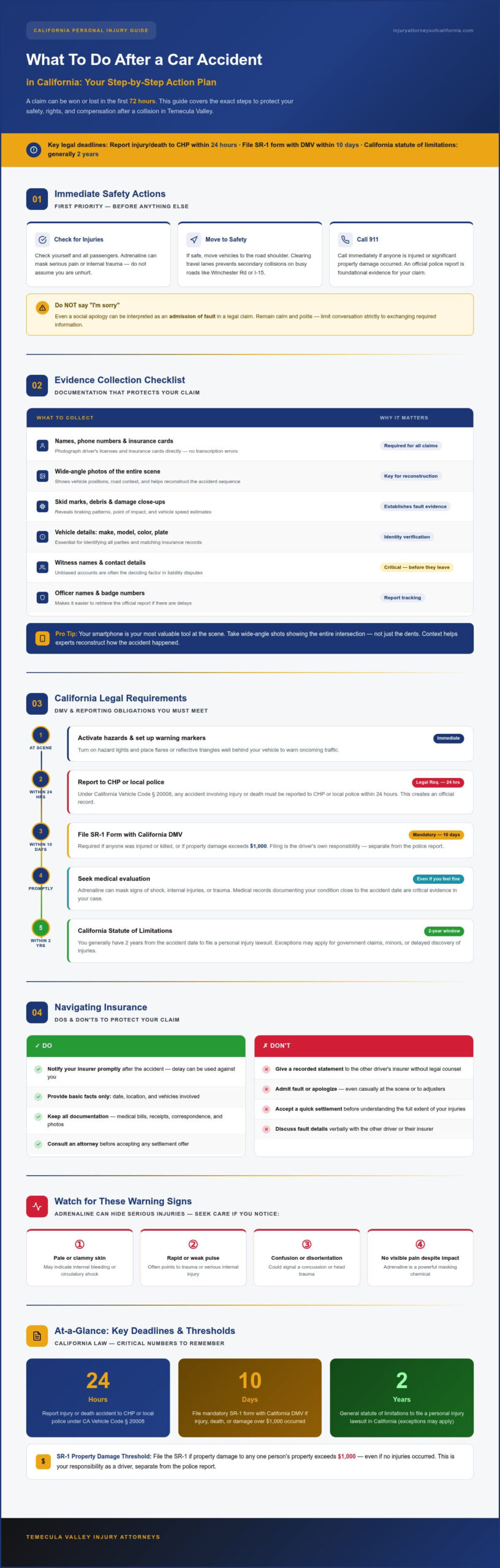
The moments following a collision are chaotic. Your heart is racing, and your mind is likely spinning with questions about vehicle damage and insurance. However, your first priority must always be physical safety. Before you step out of your vehicle, check yourself and your passengers for immediate injuries. Adrenaline is a powerful chemical that can mask significant pain or internal trauma; don’t assume you are unhurt just because you don’t see blood. If you are able to move, and it is safe to do so, relocate your vehicle to the shoulder of the road. Clearing the travel lanes on busy Murrieta thoroughfares like Winchester Road or the I-15 helps prevent secondary collisions that could cause further harm.
Once you have reached a safer position, activate your hazard lights immediately. If you carry emergency flares or reflective triangles in your trunk, place them well behind your vehicle to alert oncoming traffic. You should call 911 right away if anyone appears injured or if there is significant property damage. Understanding what to do after a car accident in California starts with establishing a safe environment and ensuring that professional help is on the way. Even if the accident seems minor, having an official response provides a layer of protection for your future claim.
Assessing the Need for Emergency Services
California law is very specific about reporting requirements. Under California Vehicle Code § 20008, you are generally required to report any accident involving injury or death to the California Highway Patrol or the local police department within 24 hours. Beyond the legal mandate, calling for an ambulance is vital if you notice signs of shock, such as pale skin, rapid pulse, or confusion. These symptoms often point to internal injuries that require immediate diagnostic testing. Requesting a police officer to the scene ensures an unbiased third party creates an official accident report. This document serves as a foundational piece of evidence when you later work with a car accident attorney to recover damages.
Interacting with Other Drivers
It is important to remain calm and polite when speaking with the other parties involved. While your instinct might be to say “I’m sorry” as a social nicety, avoid doing so. In the context of a legal claim, an apology can be interpreted as an admission of fault. Limit your conversation to the exchange of required information: names, contact details, and insurance policy numbers. If you encounter an aggressive or uncooperative driver, do not engage in an argument. Retreat to your vehicle, lock the doors, and wait for the police to arrive. They are trained to handle scene management and will facilitate the exchange of information safely. Protecting your rights means staying focused on the facts and avoiding any statements that could jeopardize your ability to seek compensation later.
Evidence Collection Checklist: Documentation for Your Claim
Once you have addressed immediate safety concerns, your focus must shift to gathering the facts. In the eyes of an insurance company, a claim is only as strong as the evidence supporting it. Documentation acts as a shield against false narratives and helps establish a clear timeline of events. Begin by exchanging names, phone numbers, and insurance policy details with every driver involved. It’s helpful to take a clear photo of their driver’s license and insurance card to ensure there are no transcription errors during this high-stress moment.
Beyond personal details, you should record specific vehicle information for every car at the scene. Write down the make, model, color, and license plate numbers. If police officers arrive, ask for their names and badge numbers. While they will file an official report, having their specific identification makes it much easier to track down the document later if there are delays. Additionally, identify any bystanders who witnessed the collision. Their unbiased accounts are often the deciding factor in liability disputes, so try to secure their contact information before they leave the area.
Visual Documentation Strategies
Your smartphone is the most valuable tool you have at the scene. Don’t just photograph the dents in your bumper; take wide-angle shots that show the entire intersection or stretch of road. This context helps experts reconstruct the accident by showing where vehicles ended up relative to one another. Ensure you capture:
- Skid marks and debris: These indicate braking patterns and the point of impact.
- Traffic signals and signs: Show if a stop sign was obscured or if a light was functioning.
- Close-up damage: Document the specific point of contact on all vehicles involved.
- Road conditions: Note potholes, wet pavement, or construction zones that may have contributed to the crash.
Recording Your Account of the Event
Memory is notoriously unreliable after a traumatic event. As soon as you are in a quiet spot, use your phone to record a voice memo or type out a detailed note. Describe your direction of travel, your approximate speed, and what you saw immediately before the impact. Note the weather conditions and the exact time of day. Knowing what to do after a car accident in California means acting quickly to preserve these fleeting details. If you’re feeling uncertain about the strength of the evidence you’ve gathered, you can always reach out for a professional review of your situation. Recording these facts now prevents insurance adjusters from twisting your words later when you are further removed from the event.
California Legal Requirements: DMV and Medical Obligations
After the dust settles at the scene, you enter a critical phase of administrative and medical obligations. Understanding what to do after a car accident in California involves more than just swapping insurance cards. You have specific legal duties to the state and health-related duties to yourself. Missing these deadlines can jeopardize your driving privileges and your ability to recover damages for your injuries. Knowing what to do after a car accident in California includes prioritizing your health as much as your legal standing.
The Critical 10-Day DMV Deadline
California law requires every driver involved in a collision to file an SR-1 report with the DMV within 10 days if the accident resulted in more than $1,000 in property damage or any level of injury or death. This is a common pitfall for many drivers. You might assume your insurance company or the police will handle this filing, but that is rarely the case. The SR-1 is an independent requirement. Failure to submit this form can lead to the mandatory suspension of your California driver’s license, regardless of who was at fault. The team at Temecula Valley Injury Attorneys can help you verify if this form has been submitted correctly to ensure your record remains clear.
Why Immediate Medical Care is Non-Negotiable
Adrenaline often acts as a natural painkiller. You may feel fine in the hour after a crash on Jefferson Avenue, but internal trauma often takes time to manifest. You should seek a medical evaluation within 24 to 72 hours of the incident. Waiting longer creates what insurance adjusters call a “gap in treatment.” They may use this delay to argue that your injuries weren’t caused by the accident or aren’t as severe as you claim. This gap is a primary tactic used to devalue or deny legitimate claims.
Conditions like whiplash, concussions, or soft tissue damage generally show symptoms days after the initial impact. A professional diagnosis provides the medical evidence needed to link these symptoms directly to the collision. Once you begin treatment, follow every doctor-recommended follow-up appointment. Skipping physical therapy or specialist visits can signal to the insurance company that you have fully recovered, even if you are still in pain.
To keep your claim organized, maintain a dedicated physical or digital file. This should include every medical record, discharge summary, and prescription receipt. You should also track out-of-pocket expenses for vehicle rentals, lost wages, and any equipment needed for your recovery. This level of organization simplifies the process when it is time to calculate the full value of your losses.
Navigating Insurance and Avoiding Common Pitfalls
After a collision, you’ll likely receive calls from insurance adjusters within hours. While you have a contractual duty to notify your own provider, you should treat these conversations with extreme caution. Provide only the basic facts: the date, time, location, and the vehicles involved. Avoid speculating about how the crash happened or who was at fault. Knowing what to do after a car accident in California means understanding that insurance companies are looking for any reason to reduce the value of your claim. They often use friendly, empathetic language to lower your guard, but their primary goal is to protect their bottom line.
One of the most dangerous traps is the early settlement offer. An adjuster might offer a quick check to cover your immediate vehicle repairs or a few medical bills. Accepting this money usually requires you to sign a release form that ends your right to seek further compensation. If you discover a week later that your neck pain is actually a herniated disc requiring surgery, you cannot go back for more help. Never sign a release or accept a settlement until your medical treatment is complete and the full extent of your damages is known.
Speaking with Insurance Adjusters
You aren’t legally required to provide a recorded statement to the other driver’s insurance company immediately. These recordings are designed to catch you in contradictions or lead you into admissions that shift liability. If an adjuster pressures you, politely decline and state that you’ll provide information through your legal representative. This is a vital part of what to do after a car accident in California to preserve your claim. Once you have a professional advocate, you can simply refer all insurance calls to them, which immediately stops the harassment and protects your words from being twisted.
Common Mistakes That Jeopardize Your Recovery
Your actions outside of the insurance calls matter just as much. Social media is a common area where claims are lost. If you post photos of yourself at a family gathering or a local park while claiming a debilitating back injury, the insurance company will use those images to argue you aren’t actually hurt. Even a simple “I’m doing okay” in a comment can be used against you. It’s best to stay off social media entirely regarding the accident until your case is resolved.
Additionally, don’t downplay your injuries to anyone. If an adjuster asks how you’re feeling, don’t say “I’m fine” out of habit. Be honest about your symptoms or simply state that you are still undergoing medical evaluation. If you find yourself overwhelmed by aggressive adjusters, you should schedule a free case evaluation to discuss your options. Avoiding these pitfalls ensures that your recovery remains focused on your health rather than fighting unnecessary legal battles.
Protecting Your Rights with Temecula Valley Injury Attorneys
The recovery process is rarely a straight line. While the immediate aftermath involves scene safety and documentation, the long-term success of your claim depends on how you handle the legal complexities that follow. Knowing what to do after a car accident in California often means recognizing when a situation has moved beyond your control. If you’re facing mounting medical bills, a disputed liability claim, or a persistent insurance adjuster, professional guidance is no longer optional. It’s a necessity for your financial and physical security.
Temecula Valley Injury Attorneys provides a shield between you and the parties trying to devalue your experience. We ensure that you meet every California statute of limitations, which generally allows two years from the date of the accident for personal injury claims. However, specific exceptions apply for claims against government entities or cases involving minors. Missing these deadlines is a permanent bar to recovery. We take the burden of filing off your shoulders so you can focus on healing.
Why Legal Representation Matters for Injury Claims
Calculating the true value of personal injury damages requires a deep understanding of both economic and non-economic losses. It’s not just about today’s bills; it’s about future surgeries, lost earning capacity, and the impact on your quality of life. This calculation becomes even more vital in complex cases involving truck accidents or multi-vehicle crashes where multiple insurance policies are at play. Our firm utilizes a calm, practical approach to untangle these complexities. We investigate the facts, preserve evidence, and build a narrative that reflects the reality of your injuries without unnecessary aggression.
Local Support in Temecula and San Diego
We are your neighbors. Our local knowledge of the roads in Murrieta and the court systems in Riverside and San Diego counties gives our clients a distinct advantage. We maintain verified offices in Temecula, San Diego, and El Centro to remain accessible to the Southern California community. You don’t have to navigate this alone or settle for a distant, national firm that doesn’t understand our local community values. We believe in providing a level of personal accountability that only a local partner can offer.
If you’re still unsure about your next steps or what to do after a car accident in California, we are here to help. You can reach our Temecula office directly at 951-289-0628. We invite you to Schedule a free case evaluation to discuss your specific situation. This professional review comes with no upfront costs, providing you with the certainty and peace of mind you deserve after a traumatic event.
Take Control of Your Recovery Today
The path toward physical and financial healing after a crash requires a clear understanding of your legal obligations. By prioritizing immediate medical care and maintaining a meticulous record of the scene, you’ve already established a strong foundation for your future. Knowing exactly what to do after a car accident in California is your best defense against insurance adjusters who may try to devalue your experience or rush you into an unfair settlement. These early actions are vital to protecting your rights and ensuring you have the resources necessary for a full recovery.
You don’t have to manage the complexities of a personal injury claim by yourself. Our personable and professional team at Temecula Valley Injury Attorneys is ready to act as your protective partner. With local offices in Temecula, San Diego, and El Centro, we provide the community-oriented support you deserve. We work on a contingency fee basis, so there is no fee unless we win, though clients remain responsible for case costs. Please Schedule a free case evaluation with Temecula Valley Injury Attorneys to discuss your situation with a local expert. We’re here to help you move forward with confidence and certainty.
Frequently Asked Questions
How long do I have to report a car accident to the DMV in California?
You have exactly 10 days from the date of the collision to report the accident to the California DMV. This requirement applies if anyone was injured, or if the property damage to any vehicle involved exceeds $1,000. Failing to meet this deadline can result in a suspended driver’s license. It’s a separate step from notifying your insurance company or the police.
Do I need to call the police for a minor car accident in California?
You should generally call the police if the accident results in any injury, death, or significant property damage. California law requires an immediate report to the local police or CHP if someone is hurt. Even for minor fender benders, a police report provides an objective record of the event. This document is often essential when determining liability for your insurance claim later.
What information should I exchange with the other driver after a crash?
You are required to exchange your name, contact information, and insurance policy details with all other drivers involved. You should also record their driver’s license number and the vehicle’s license plate. Taking photos of these documents ensures accuracy. Avoid discussing the details of how the accident happened during this exchange to prevent unintentional admissions of fault.
Should I see a doctor even if I do not feel hurt after an accident?
You should seek a medical evaluation within 72 hours of the crash, even if you feel fine. Adrenaline often masks symptoms of serious conditions like concussions, internal bleeding, or soft tissue damage. A prompt doctor’s visit establishes a medical record that links your potential injuries to the accident. This documentation is vital for your health and for your legal claim.
What is the California SR-1 form and when is it required?
The SR-1 is the official Report of Traffic Accident Occurring in California that must be submitted to the DMV. You must file this form if the accident caused more than $1,000 in property damage or if any person was injured or killed. Knowing what to do after a car accident in California includes completing this form regardless of who was at fault for the collision.
Can I still recover compensation if I was partially at fault for the accident?
You may still be able to recover compensation even if you were partially responsible for the crash. California follows a pure comparative negligence rule; this means your total recovery is reduced by your percentage of fault. For example, if you are found 20% at fault, you could still receive 80% of the damages. An attorney helps ensure your level of fault is assessed fairly.
How long do I have to file a car accident lawsuit in California?
You generally have two years from the date of the accident to file a lawsuit for personal injuries in California. If you are only seeking compensation for property damage, the limit is three years. However, much shorter deadlines apply if a government vehicle or entity is involved. It’s best to consult a professional early to avoid missing these critical legal windows.
What should I avoid saying to an insurance adjuster after an accident?
You should avoid making any statements that suggest you were at fault, such as “I’m sorry” or “I didn’t see you.” Don’t tell an adjuster you feel “fine” or “okay” before you’ve completed a full medical evaluation. Stick to the basic facts of the crash. Understanding what to do after a car accident in California means letting your attorney handle the detailed communications to protect your claim.


