

Did you know that California recently doubled its minimum liability limits to $30,000 per person? This marks the first major update to insurance requirements in over 50 years. It’s natural to feel overwhelmed by rising medical costs and the pressure of insurance adjusters seeking a quick payout. You’re likely asking yourself: how are car accident settlements calculated in California? At Temecula Valley Injury Attorneys, we believe you shouldn’t have to guess about the value of your recovery.
We understand the stress of trying to quantify your pain and suffering while focusing on your health. You need a clear path forward. This guide will show you the specific formulas adjusters use, how California’s pure comparative negligence rules work, and what the 2026 insurance updates mean for your bottom line. We’ll provide a framework to help you determine if a settlement offer is actually fair or if you’re being undervalued by a carrier.
Key Takeaways
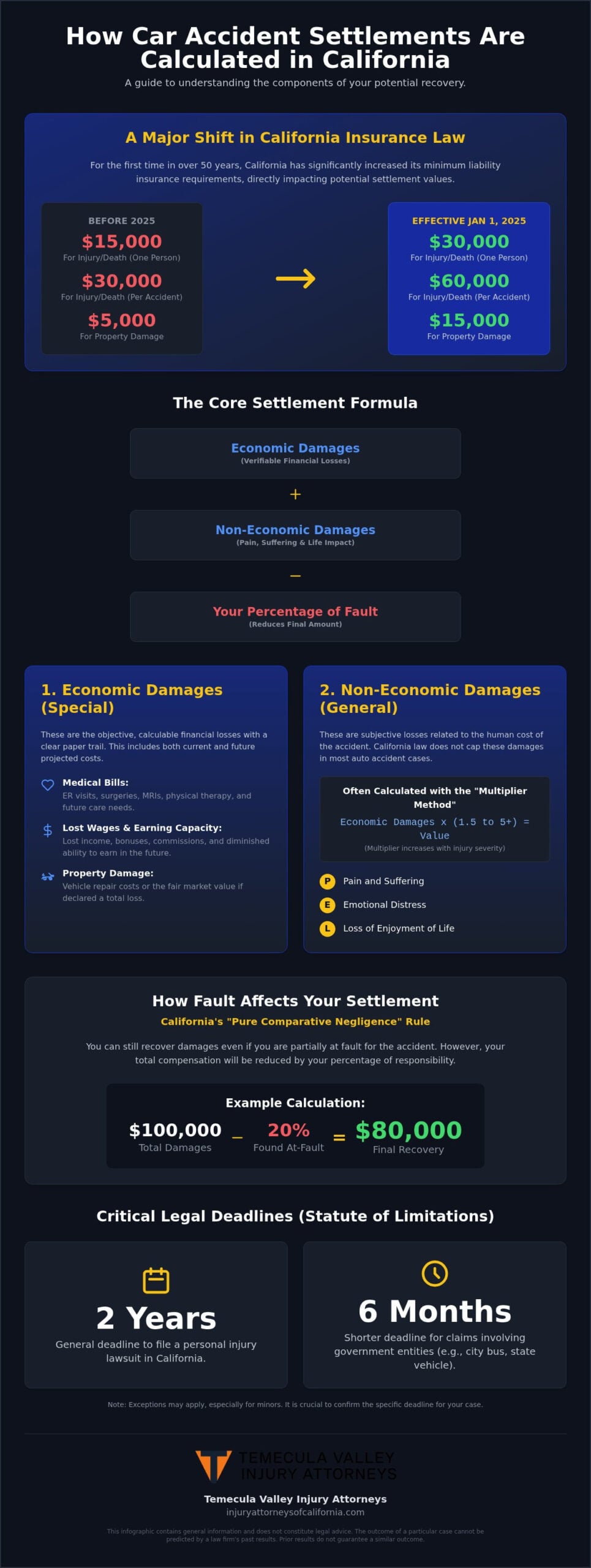
- Learn how the 2026 increase in California’s minimum liability insurance requirements directly impacts the potential recovery for your injury claim.
- Discover how are car accident settlements calculated in California by distinguishing between objective economic losses and subjective non-economic damages.
- Understand how California’s pure comparative negligence rule affects your compensation if you are found partially responsible for the collision.
- Identify critical legal deadlines, including the general two-year statute of limitations and shorter six-month windows for claims involving government entities.
- Recognize when to transition from managing a claim alone to partnering with a legal professional to protect your recovery from insurance company pressure.
The Framework of a California Car Accident Settlement
A car accident settlement is essentially a legal contract. You agree to accept a specific sum of money, and in exchange, you sign a release that prevents you from seeking further compensation from the at-fault party for that specific incident. In California, the vast majority of these claims are resolved through direct negotiations with insurance companies. While television often focuses on dramatic courtroom scenes, the reality is that your recovery usually happens through strategic correspondence and evidence sharing rather than a jury trial.
Understanding how are car accident settlements calculated in California requires looking at both the ledger and the life impact. The 2026 legal environment has become increasingly data-driven. Insurance carriers now place a heavy emphasis on verifiable, out-of-pocket costs. To secure a fair result, we must prove both the financial hit and the human toll using a combination of Economic vs. Non-Economic Damages. This framework ensures that your settlement covers not just what you’ve lost, but the future challenges you may face.
Why ‘Average’ Settlement Numbers Can Be Misleading
You might see online statistics suggesting an average settlement range of $20,000 to $80,000. These numbers are often unhelpful because they blend minor fender benders with life-altering collisions. A spinal injury sustained in heavy Temecula traffic on the I-15 carries vastly different stakes than a low-speed parking lot scrape. Every case value is unique to the individual’s specific medical and financial records. A high-income earner who loses months of professional wages will have a different calculation than someone with a shorter recovery time. We treat your case as a unique file, not a statistic, because your recovery depends on the specific facts of your life. For more detailed information on specific crash types, you can explore our guide to car accidents.
The Role of the Insurance Adjuster in 2026
In 2026, insurance adjusters rely heavily on sophisticated software programs to assign a dollar value to your physical pain. These systems look for specific “value drivers” in your medical reports. If your records don’t use the precise terminology the software recognizes, the system may automatically undervalue your claim. The adjuster’s initial offer is almost always the lowest number they can justify to their supervisors. They aren’t your neighbor; they’re professionals tasked with protecting their company’s bottom line. This is why we focus on creating a comprehensive “demand package” that speaks the insurer’s language. By presenting a technical, evidence-backed argument, we make it difficult for adjusters to rely on software shortcuts to minimize your settlement.
Economic vs. Non-Economic Damages: The Math Behind the Money
To understand how are car accident settlements calculated in California, you must first distinguish between what can be proven with a receipt and what is felt in the heart. California law divides compensatory damages into two specific buckets: economic and non-economic. Unlike some other states, California does not currently place a cap on non-economic damages for standard personal injury claims. This means your recovery isn’t limited by arbitrary ceilings, but rather by the strength of your evidence and the limits of California’s minimum liability insurance.
Calculating Economic Losses (The Paper Trail)
Economic damages, often called “special damages,” are the objective financial losses that have a clear paper trail. These are the easiest to calculate because they’re based on historical data and expert projections. In 2026, insurance adjusters are scrutinizing these figures more than ever. We focus on securing documentation for:
- Medical bills: This includes the initial ER visit, diagnostic imaging like MRIs, surgeries, and future physical therapy sessions.
- Lost wages: We calculate the exact income you lost while recovering, including missed bonuses, commissions, and used vacation time.
- Property damage: This covers the repair costs for your vehicle or its fair market value if it was totaled.
Crucially, we also project future economic needs. If your injury requires lifelong care or limits your career growth, those projected losses must be included in the initial settlement math. We treat these calculations as a matter of professional integrity to ensure your financial security is protected long after the case closes.
Estimating Non-Economic Damages (The Multiplier Method)
Non-economic damages, or “general damages,” represent the subjective human impact of the crash. This covers pain, suffering, emotional distress, and the loss of enjoyment of life. Because you can’t put a price tag on a sleepless night or the inability to hold your child, legal professionals often use two primary methods to estimate these values. The Multiplier Method takes your total economic damages and multiplies them by a number, typically between 1.5 and 5. A higher multiplier is used for permanent scarring, chronic pain, or catastrophic injuries. Alternatively, the Per Diem Method assigns a specific dollar value to every day you lived in pain from the date of the accident until you reached maximum medical improvement.
If you’re struggling to make sense of how are car accident settlements calculated in California, you can reach out for a professional review to ensure no value is left on the table. We take the responsibility of accurate calculation seriously because it’s the foundation of your future security.
Factors That Shift Your Claim’s Value in Southern California
The total value of your medical bills is only one part of the story. In practice, how are car accident settlements calculated in California depends heavily on the legal principle of “pure comparative negligence.” This rule allows you to recover damages even if you were partially responsible for the collision, but your final check is reduced by your percentage of fault. If a jury or insurance adjuster determines you were 20% at fault because you were slightly over the speed limit, your $100,000 claim would result in an $80,000 settlement. We see insurance companies use this rule as a primary tactic to protect their bottom line, often assigning “partial fault” to victims without sufficient evidence.
To counter these tactics, we rely on concrete evidence from local sources. Whether it’s a dashcam recording from a commute in Murrieta or witness statements gathered by Fallbrook police, these details prevent adjusters from unfairly shifting the blame onto you. For those involved in more complex collisions, such as truck accidents, the calculation becomes even more intricate due to the multiple parties and federal regulations involved.
How Comparative Fault Affects Your Check
Imagine a scenario where a driver turns left in front of you, but you were distracted by your phone for a split second. The other driver is clearly the primary cause, but an adjuster might argue you could have avoided the crash if you were more alert. They might assign you 30% of the fault. This isn’t a random guess; it’s a calculated move to save the company money. We fight these assertions by reconstructing the accident to show the true sequence of events. Our goal is to ensure your settlement reflects the reality of the crash, not an adjuster’s convenient narrative.
Insurance Policy Limits and SB 1107
The availability of insurance coverage often acts as a hard ceiling on your recovery. Generally, you cannot collect more than the at-fault driver’s policy limit unless they have significant personal assets. This is why the 2026 legal landscape is so important for victims. Under SB 1107, California transitioned to higher mandatory liability limits. For policies issued or renewed on or after January 1, 2025, the minimum bodily injury coverage is now $30,000 per person and $60,000 per accident, with property damage at $15,000. These higher limits mean more funds are available for your recovery than in previous years.
Even with these updates, many drivers remain underinsured or carry no insurance at all. National data on the uninsured motorist population highlights a persistent risk for Southern California drivers. In these cases, your own Uninsured/Underinsured Motorist (UM/UIM) coverage becomes a vital secondary source of recovery. We treat these policy details as a technical puzzle, identifying every possible avenue to ensure you aren’t left paying for someone else’s mistake. If you have concerns about a specific injury type, such as those resulting from motorcycle accidents, we can help you understand how these policy limits apply to your unique situation.
The Legal Landscape: California Laws and 2026 Realities
When you’re trying to understand how are car accident settlements calculated in California, you have to look beyond the medical bills. The legal framework of our state creates specific guardrails that can either protect your recovery or end it entirely before it begins. In 2026, the process has become more technical due to new regulations regarding digital evidence. Modern vehicles now record “black box” data, providing objective details about speed, braking, and steering. This data often overrides human memory in a settlement negotiation, making it a critical component of your claim’s technical foundation.
We treat every case with the meticulous care of a neighbor protecting their community. This means we don’t just look at what happened; we look at the specific California statutes that govern your right to collect. Whether you are dealing with a standard personal injury claim or a complex multi-vehicle collision, these laws dictate the maximum potential of your settlement math.
Deadlines You Cannot Miss
California law generally provides a two-year statute of limitations for personal injury claims. This means you have exactly two years from the date of the accident to file a lawsuit in court. If you miss this deadline, you lose your legal right to seek compensation forever. However, the clock runs much faster in certain scenarios. If your accident involved a government entity, such as an MTS bus in San Diego or a municipal vehicle in Temecula, you must file an administrative claim within six months. Waiting until the last minute makes it significantly harder for us to calculate the full value of your losses, as evidence can disappear and witnesses’ memories can fade. For cases involving minors, the timeline may be different, but prompt action is always the safest path to certainty.
Prop 213: The ‘No Pay, No Play’ Rule
California Civil Code 3333.4, known as Proposition 213, is a rule that catches many drivers by surprise. If you were driving without insurance at the time of the crash, this law generally bars you from recovering non-economic damages. Even if the other driver was 100% at fault, your settlement calculation would be limited strictly to economic losses like medical bills and car repairs. You wouldn’t be eligible for compensation related to pain, suffering, or emotional distress. There are narrow exceptions, such as if the at-fault driver is convicted of a DUI in connection with the crash. This rule underscores the importance of maintaining your own coverage to protect your right to a full recovery.
Because these legal nuances can drastically shift the value of your claim, we recommend that you Schedule a free case evaluation to review the specifics of your situation. We’re here to provide the informed decision-making tools you need to move forward with confidence.
Navigating Your Claim with Temecula Valley Injury Attorneys
We don’t view your case as a simple file number or a set of medical codes. We see the family who depends on you and the Southern California community where you live. Our team combines technical legal expertise with the protective care of a neighbor. We focus on building a comprehensive calculation that accounts for the “familial stakes” of your recovery. This means we look beyond the immediate bills to see how your life has been altered. We treat your security as a point of professional integrity.
When determining how are car accident settlements calculated in California, we look at the true long-term costs. Our team handles the aggressive negotiations with insurance adjusters. This allows you to focus on your physical healing while we secure your financial future. We utilize local Southern California experts who can testify on regional medical costs and the specific life impact of your injuries. Whether you are in San Diego, El Centro, or Fallbrook, we ground our calculations in the economic realities of your specific community.
Our Process for Calculating Your Case Value
We begin with a meticulous review of your medical records and employment history. If your injury prevents you from returning to work in Temecula or Murrieta, we consult with vocational experts. These professionals help us quantify your lost earning capacity with precision. This technical approach ensures that no future financial risk is overlooked. We take the responsibility of your safety and financial stability seriously. You can learn more about our car accident practice to see how we build these high-stakes calculations.
Next Steps: Schedule a Free Case Evaluation
You deserve certainty without added stress. We offer a free case evaluation to help you understand the potential value of your claim. There is no obligation to hire our firm after this initial consultation. It’s simply a tool for informed decision-making. To prepare, please bring any police reports, photos of the scene, and your current medical bills. We’ll walk through the math together and identify any specific value drivers that an insurance adjuster might have missed. We prioritize clear, immediate action to help you regain control of your situation.
Our verified offices in Temecula, San Diego, and El Centro are ready to assist you. We maintain constant digital accessibility because we know the aftermath of an accident is urgent and fast-paced. Don’t let an insurance company dictate the value of your recovery or pressure you into a quick, undervalued settlement. Contact our San Diego or Temecula offices today to start your path toward a fair settlement with a partner who is deeply invested in your well-being.
Secure the Recovery You Deserve
You now have the technical framework to understand how 2026 insurance updates and California’s negligence laws interact. We’ve covered the distinction between verifiable economic losses and the human impact of non-economic damages. These factors are the building blocks of your claim. However, because every accident involves unique facts, knowing exactly how are car accident settlements calculated in California for your specific situation requires a detailed professional review.
At Temecula Valley Injury Attorneys, we serve as protective partners for our neighbors in Temecula, Murrieta, San Diego, and El Centro. We take the responsibility of your financial and physical recovery seriously. Please remember that each case is unique, and prior results do not guarantee similar outcomes.
Don’t let the stress of medical bills or insurance pressure dictate your future. Schedule a free case evaluation with Temecula Valley Injury Attorneys or call us at 951-289-0628 to get the clarity you need. We’re ready to help you move forward with the professional support and familial warmth you deserve.
Frequently Asked Questions
What is the average car accident settlement in California for 2026?
Settlement averages generally range from $15,000 to $80,000, though the median for cases that don’t go to litigation is approximately $23,000. In San Diego, minor injury cases typically settle between $15,000 and $40,000, while moderate injuries can reach $150,000. Severe or catastrophic cases often exceed $500,000. Because every case is unique, these figures serve as a general baseline rather than a guarantee for your specific recovery.
How much is pain and suffering worth in a California car accident?
Pain and suffering value is subjective and depends on the severity and duration of your injuries. Adjusters often use a multiplier between 1.5 and 5 times your total medical bills to estimate this amount. Factors like permanent scarring or a loss of mobility significantly influence how are car accident settlements calculated in California. There is currently no legal cap on these non-economic damages for standard personal injury claims in our state.
Can I still get a settlement if I was partially at fault for the accident?
Yes, you can still recover compensation even if you were primarily responsible for the collision. California follows a pure comparative negligence rule, which means your final check is reduced by your percentage of fault. If your total damages are $100,000 and you are found 30% at fault, you would receive $70,000. We focus on gathering evidence like dashcam footage to ensure insurance companies don’t unfairly inflate your responsibility.
How long does it typically take to receive a settlement check in California?
Most uncomplicated claims are resolved within three to six months after you have finished your medical treatment. If your case involves significant injuries or requires filing a lawsuit, the process can take one to two years to reach a conclusion. We prioritize a thorough approach to ensure all future medical costs are accounted for before you sign a final release. Moving too quickly can often result in an undervalued settlement.
What happens to my settlement if the other driver has no insurance?
If the at-fault driver lacks insurance, you will generally seek a settlement through your own Uninsured Motorist (UM) coverage. This policy is designed to protect you by stepping into the shoes of the at-fault party’s missing insurance. Our team reviews your specific policy to identify every available source of recovery. This is a common challenge in areas like El Centro, and having the right coverage is a vital safety net for your family.
Do I have to pay taxes on my car accident settlement money in California?
Settlement proceeds for physical personal injuries or physical sickness are generally not taxable under federal or California law. This includes compensation for medical bills, pain and suffering, and emotional distress linked to the injury. However, portions of a settlement designated for punitive damages or interest may be considered taxable income. It’s always best to consult with a tax professional to understand the specific breakdown of your recovery funds.
What is the 2026 minimum auto insurance requirement in California?
The 2026 minimum liability requirements are $30,000 for bodily injury per person, $60,000 per accident, and $15,000 for property damage. These limits were increased under SB 1107 to better reflect the rising costs of medical care and vehicle repairs. These higher mandatory minimums play a significant role in how are car accident settlements calculated in California today. They provide a more robust starting point for victims seeking fair compensation from at-fault drivers.
Should I accept the first settlement offer from the insurance company?
You generally should not accept the first offer because it is often the lowest amount the insurance company believes you might take. Adjusters frequently use early offers to settle claims before the full extent of your injuries is known. These “lowball” offers rarely cover long-term medical needs or the true cost of your pain and suffering. We recommend a professional review of any offer to ensure it provides the security you and your family deserve.


