

Missing the filing deadline by just one day can permanently end your chance to recover compensation, regardless of how clear the other driver’s liability may be. In most cases, the car accident statute of limitations California establishes a two-year window from the date of the crash to file a personal injury lawsuit. While two years sounds like a long time, waiting too long can lead to lost evidence and faded witness memories, which often weakens your standing against insurance companies.
At Temecula Valley Injury Attorneys, we know you’re likely overwhelmed by medical bills and the complexity of insurance claims. You deserve a clear path forward without the stress of missing a hidden deadline. This guide provides the certainty you need by breaking down the 2026 filing requirements for injuries, vehicle repairs, and wrongful death claims. We’ll also cover the strict six-month notification rule for government entities and explain how the recent 2026 expansion of safety laws might impact your legal standing.
Key Takeaways
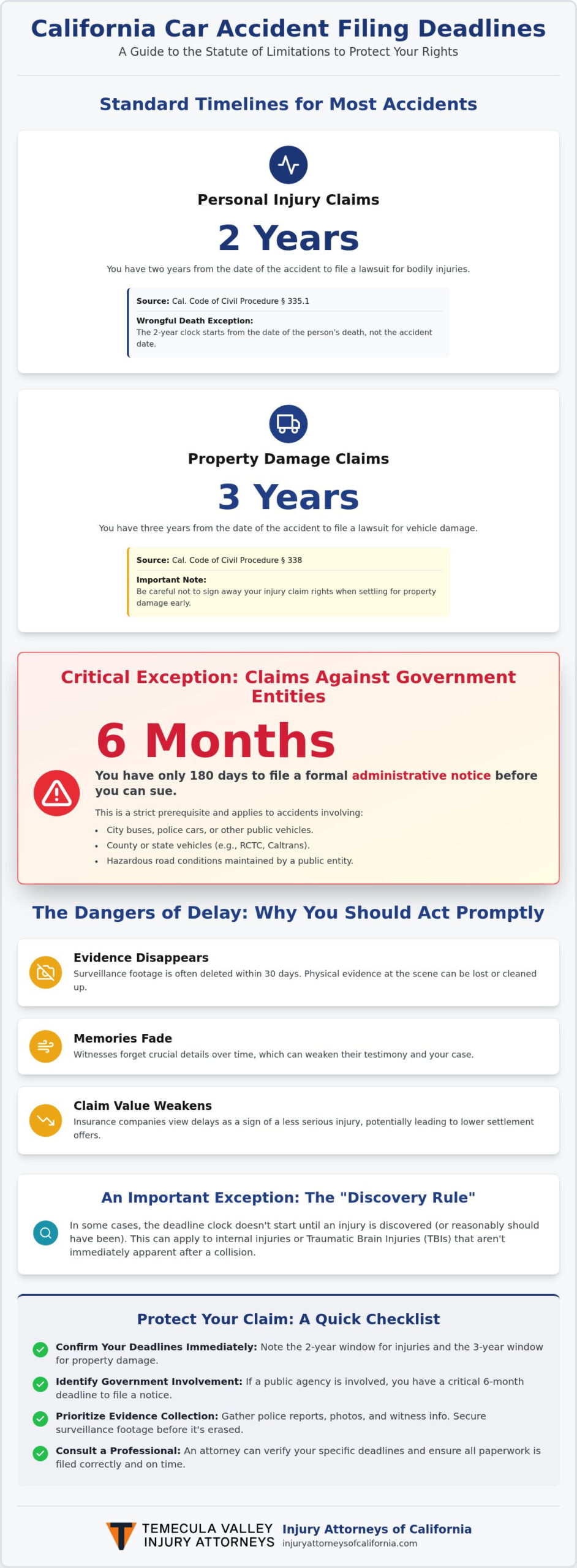
- Confirm your filing window immediately, as the car accident statute of limitations California generally allows two years for personal injuries but only three years for property damage.
- Identify government involvement early since claims involving city vehicles or public roads require a formal administrative notice within a strict six-month timeframe.
- Prioritize evidence collection in the first 30 days to secure surveillance footage and witness statements before they are lost or forgotten.
- Understand the discovery rule, which may offer flexibility if internal injuries or traumatic brain injuries were not immediately apparent after the collision.
- Consult with a professional to verify your specific deadlines and ensure your right to compensation is protected by meticulous legal management.
Understanding the California Car Accident Statute of Limitations
A statute of limitations acts as a firm expiration date for your legal rights. Once this window closes, California courts lose the authority to hear your case, and the person who caused your injuries is no longer legally obligated to pay you. For most victims, the car accident statute of limitations California provides two years from the date of the collision to file a lawsuit for bodily injuries. This deadline is strictly enforced under California Code of Civil Procedure section 335.1.
Damage to your vehicle follows a different set of rules. Under section 338, you generally have three years to seek compensation for repairs or the total loss of your car. It’s a common mistake to assume that opening an insurance claim satisfies these legal requirements. It doesn’t. An insurance claim is a private negotiation; a lawsuit is a formal legal action. You must file the lawsuit before the clock runs out, even if you’re still talking to an insurance adjuster or waiting for a settlement offer.
When Does the Clock Start Ticking?
The countdown usually begins the moment the impact occurs. If your accident happened on August 15, 2024, your injury filing deadline is August 15, 2026. Different rules apply to wrongful death cases. In those tragic situations, the two-year clock begins on the date of the victim’s passing rather than the date of the accident itself. If your final filing day happens to fall on a Saturday, Sunday, or a court holiday, California law generally allows you to file on the next open business day.
Injury vs. Property Damage: Why the Split Matters
Managing two separate timelines for one accident requires precision. You might feel pressured to settle your vehicle damage claim quickly so you can get back on the road. However, insurance companies often include broad release language in property settlements. Signing a document without a thorough review could accidentally waive your right to pursue an ongoing personal injury claim.
Our team at Temecula Valley Injury Attorneys coordinates these deadlines to protect your full recovery. We ensure your property is repaired while simultaneously gathering the medical evidence needed for your injury claim. By separating these issues, we prevent a quick vehicle fix from jeopardizing your long-term health and financial security. We take the responsibility of your safety seriously, ensuring no detail of the car accident statute of limitations California is overlooked while you focus on healing.
Exceptions and Shorter Deadlines for Government Claims
While the standard car accident statute of limitations California allows two years for most injury claims, that window shrinks significantly if a public entity is involved. Under California Government Code section 911.2, you generally have only six months from the date of the accident to file a formal administrative claim. This is not a lawsuit; it’s a mandatory prerequisite. If you fail to file this notice within the 180-day deadline, you’ll likely be barred from recovering any compensation. This strict rule applies to accidents involving city buses, police cruisers, or even crashes caused by hazardous road conditions maintained by a municipality, diverging from the broader timelines found in California Code of Civil Procedure § 335.1.
Local Southern California Entities to Watch For
Identifying government involvement isn’t always straightforward. In our region, you must act quickly if your collision involves vehicles or property managed by local agencies. These claims often require specific forms and precise delivery methods to be considered valid. Common entities include:
- San Diego Metropolitan Transit System (MTS) buses or trolleys.
- North County Transit District (NCTD) vehicles in the Fallbrook or Oceanside areas.
- Riverside County Transportation Commission (RCTC) commuter services.
- Caltrans maintenance vehicles or poorly designed infrastructure on the I-15 or I-215 freeways.
Because these agencies have high-stakes legal teams protecting their budgets, meticulous documentation is required from day one. If you’re unsure if a government agency is involved in your crash, you can request a free case evaluation to verify the specific deadlines for your situation.
Tolling the Statute: When the Clock Pauses
There are specific circumstances where the legal clock “tolls,” or pauses, giving you more time than the standard car accident statute of limitations California suggests. These exceptions are narrow and require technical proof to survive a court challenge. The clock may pause for:
- Minors: If the victim is under 18, the statute of limitations generally doesn’t begin until their 18th birthday.
- Mental Incapacity: The clock may pause if the injured person is legally considered incapacitated or lacks the mental capacity to understand their legal rights at the time of the accident.
- Absence from State: If the at-fault driver leaves California for a period before a lawsuit is filed, that time away might be excluded from the two-year calculation.
Relying on a pause in the clock without professional verification is risky. Our team at Temecula Valley Injury Attorneys monitors these timelines with technical rigor to ensure your right to recovery remains secure.
The Risks of Delay: Why Waiting to File Can Devalue Your Claim
The car accident statute of limitations California provides a legal safety net, but it shouldn’t be your filing strategy. Waiting months or years to start your claim often causes critical evidence to vanish. Digital surveillance footage from local businesses is frequently overwritten within 30 days. Physical evidence at the crash site, like skid marks or debris, disappears even faster. When you wait, you’re essentially handing the insurance company a tool to devalue your recovery.
Witness reliability also drops over time. People move, change their phone numbers, or simply forget the specific details that prove the other driver was at fault. If we can’t find the witnesses who saw the light turn red, proving your case becomes significantly harder. Additionally, many law firms follow an internal “90-day rule.” They may decline cases that are too close to the filing deadline because there isn’t enough time to conduct a thorough investigation and prepare a high-quality lawsuit. Insurance adjusters also use your delay to argue that your injuries aren’t as serious as you claim, suggesting that a truly injured person would’ve acted sooner.
The Impact on Evidence Preservation
Certain collisions require immediate technical intervention. For example, truck accidents involve commercial vehicles equipped with Event Data Recorders, or “black boxes.” This data, which proves speed and braking patterns, can be legally erased or recorded over if a preservation letter isn’t sent immediately. We act quickly to secure this data before it’s lost forever.
In local areas like Murrieta or Temecula, road conditions change quickly. Potholes are filled and signage is updated, potentially erasing the proof of a dangerous intersection. By involving Temecula Valley Injury Attorneys early, we can deploy accident reconstructionists to document the scene while the evidence is still fresh. This technical rigor ensures that the facts of your crash are preserved before they’re lost to time or construction crews.
Medical Documentation and the ‘Gap in Treatment’ Trap
Insurance adjusters look for any reason to pay less. If you wait weeks to see a doctor or have long breaks between appointments, they’ll label this a “gap in treatment.” They’ll argue that if you were truly injured, you would’ve sought immediate and consistent care. They might even claim your pain was caused by a different event that happened during your delay. Consistent medical records serve as the foundation for case value. Linking your injuries directly to the crash is much easier when the medical trail starts on day one. We help you stay organized so your health and your legal standing remain protected under the car accident statute of limitations California.
How to Calculate Your Deadline and Preserve Your Rights
Determining the exact expiration date for your claim requires more than just looking at a calendar. While the car accident statute of limitations California generally provides a two-year window, the specific day the clock starts can vary based on the nature of your injuries. For most people, the countdown begins at the moment of impact. However, if you’re approaching the two-year mark and haven’t filed a formal summons and complaint, you’re in the legal “red zone.” At this stage, you must act immediately to preserve your right to recovery, as courts rarely grant extensions for simple administrative delays or ongoing negotiations.
The “Discovery Rule” offers a narrow exception for injuries that aren’t immediately apparent. This often applies to traumatic brain injuries (TBI) or internal organ damage that may take days or weeks to manifest symptoms. Under this rule, the clock might not start until you discovered, or reasonably should have discovered, the injury. It’s a high legal bar to clear. You’ll likely need expert medical testimony to prove that a reasonable person wouldn’t have known about the injury sooner. If you’re concerned about a latent injury, you should schedule a free case evaluation to see how these rules apply to your specific medical records.
Wrongful Death Timelines
Losing a loved one in a fatal accident involves a different calculation. The two-year statute of limitations begins on the date of the person’s death, which may be different from the date of the actual collision. California law also limits who can file these claims, generally prioritizing surviving spouses, domestic partners, and children. If you’re filing on behalf of an estate, you must also meet specific statutory requirements to ensure the court recognizes your standing as a personal representative. We handle these technical filings with the meticulous care they deserve, ensuring your family’s future remains protected.
What to Do If You Missed the Deadline
If you’ve already passed the filing window, your options are extremely limited, but they may not be entirely gone. For claims involving government entities, you might be able to file a “late claim” petition if you’re still within one year of the incident, though you must prove the delay was due to mistake, inadvertence, or excusable neglect. Courts also occasionally apply “equitable tolling” in rare circumstances where a defendant’s own fraudulent actions prevented you from filing on time. These exceptions are technically complex and difficult to win. You should still consult a lawyer to verify if any rare legal exemptions apply to your standing before assuming your case is lost.
How Temecula Valley Injury Attorneys Protects Your Rights
Temecula Valley Injury Attorneys takes the responsibility of your legal safety seriously. We understand that the car accident statute of limitations California is more than just a date on a calendar; it’s the boundary between a secured future and a lost opportunity. Our team manages every technical detail of your filing timeline with professional integrity. We maintain a local presence in Temecula, San Diego, and El Centro, giving us a deep understanding of the specific procedural requirements in our regional courts. This localized expertise ensures your claim is handled with the precision required by Southern California judges.
We handle the heavy lifting immediately so you don’t have to. Our process includes rapid evidence collection and detailed witness interviews conducted while memories remain fresh. Whether you were involved in car accidents on the I-15 or a collision in downtown San Diego, we ensure all paperwork is filed correctly the first time. We don’t just wait for the deadline. We act with the speed and precision necessary to protect the value of your claim against aggressive insurance company tactics.
A Professional and Personable Approach
We strike a balance between being rigorous technical experts and protective, community-oriented neighbors. You aren’t just a case number to us. We treat your recovery as a point of professional integrity and personal commitment. We maintain constant accessibility so you’ll always know exactly where your case stands against the clock. We provide the certainty you need to focus on recovery while we secure your legal timeline. This collaborative approach ensures that the stress of legal deadlines doesn’t interfere with your physical healing.
Schedule a Free Case Evaluation
Determining your specific filing window shouldn’t be a source of anxiety. We offer a no-cost, no-obligation consultation to verify your unique deadlines. This is especially critical if you suspect government involvement, as we can quickly identify hidden administrative requirements that might otherwise bar your recovery. We’ll review your medical records, accident reports, and any communication with insurers to build a comprehensive timeline for your case. Taking the first step is simple and provides immediate peace of mind.
Our team is ready to listen to your story and offer the objective, informed decision-making you need right now. Don’t let a technicality end your right to compensation. Schedule a free case evaluation with Temecula Valley Injury Attorneys today by calling 951-289-0628.
Protect Your Recovery with Proactive Legal Action
Understanding the car accident statute of limitations California is the first step toward securing the compensation you deserve. Whether you’re navigating the standard two-year window for injuries or the much tighter six-month deadline for government claims, precision matters. Waiting too long doesn’t just risk a court dismissal; it allows vital evidence to disappear and gives insurance companies room to question your recovery needs. You deserve a partner who watches over your case with the same care they would for their own family.
At Temecula Valley Injury Attorneys, we combine the rigor of technical experts with the care of a protective neighbor. Our local offices in Temecula, San Diego, and El Centro ensure you have a dedicated partner who understands the specific nuances of Southern California personal injury law. We take the responsibility of your safety seriously, managing the complex timelines so you can focus on your recovery. You don’t have to face the legal clock alone.
Schedule a free case evaluation today to confirm your deadlines and start building a strong foundation for your claim. We’re ready to provide the certainty and informed decision-making you need to move forward with confidence.
Frequently Asked Questions
Can I still file a claim if the accident was 18 months ago?
You generally can still file a claim 18 months after a collision because the standard statute of limitations for personal injury is two years. However, waiting this long means critical evidence like skid marks, dashcam footage, or business surveillance may already be gone. We recommend acting immediately to preserve what remains of your case before the final six months of your eligibility window expire and your standing weakens.
What happens if the 2-year deadline for my car accident passes?
If your deadline passes without a lawsuit being filed, you permanently lose your legal right to seek compensation from the at-fault party. California courts are strict and will likely dismiss any late filings regardless of the severity of your injuries. This is why verifying your specific car accident statute of limitations California deadline early is the only way to ensure your right to a recovery is protected.
Is the statute of limitations different for a hit and run in California?
The filing deadline for a hit and run accident is generally the same two-year period from the date of the injury. The primary challenge is identifying the responsible driver before that time runs out. If the driver is never found, you may need to file an Uninsured Motorist claim with your own insurer, which also carries strict contractual deadlines that often mirror state law timelines.
Does the statute of limitations apply if I am still in medical treatment?
Yes, the legal deadline applies even if you are still receiving active medical care for your injuries. Many victims mistakenly believe the clock pauses while they are healing, but it does not. You must file your lawsuit within the two-year window to protect your claim, even if your final medical bills and long-term prognosis are not yet fully determined by your doctors.
What is the deadline if a city vehicle or police car hit me?
You generally have only six months from the date of the accident to file a formal administrative claim if a city vehicle or police car was involved. This shorter window is a mandatory prerequisite under the California Government Code. If the government denies your claim, you then have a limited time, often only six months from the denial date, to file a formal lawsuit in court.
Can a minor file a lawsuit after they turn 18 for an old accident?
Yes, California law typically “tolls” or pauses the statute of limitations for minors until they reach the age of 18. This means a child injured in a crash generally has until their 20th birthday to file a personal injury lawsuit. However, parents should consider acting much sooner to ensure evidence is preserved and witnesses are still available to testify about the facts of the collision.
How does the statute of limitations work for a wrongful death car accident?
For wrongful death claims, the two-year statute of limitations generally begins on the date of the victim’s death rather than the date of the accident. This distinction is vital if the victim survived for a period after the initial crash. Filing on behalf of an estate requires specific legal standing, so it’s important to verify these requirements with a professional early in the grieving process.
Does an insurance claim count as ‘filing’ for the statute of limitations?
No, opening a claim with an insurance company does not count as “filing” under the car accident statute of limitations California rules. The only action that legally stops the clock is filing a formal summons and complaint in a California civil court. Many adjusters will continue negotiations until the deadline passes, at which point they are no longer legally required to offer you any settlement at all.


