

If you wait until you get home to think about filing a police report after car accident California, you might have already missed your most critical legal window. It’s frustrating to realize that a simple exchange of insurance information rarely provides the protection you need. Most drivers assume the police will handle the paperwork, but when officers don’t arrive at the scene of a “minor” accident, you’re often left to navigate complex reporting thresholds on your own.
You deserve to feel secure in your recovery and informed about your legal obligations. We’ll show you exactly how to meet California’s strict reporting deadlines, including the 24-hour police notification for injuries and the 10-day DMV requirement for property damage over $1,000. This 2026 guide outlines the specific steps for residents in Temecula, Murrieta, and San Diego to ensure your rights remain protected and your settlement foundation stays strong.
Key Takeaways
- Identify the two critical reporting deadlines that could determine the success of your future insurance claim.
- Learn why filing a police report after car accident California is legally required even for minor collisions involving property damage over $1,000.
- Understand the specific steps to take if law enforcement refuses to come to the scene of your accident.
- Discover how the narrative within an officer’s report acts as a primary foundation for establishing fault in Southern California.
- Find out how to determine if the California Highway Patrol or a local city department is responsible for your accident record.
California Car Accident Reporting Laws: What You Need to Know
Many Southern California drivers believe that simply exchanging insurance cards at the scene of a fender bender fulfills their legal obligations. That is a mistake that could lead to a suspended license or a weakened injury claim. Under California law, filing a police report after car accident California is often a mandatory step, not a suggestion. Whether you are on the I-15 in Temecula or a surface street in San Diego, the law requires specific actions based on the severity of the crash. Relying on a verbal agreement with the other driver offers you zero legal protection when the insurance adjusters start their investigation.
CVC § 20008: Reporting Injury or Death
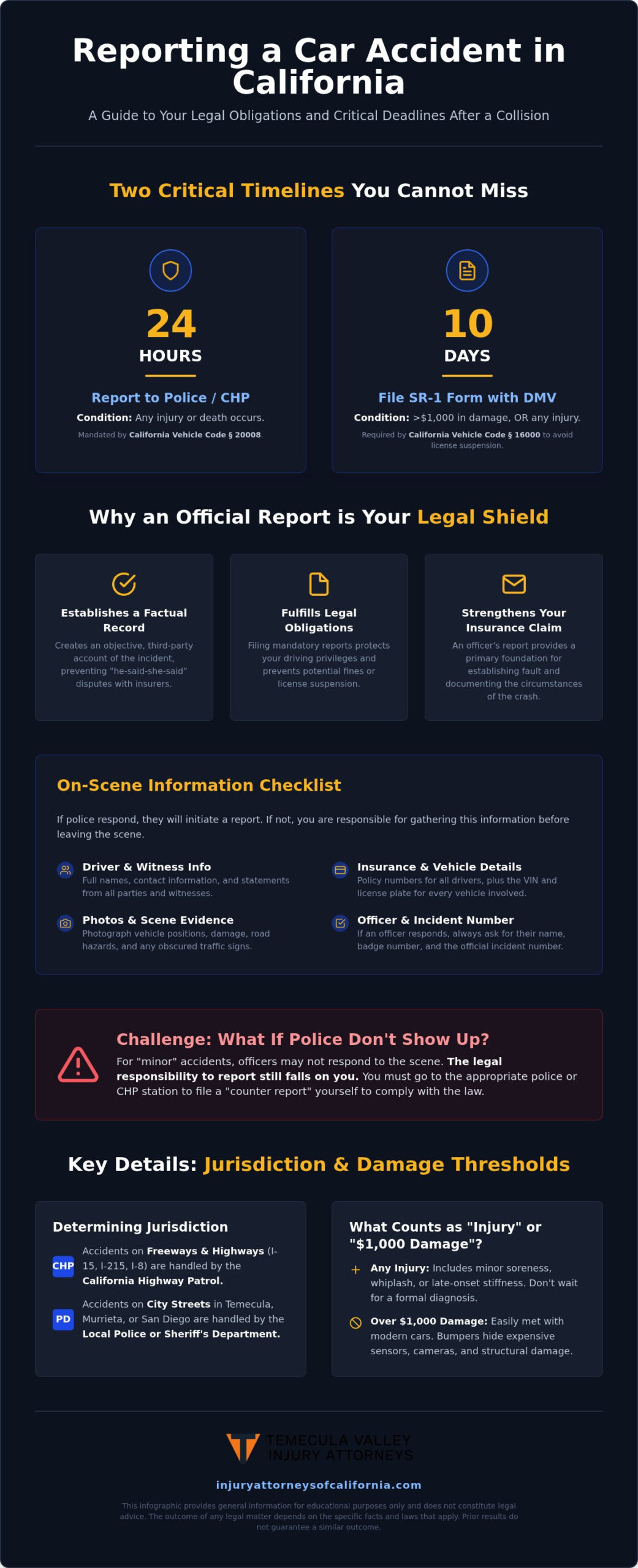
California Vehicle Code § 20008 is strict and unforgiving. If an accident results in any injury or death, you must make a written report to the California Highway Patrol (CHP) or the local police department within 24 hours. Don’t wait for a formal medical diagnosis to decide if you’re “injured.” In California, an injury includes minor soreness, whiplash, or late-onset stiffness that might not feel severe until the adrenaline wears off. If an officer doesn’t come to the scene to document the event, the responsibility falls entirely on you to initiate that report. These individual reports contribute to broader safety data sets like the Uniform Crime Reports, which help agencies track regional traffic trends, but their primary purpose for you is to create a legal record of the incident. Failing to report an injury accident is a violation of the vehicle code and significantly complicates your ability to seek a car accident settlement later.
CVC § 16000: The DMV SR-1 Requirement
It’s vital to understand that a police report and a DMV report are two different legal requirements. Per CVC § 16000, you have exactly 10 days to file Form SR-1 with the DMV if the accident caused more than $1,000 in property damage or any level of injury. In 2026, with the rising costs of vehicle sensors, cameras, and specialized paint matching, even a minor “tap” almost always exceeds this $1,000 threshold. If you don’t file this form, the DMV has the authority to suspend your driver’s license, regardless of who was at fault for the crash. We recommend filing even if the damage looks superficial. Modern bumpers are designed to absorb impact, often hiding thousands of dollars in structural damage beneath the plastic cover.
Exchanging info is a courtesy; filing a report is a legal shield. We often see insurance companies deny valid claims because there is no official record of the event. A police report provides an objective foundation that “he-said-she-said” arguments can’t easily dismantle. If you’re unsure about the damage amount or the extent of your pain, it’s always safer to file. It protects your driving privilege and ensures you have the documentation needed to pursue a fair recovery.
Step-by-Step: How to File Your Accident Report in Southern California
Securing an official record starts with knowing exactly who to call. If you are involved in a collision, filing a police report after car accident California isn’t just about insurance; it’s about creating a factual timeline before memories fade. If an officer arrives at the scene, they will initiate the process. However, if the accident is considered “minor” or occurs during a high-volume traffic period, you might be instructed to file a report at the station or online. Taking the right steps in those first few hours ensures that your version of events is preserved for the record.
Jurisdiction: Who Do You Call in Temecula or San Diego?
Determining which agency has jurisdiction depends entirely on where the wheels stopped. In incorporated cities like Temecula or Murrieta, you’ll typically interact with the local police department or the Riverside County Sheriff. If your accident occurs on the I-15, I-215, or I-8 freeways, the California Highway Patrol (CHP) Border Division takes the lead. Always ask the responding officer for a “service number” or “incident number.” If no officer responds, you must visit the nearest precinct of the agency that has jurisdiction over that specific road to file a counter report. This requirement is reinforced by California Vehicle Code § 20008, which mandates a written report for injury accidents when law enforcement isn’t present at the scene.
Before you leave the scene or head to the station, ensure you have gathered these specific details:
- Full names and insurance policy numbers for all drivers involved.
- The Vehicle Identification Number (VIN) and license plate for every car.
- Contact information for any witnesses who saw the impact.
- Photos of the vehicle positions and any visible road hazards or obscured signs.
Filling Out the SR-1 Form Correctly
The SR-1 form is your direct communication with the DMV, and it’s separate from any police paperwork. You must list your insurance carrier’s name and your specific policy number. A common mistake that triggers a license suspension is failing to include the other driver’s insurance details or misidentifying the policy holder. The DMV uses this form to verify that all parties meet California’s 30/60/15 minimum liability requirements. You can submit this form through the DMV Virtual Office to ensure it arrives within the 10-day window. If you’re feeling overwhelmed by the paperwork or unsure how to describe the mechanics of the crash, you can schedule a free case evaluation to have a professional review your documentation before it becomes part of the permanent record.
Accuracy is your best defense. Insurance adjusters look for any discrepancy between your SR-1 and the police report to devalue your claim. By taking a methodical approach to these filings, you’re building a foundation that protects your right to a fair settlement later on.
How a Police Report Impacts Your Personal Injury Settlement
Filing a police report after car accident California turns a chaotic event into a structured legal record. Insurance adjusters don’t know you, and they certainly don’t trust the other driver’s memory. They trust the badge. When an officer documents the skid marks, vehicle positioning, and weather conditions, they create a third-party foundation that is difficult for an insurance company to ignore. This report proves the specific time and location of your incident, preventing the other party from claiming the crash happened elsewhere or after their policy had lapsed.
Insurance companies also rely on these reports to identify witnesses. At the scene, an officer will collect names and contact information for bystanders who saw the impact. These individuals often disappear once the tow trucks arrive. Having their statements recorded in an official document prevents “witness drift,” where a person’s memory of the event changes or fades over several months. A report ensures that the most accurate, immediate version of the truth remains the centerpiece of your claim.
Establishing Negligence and Liability
If an officer issues a citation at the scene for a violation like speeding or an illegal lane change, it creates a powerful legal concept known as “negligence per se.” This effectively presumes the other driver was at fault because they violated a safety law designed to prevent collisions. Even if no ticket is written, the officer will usually include a “Primary Collision Factor” in their narrative. This opinion carries significant weight during the early stages of a car accident settlement negotiation. Adjusters are far less likely to dispute liability when an objective law enforcement officer has already pointed to their insured driver as the cause of the crash.
Combating Insurance Company Denials
Without an official report, adjusters often default to a “word-versus-word” denial. This allows them to reject your claim simply because there is no neutral evidence to prove their driver was negligent. By understanding California car accident reporting laws, you ensure that you have the evidence needed to debunk false narratives. While police reports are generally considered hearsay and may not be admissible as evidence in a California courtroom, they remain the most vital tool for securing a fair pre-trial settlement with an insurance carrier. If the report contains a factual error, such as a misspelled street name or an incorrect insurance company, we can help you act quickly to have it amended. Protecting the integrity of this document is often the difference between a denied claim and a successful recovery.
Common Challenges: What if the Police Don’t Show Up?
In high-traffic Southern California hubs, law enforcement resources are often stretched thin. If you call 911 after a collision in Murrieta or San Diego, dispatch may inform you that an officer won’t be sent to the scene if there are no apparent injuries or blocked lanes. This doesn’t excuse you from your legal duty. Even if the police don’t arrive, filing a police report after car accident California remains a requirement if the property damage exceeds $1,000. You must become your own advocate and document the evidence before the vehicles are moved and the scene changes.
Never leave the scene without the other driver’s full name, phone number, and insurance details. If they refuse to provide them, call the police back and report it as a potential hit-and-run. Once you have your information gathered, contact our team to schedule a free case evaluation. We can help you navigate the counter-report process and ensure your self-documented evidence is organized effectively for your claim.
Self-Documentation Strategy
When no officer is present, your smartphone is your most valuable tool. You need to capture the scene from multiple angles to prevent the other driver from changing their story later. Focus on the following elements:
- Take wide shots of the entire intersection or road stretch to show traffic signs and signals.
- Photograph the skid marks and debris fields on the pavement.
- Record a video walk-through, narrating the damage to both vehicles and the weather conditions.
- Approach neutral witnesses immediately; their unbiased perspective is often more valuable than yours in a personal injury claim.
Filing a Report After You’ve Left the Scene
If the police didn’t come to you, you must go to them. Most local departments require you to file a “counter report” at the station or through an online portal within 24 hours if injuries are involved. Don’t assume that because you “feel fine” at the scene, you don’t need to report it. Adrenaline often masks symptoms of whiplash or internal bruising that may not appear for several days. We recommend seeking medical attention immediately. A doctor’s visit on the same day as your report creates a clear link between the crash and your physical condition, making it much harder for insurance companies to claim your injuries were pre-existing.
Accuracy is vital when filing these late reports. If you provide conflicting information about the direction of travel or the point of impact, the insurance company will use those discrepancies to devalue your claim. Taking the time to review your photos and notes before heading to the station ensures your official record is as precise as possible.
Protecting Your Rights with Temecula Valley Injury Attorneys
Filing a police report after car accident California is a vital first step, but the document itself is just raw data. At Temecula Valley Injury Attorneys, we treat that report as a starting point for a deeper investigation. We don’t just read the officer’s summary; we scrutinize the narrative for inconsistencies, analyze the recorded weather conditions, and cross-reference witness statements with physical evidence. Our team looks for details that may be buried in the report, such as notes on poor road lighting or malfunctioning signals, which could shift the liability profile of your case. We aim to uncover every nuance that an insurance adjuster might try to overlook to devalue your claim.
Why Local Legal Representation Matters
Southern California roadways present unique challenges, from the high-speed congestion of the I-15 to the specific accident hotspots in Murrieta and San Diego. We understand the jurisdictional nuances between the CHP Border Division and local city departments. This local knowledge allows us to obtain your records faster and communicate effectively with the specific precincts involved. Dealing with insurance adjusters who are familiar with our firm’s rigorous standards often leads to more productive negotiations. You shouldn’t have to explain the layout of a Temecula intersection to your legal team; we already know the traffic patterns and common hazards. Schedule a free case evaluation to discuss your report and your rights with a team that lives and works in your community.
Our Approach to Your Case
We believe that your primary focus should be on your physical and emotional recovery. Our team takes the burden of paperwork off your shoulders, managing the complex requirements, including filing a police report after car accident California, when necessary. We maintain direct, open lines of communication so you never feel left in the dark about the status of your car accident claim. Whether we are correcting an inaccurate police report or gathering supplemental evidence from a crash site, we act as your watchful, detail-oriented partner.
If you have questions about a report you’ve already filed or need guidance on how to start the process, we are here to help. Call us at 951-289-0628 for local assistance in the Temecula Valley area. As a firm rooted in local ownership and traditional values, we treat your security as a point of professional integrity. With verified offices in Temecula, San Diego, and El Centro, we provide the localized care and professional expertise you need to secure a fair settlement.
Secure Your Path to a Fair Recovery
Taking control of the aftermath of a collision is overwhelming, but your actions in the first few days set the stage for your future security. Remember that filing a police report after car accident California isn’t just a bureaucratic hurdle; it’s your most effective tool for establishing fault and protecting your right to a settlement. Whether you’re meeting the 24-hour injury reporting deadline or submitting an SR-1 form within 10 days, accuracy and speed are your best allies. These documents prevent insurance carriers from turning your claim into a word-versus-word dispute.
Temecula Valley Injury Attorneys has provided professional representation for Southern California residents since 2018. With verified offices in Temecula, San Diego, and El Centro, we understand the local jurisdictions and the specific tactics insurance adjusters use to devalue claims. We’re here to interpret the fine print and ensure your voice is heard. Don’t let a missing or inaccurate report jeopardize your health and financial stability. Legal Disclaimer: Prior results do not guarantee similar outcomes.
You’ve already taken the first step by getting informed. Now, let our team help you finalize the foundation of your case. Schedule a free case evaluation today to review your report and discuss your legal options. We are ready to stand by your side and help you move forward with confidence.
Frequently Asked Questions
Do I have to call the police for a minor car accident in California?
You must report the accident to law enforcement within 24 hours if anyone suffered an injury, regardless of how minor it seems. For accidents involving only property damage, you generally aren’t required to call the police to the scene, but you must still file a report if the damage exceeds $1,000. We recommend calling dispatch anyway to see if an officer is available to document the scene objectively.
What is the deadline for filing an SR-1 report with the DMV?
You have exactly 10 days from the date of the collision to submit Form SR-1 to the DMV. This requirement applies to any accident resulting in an injury, death, or property damage greater than $1,000. This is a separate legal obligation from filing a police report after car accident California, and failing to meet this deadline can result in the suspension of your driving privileges.
Can I file a police report online for a car accident?
Many Southern California agencies, including the San Diego Police Department and various Riverside County offices, offer online reporting portals for minor collisions. However, these portals are typically restricted to property damage only accidents where the other driver remained at the scene. If there are any injuries or if a crime like a DUI is suspected, you generally must file the report in person at a station or with a responding officer.
What happens if I don’t report a car accident to the DMV within 10 days?
The DMV has the authority to suspend your driver’s license if you fail to report an accident that meets the legal thresholds. This suspension can last for up to one year and may occur even if you wasn’t the driver responsible for the crash. It’s vital to file the SR-1 form promptly to protect your right to drive while your insurance claim is being processed.
Does a police report automatically go to my insurance company?
No, police departments don’t automatically send reports to insurance carriers. While your insurer will likely perform their own investigation, you or your attorney must provide them with the report or the incident number. We often obtain these reports for our clients in Temecula and Murrieta to ensure the insurance adjuster has the most accurate information as soon as it becomes available.
What if the police report is wrong about who caused the accident?
You can contact the reporting officer to request a correction if there is a factual error, such as an incorrect street name or date. If you disagree with the officer’s opinion of fault, you may be able to file a supplemental statement that includes your version of events, photos, or witness contact info. While the original report is rarely retracted, a supplemental statement ensures your perspective is part of the official record.
Do I need a lawyer if the police report says the other driver is at fault?
Even with a favorable report, you may still benefit from legal representation. California follows pure comparative negligence rules, meaning an insurance company might still try to assign you a percentage of fault to reduce your settlement. We analyze reports to ensure the narrative fully supports your claim and prevents adjusters from twisting the officer’s words to save their company money.
What information do I need to include in a California police report?
You must provide your full name, current address, driver’s license number, and insurance policy details. It’s also necessary to include the Vehicle Identification Number (VIN) for all cars involved and a clear description of the location and time. When filing a police report after car accident California, including the contact information for neutral witnesses can significantly strengthen the evidentiary foundation of your personal injury claim.


