

GET COMPENSATED (951) 289-0628

What Is My Personal Injury Case Worth? A Guide to California Settlements

What if the “final offer” currently sitting on your desk is only a small fraction of what you truly need to recover? If you are asking what is my personal injury case worth, the answer is not a single number found on a static chart. In California, your settlement value generally depends on a combination of your total medical expenses, lost income, and the long-term impact on your quality of life. Insurance adjusters often push for quick, low-ball settlements while you are still in the middle of recovery. Your actual case value could be much higher once you factor in future care and the state’s specific liability rules.

We understand the weight of mounting bills and the stress of being away from your job. This guide provides a practical look at how legal professionals calculate damages, including the 2025 increases in California minimum insurance coverage and pure comparative negligence standards. You will learn how to identify the specific evidence that strengthens a claim and when it makes sense to have a protective partner evaluate your case. This overview offers the clarity you need to move forward with confidence and professional certainty.

Key Takeaways

  • Identify the specific economic and non-economic damages that could form the foundation of your legal recovery.
  • Understand the formulas, such as the Multiplier Method, that legal professionals generally use to estimate pain and suffering.
  • Learn how California’s pure comparative negligence laws and insurance policy limits directly impact what is my personal injury case worth.
  • Discover why waiting for Maximum Medical Improvement (MMI) may significantly increase the accuracy and value of your final settlement.
  • Gain insight into how local legal knowledge in Southern California provides a protective advantage against aggressive insurance tactics.

The Components of a California Personal Injury Claim

The foundation of any legal settlement is the legal definition of damages. This term refers to the compensation meant to restore you to the position you were in before the incident occurred. When you ask what is my personal injury case worth, you’re essentially looking for the sum of your economic and non-economic losses. California law generally allows victims to recover both types of compensation, but the burden of proof rests on you to provide specific evidence for every dollar claimed.

Calculating Economic Damages: The Paper Trail

Economic damages are the quantifiable financial losses that leave a clear trail of receipts, invoices, and bank statements. These are often the most straightforward part of a claim because they have a fixed dollar value. However, calculating them accurately requires looking beyond your current bills. We look at the total financial impact, which may include:

  • Medical Expenses: This covers current hospital stays, surgeries, and prescriptions. It also includes future costs like long-term rehabilitation, physical therapy, or specialized medical equipment needed for home care.
  • Lost Income: You can claim the wages you lost while recovering. If your injuries are severe, you may also be entitled to compensation for a loss of earning capacity if you can no longer perform your previous job duties.
  • Property Damage: These costs involve vehicle repairs or the total replacement value of your car, which is common in car accident cases.

The strength of these claims depends on a meticulous paper trail. Temecula Valley Injury Attorneys helps you organize these records to ensure that insurance adjusters don’t overlook your out-of-pocket expenses.

Understanding Non-Economic Damages

Non-economic damages address the intangible, human impact of an injury. While these losses don’t come with a receipt, they’re often the most significant part of a victim’s experience. California law recognizes that physical injuries cause more than just financial strain. These damages could include compensation for physical pain, the loss of enjoyment of life, and the inability to participate in hobbies you once loved.

Mental health is another critical component. Victims often experience emotional distress, chronic anxiety, or PTSD following a catastrophic accident. In California, juries generally look for “objective” signs of “subjective” pain. This means your personal testimony, supported by medical records that describe your physical limitations, becomes the primary evidence. Determining what is my personal injury case worth requires a professional evaluation of these subjective factors to ensure your settlement reflects the true cost of your recovery.

How Attorneys Calculate Pain and Suffering in 2026

Determining the financial value of physical pain and emotional trauma is a nuanced process. Unlike a hospital bill, there is no fixed price for the loss of a night’s sleep or the inability to hold your child after an accident. To provide clarity on what is my personal injury case worth, attorneys and insurance adjusters generally rely on two established calculation models. These methods help translate subjective experiences into objective dollar amounts that can be used during settlement negotiations.

The California Civil Jury Instructions for personal injury damages serve as the official guide for how juries should weigh these intangible losses. While these instructions don’t provide a specific math formula, they authorize compensation for “past and future physical pain, mental suffering, and loss of enjoyment of life.” To reach a settlement before a trial, we typically utilize the Multiplier or Per Diem methods to build a persuasive argument for your recovery.

The Multiplier Method Explained

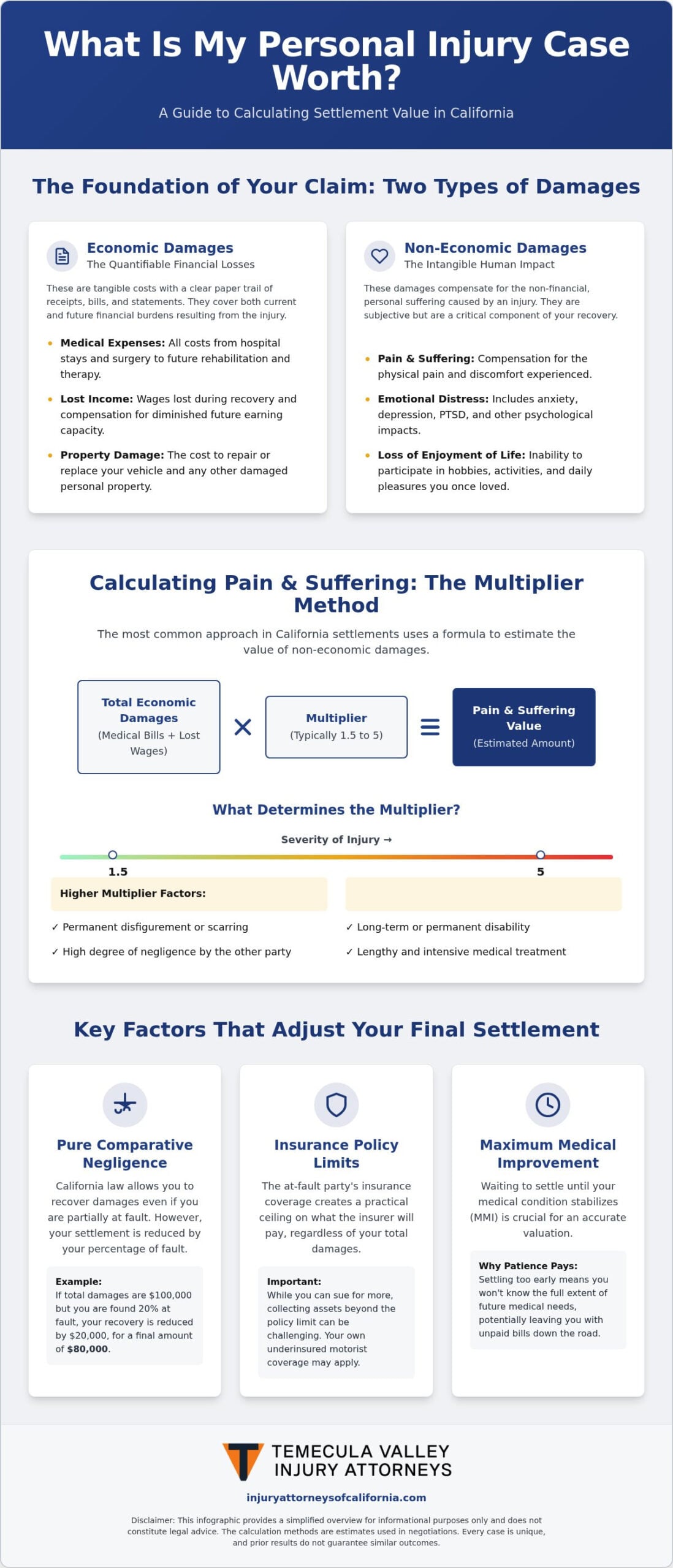
The Multiplier Method is the most common approach for California settlements. It involves taking the total sum of your economic damages (medical bills and lost wages) and multiplying that figure by a number between 1.5 and 5. The multiplier method serves as a standard negotiation starting point, where the specific factor depends on the severity of your injuries. Several factors can justify a higher multiplier, including:

  • Permanent disfigurement or scarring.
  • Long-term or permanent disability.
  • The degree of the other party’s negligence.
  • The length and intensity of your medical treatment.

The Per Diem Approach

The Per Diem method assigns a specific daily dollar value to your recovery period. “Per diem” is Latin for “by the day.” Under this approach, a dollar amount is assigned for every day from the date of the accident until you reach Maximum Medical Improvement (MMI). This rate is often based on your actual daily earnings or what a jury might consider a reasonable daily rate for enduring pain. This method is frequently used for shorter recovery periods where the daily impact on your life is high and easily demonstrated. If you’re unsure which method applies to your situation, you can schedule a free case evaluation to discuss your specific damages.

It’s important to recognize that insurance companies often use software like Colossus to evaluate claims. These programs are designed to minimize payouts by stripping away the human element of your story. Temecula Valley Injury Attorneys works to counter these digital estimates with real-world evidence. We focus on the details that software ignores, ensuring that your settlement reflects the true impact of the accident on your daily life.

External Factors That May Reduce or Increase Your Settlement

Even with clear medical documentation, the final value of your claim isn’t determined in a vacuum. External variables, legal rules, and insurance realities often shift the needle. When you’re trying to figure out what is my personal injury case worth, you have to look beyond your bills and consider how California’s specific laws and the available insurance coverage interact with your story. This Forbes guide to settlement values highlights how these outside factors often dictate the strategy we use during negotiations.

California’s Pure Comparative Negligence Rule

California follows a “pure comparative negligence” standard, established in the landmark case Li v. Yellow Cab Co. This rule is a double edged sword for victims. On one hand, you can recover damages even if you were 99% at fault for the incident. On the other hand, your final award is reduced by your exact percentage of responsibility. If a jury determines your total damages are $100,000 but finds you 20% at fault for the crash, you’ll only receive $80,000.

This rule is particularly critical in motorcycle accident claims. Riders often face an unfair social bias from insurance adjusters who assume they were speeding or weaving through traffic. Proving the other party’s full liability is essential for protecting the maximum value of your claim. We focus on gathering forensic evidence and witness statements to counter these biases and ensure your percentage of fault is as low as possible.

The Impact of Insurance Policy Limits

In many cases, the at fault party’s insurance policy acts as a “ceiling” for your recovery. As of January 1, 2025, California’s minimum liability requirements increased to 30/60/15. This means a standard driver may only have $30,000 in coverage for bodily injury to a single person. If your medical bills and lost wages total $100,000, that $30,000 limit can create a significant gap in your recovery.

However, the situation changes when dealing with commercial truck accident policies, which generally carry much higher limits, often in the millions. When damages exceed a standard policy limit, we look for other avenues of recovery, such as your own Uninsured/Underinsured Motorist (UM/UIM) coverage. This part of your policy is designed to step in and cover the difference when the other driver’s insurance is insufficient to meet your needs.

Finally, the location where you file your claim can influence the outcome. Jury trends in San Diego can differ from those in El Centro or Riverside County. Our local knowledge of these specific court systems allows us to tailor our approach based on regional tendencies. Whether it’s the strength of a specific witness or the way local juries view “pain and suffering,” these nuances play a major role in determining what is my personal injury case worth in a Southern California courtroom.
What Is My Personal Injury Case Worth? A Guide to California Settlements

The Settlement Timeline: Why Patience Increases Value

Patience is often the most difficult part of the recovery process. When bills are mounting and income is scarce, a quick settlement offer from an insurance company can feel like a lifeline. However, settling too early is the primary reason victims receive significantly less than their claim’s actual value. To accurately determine what is my personal injury case worth, we must first understand the full extent of your physical and financial recovery. Rushing to sign a release form can permanently bar you from seeking additional compensation if new complications arise later.

While you wait for your medical status to stabilize, you must remain aware of California’s legal deadlines. Under California Code of Civil Procedure §335.1, you generally have two years from the date of the injury to file a lawsuit. If your claim involves a wrongful death, that two year clock usually starts on the date of the person’s death. However, exceptions apply. If your claim involves a government entity, you must file an administrative claim within six months. Claims involving minors may also follow different rules. Staying mindful of these dates ensures your right to compensation remains protected while you focus on healing.

Reaching Maximum Medical Improvement (MMI)

MMI is the clinical point where your condition has stabilized as much as medically possible. It doesn’t necessarily mean you are 100% healed; it means your doctors don’t expect further significant improvement. Reaching this milestone is a prerequisite for an accurate valuation. Until you hit MMI, we cannot know if you will require lifelong physical therapy, future surgeries, or specialized home equipment. We work with medical experts to forecast these long term care costs, ensuring they are included in your demand. Never sign a settlement release until your future medical needs are fully documented.

The Negotiation and Litigation Process

The timeline for slip and fall settlements and other injury claims in Southern California varies based on the complexity of the evidence. Most cases begin with a formal demand letter. This starts a back and forth process of offers and counter offers. If the insurance company refuses to offer a fair amount, filing a lawsuit often serves as a powerful motivator. Litigation shows the insurer that you are serious about your recovery, which can lead to a higher settlement offer during the discovery phase.

If you are concerned about mounting deadlines or want a realistic look at what is my personal injury case worth based on your specific injuries, you should contact us for a free case evaluation today. We take the burden of the timeline off your shoulders so you can prioritize your health.

How Temecula Valley Injury Attorneys Evaluates Your Claim

At Temecula Valley Injury Attorneys, we don’t guess when it comes to your financial security. We use a meticulous, evidence-based approach to determine the potential value of your claim. This involves a deep dive into your medical history, employment records, and the specific circumstances of your accident. Because we have verified offices in Temecula, San Diego, and El Centro, we bring a strategic local advantage to every case. We understand the specific tendencies of Riverside and San Diego County courts, which directly impacts how we answer the question: what is my personal injury case worth?

Our Personable and Professional Approach

We treat you like a neighbor because you are one. Our firm strikes a balance between technical legal expertise and the familial warmth you deserve during a crisis. You’ll have direct access to our legal team to discuss the specific details of your wrongful death or catastrophic injury claim. We focus on identifying “hidden” damages that insurance companies often ignore. This might include the cost of household services you can no longer perform or the long-term emotional toll of a permanent disability. We handle all communication with insurance adjusters so you can focus entirely on your physical recovery.

Next Steps: Your Free Case Evaluation

Generic online calculators often provide misleading figures that don’t account for California’s specific legal landscape. We provide a realistic assessment based on established facts rather than automated estimates. To get the most out of your consultation, please bring any available documentation, including:

  • Official police or CHP reports from the accident.
  • Detailed medical records and diagnostic images.
  • Photos of the accident scene and your visible injuries.
  • Correspondence or settlement offers from insurance companies.

Knowing what is my personal injury case worth starts with a professional review of these materials. We’re here to ensure you aren’t pressured into a low-ball settlement that fails to cover your future needs. Our goal is to provide certainty through informed decision-making. You can schedule a free case evaluation by calling 951-289-0628 or visiting our website today. Our commitment is to protect your integrity and your future by serving as your watchful legal partner.

Protecting Your Future with Informed Decisions

Understanding what is my personal injury case worth is the first step toward regaining your financial stability. Your final settlement generally depends on reaching Maximum Medical Improvement, navigating California’s pure comparative negligence rules, and countering the low-ball software estimates used by insurance adjusters. These calculations are complex, but you don’t have to face them alone. Our team brings deep experience in Southern California court systems to every case we handle.

Temecula Valley Injury Attorneys provides professional, client-focused representation with verified offices in Temecula, San Diego, and El Centro. We act as your protective partner, handling the technical legal details so you can focus on your health and your family. If you’re ready for a realistic assessment based on the specific facts of your accident, we’re here to help. Schedule a free case evaluation with Temecula Valley Injury Attorneys to start the process. You deserve a recovery that reflects the true impact of your injuries, and we’re committed to helping you achieve it.

Frequently Asked Questions

Is there a minimum settlement amount for personal injury in California?

No, there is no state-mandated minimum settlement amount for personal injury claims in California. Every settlement is a unique calculation based on your specific medical expenses, lost income, and the available insurance coverage. While small claims court is limited to $12,500 for individuals as of 2024, most formal personal injury claims involve much higher stakes. Determining what is my personal injury case worth requires a professional review of your medical records and the other party’s liability.

How much does a personal injury lawyer cost in Temecula?

Most personal injury attorneys in Temecula and Southern California work on a contingency fee basis. This means you don’t pay upfront costs or hourly rates for legal services. Instead, the firm receives a percentage of the final settlement or verdict. If your attorney doesn’t recover compensation for you, you generally won’t owe attorney fees. This model ensures that professional legal representation remains accessible to everyone, regardless of their current financial situation during recovery.

Can I still get money if I was partially at fault for the accident?

Yes, you can still recover compensation even if you were partially at fault for the incident. California uses a pure comparative negligence system, which means your final financial award is reduced by your percentage of responsibility. For example, if your damages are $50,000 but you are found 30% responsible, you could still receive $35,000. We work to gather evidence that minimizes your assigned fault and protects the total value of your recovery.

What is the average settlement for a car accident with soft tissue injuries?

There is no universal average settlement for soft tissue injuries like whiplash or sprains. These cases generally depend on the length of your medical treatment and how the injury affects your daily life. A soft tissue injury that requires months of physical therapy and prevents you from working could be valued higher than one that heals in two weeks. We look at the specific impact on your quality of life to build a persuasive case.

How long does it take to receive my settlement check after a case closes?

You can generally expect to receive your settlement check within four to six weeks after the insurance company receives the signed release form. The insurance company must first process the paperwork and issue the payment to your attorney’s trust account. Once medical liens and legal fees are settled, the remaining funds are distributed to you. We maintain constant communication with adjusters to ensure this final stage of the process moves as quickly as possible.

Will my personal injury settlement be taxed by the IRS or California?

Generally, the IRS and the State of California do not tax personal injury settlements intended to compensate for physical injuries or sickness. This includes money for medical bills, pain and suffering, and emotional distress stemming from a physical injury. However, if a portion of your settlement is specifically for punitive damages or interest on an award, that specific amount could be taxable. It is always wise to consult with a tax professional regarding your final settlement.

What happens if my medical bills are higher than the insurance policy limits?

If your medical bills exceed the at-fault party’s insurance limits, you may have other options for recovery. You could potentially use your own Uninsured/Underinsured Motorist (UM/UIM) coverage to bridge the gap. In some cases, we may identify additional liable parties or commercial policies that provide higher limits. Understanding what is my personal injury case worth involves looking at every possible source of insurance to cover your total losses and future care.

Do most personal injury cases in San Diego go to trial?

No, the vast majority of personal injury cases in San Diego and across California settle out of court before ever reaching a trial. While we prepare every case as if it might go to a jury, a negotiated settlement is often faster and less stressful for the victim. However, if an insurance company refuses to offer a fair amount, we are fully prepared to take your case to trial to protect your right to full compensation.

SERVING TEMECULA AND THE SAN DIEGO METRO

What if the “final offer” currently sitting on your desk is only a small fraction of what you truly need to recover? If you are asking what is my personal injury case worth, the answer is not a single number found on a static chart. In California, your settlement value generally depends on a combination of your total medical expenses, lost income, and the long-term impact on your quality of life. Insurance adjusters often push for quick, low-ball settlements while you are still in the middle of recovery. Your actual case value could be much higher once you factor in future care and the state’s specific liability rules.

We understand the weight of mounting bills and the stress of being away from your job. This guide provides a practical look at how legal professionals calculate damages, including the 2025 increases in California minimum insurance coverage and pure comparative negligence standards. You will learn how to identify the specific evidence that strengthens a claim and when it makes sense to have a protective partner evaluate your case. This overview offers the clarity you need to move forward with confidence and professional certainty.

Key Takeaways

  • Identify the specific economic and non-economic damages that could form the foundation of your legal recovery.
  • Understand the formulas, such as the Multiplier Method, that legal professionals generally use to estimate pain and suffering.
  • Learn how California’s pure comparative negligence laws and insurance policy limits directly impact what is my personal injury case worth.
  • Discover why waiting for Maximum Medical Improvement (MMI) may significantly increase the accuracy and value of your final settlement.
  • Gain insight into how local legal knowledge in Southern California provides a protective advantage against aggressive insurance tactics.

The Components of a California Personal Injury Claim

The foundation of any legal settlement is the legal definition of damages. This term refers to the compensation meant to restore you to the position you were in before the incident occurred. When you ask what is my personal injury case worth, you’re essentially looking for the sum of your economic and non-economic losses. California law generally allows victims to recover both types of compensation, but the burden of proof rests on you to provide specific evidence for every dollar claimed.

Calculating Economic Damages: The Paper Trail

Economic damages are the quantifiable financial losses that leave a clear trail of receipts, invoices, and bank statements. These are often the most straightforward part of a claim because they have a fixed dollar value. However, calculating them accurately requires looking beyond your current bills. We look at the total financial impact, which may include:

  • Medical Expenses: This covers current hospital stays, surgeries, and prescriptions. It also includes future costs like long-term rehabilitation, physical therapy, or specialized medical equipment needed for home care.
  • Lost Income: You can claim the wages you lost while recovering. If your injuries are severe, you may also be entitled to compensation for a loss of earning capacity if you can no longer perform your previous job duties.
  • Property Damage: These costs involve vehicle repairs or the total replacement value of your car, which is common in car accident cases.

The strength of these claims depends on a meticulous paper trail. Temecula Valley Injury Attorneys helps you organize these records to ensure that insurance adjusters don’t overlook your out-of-pocket expenses.

Understanding Non-Economic Damages

Non-economic damages address the intangible, human impact of an injury. While these losses don’t come with a receipt, they’re often the most significant part of a victim’s experience. California law recognizes that physical injuries cause more than just financial strain. These damages could include compensation for physical pain, the loss of enjoyment of life, and the inability to participate in hobbies you once loved.

Mental health is another critical component. Victims often experience emotional distress, chronic anxiety, or PTSD following a catastrophic accident. In California, juries generally look for “objective” signs of “subjective” pain. This means your personal testimony, supported by medical records that describe your physical limitations, becomes the primary evidence. Determining what is my personal injury case worth requires a professional evaluation of these subjective factors to ensure your settlement reflects the true cost of your recovery.

How Attorneys Calculate Pain and Suffering in 2026

Determining the financial value of physical pain and emotional trauma is a nuanced process. Unlike a hospital bill, there is no fixed price for the loss of a night’s sleep or the inability to hold your child after an accident. To provide clarity on what is my personal injury case worth, attorneys and insurance adjusters generally rely on two established calculation models. These methods help translate subjective experiences into objective dollar amounts that can be used during settlement negotiations.

The California Civil Jury Instructions for personal injury damages serve as the official guide for how juries should weigh these intangible losses. While these instructions don’t provide a specific math formula, they authorize compensation for “past and future physical pain, mental suffering, and loss of enjoyment of life.” To reach a settlement before a trial, we typically utilize the Multiplier or Per Diem methods to build a persuasive argument for your recovery.

The Multiplier Method Explained

The Multiplier Method is the most common approach for California settlements. It involves taking the total sum of your economic damages (medical bills and lost wages) and multiplying that figure by a number between 1.5 and 5. The multiplier method serves as a standard negotiation starting point, where the specific factor depends on the severity of your injuries. Several factors can justify a higher multiplier, including:

  • Permanent disfigurement or scarring.
  • Long-term or permanent disability.
  • The degree of the other party’s negligence.
  • The length and intensity of your medical treatment.

The Per Diem Approach

The Per Diem method assigns a specific daily dollar value to your recovery period. “Per diem” is Latin for “by the day.” Under this approach, a dollar amount is assigned for every day from the date of the accident until you reach Maximum Medical Improvement (MMI). This rate is often based on your actual daily earnings or what a jury might consider a reasonable daily rate for enduring pain. This method is frequently used for shorter recovery periods where the daily impact on your life is high and easily demonstrated. If you’re unsure which method applies to your situation, you can schedule a free case evaluation to discuss your specific damages.

It’s important to recognize that insurance companies often use software like Colossus to evaluate claims. These programs are designed to minimize payouts by stripping away the human element of your story. Temecula Valley Injury Attorneys works to counter these digital estimates with real-world evidence. We focus on the details that software ignores, ensuring that your settlement reflects the true impact of the accident on your daily life.

External Factors That May Reduce or Increase Your Settlement

Even with clear medical documentation, the final value of your claim isn’t determined in a vacuum. External variables, legal rules, and insurance realities often shift the needle. When you’re trying to figure out what is my personal injury case worth, you have to look beyond your bills and consider how California’s specific laws and the available insurance coverage interact with your story. This Forbes guide to settlement values highlights how these outside factors often dictate the strategy we use during negotiations.

California’s Pure Comparative Negligence Rule

California follows a “pure comparative negligence” standard, established in the landmark case Li v. Yellow Cab Co. This rule is a double edged sword for victims. On one hand, you can recover damages even if you were 99% at fault for the incident. On the other hand, your final award is reduced by your exact percentage of responsibility. If a jury determines your total damages are $100,000 but finds you 20% at fault for the crash, you’ll only receive $80,000.

This rule is particularly critical in motorcycle accident claims. Riders often face an unfair social bias from insurance adjusters who assume they were speeding or weaving through traffic. Proving the other party’s full liability is essential for protecting the maximum value of your claim. We focus on gathering forensic evidence and witness statements to counter these biases and ensure your percentage of fault is as low as possible.

The Impact of Insurance Policy Limits

In many cases, the at fault party’s insurance policy acts as a “ceiling” for your recovery. As of January 1, 2025, California’s minimum liability requirements increased to 30/60/15. This means a standard driver may only have $30,000 in coverage for bodily injury to a single person. If your medical bills and lost wages total $100,000, that $30,000 limit can create a significant gap in your recovery.

However, the situation changes when dealing with commercial truck accident policies, which generally carry much higher limits, often in the millions. When damages exceed a standard policy limit, we look for other avenues of recovery, such as your own Uninsured/Underinsured Motorist (UM/UIM) coverage. This part of your policy is designed to step in and cover the difference when the other driver’s insurance is insufficient to meet your needs.

Finally, the location where you file your claim can influence the outcome. Jury trends in San Diego can differ from those in El Centro or Riverside County. Our local knowledge of these specific court systems allows us to tailor our approach based on regional tendencies. Whether it’s the strength of a specific witness or the way local juries view “pain and suffering,” these nuances play a major role in determining what is my personal injury case worth in a Southern California courtroom.

What Is My Personal Injury Case Worth? A Guide to California Settlements

The Settlement Timeline: Why Patience Increases Value

Patience is often the most difficult part of the recovery process. When bills are mounting and income is scarce, a quick settlement offer from an insurance company can feel like a lifeline. However, settling too early is the primary reason victims receive significantly less than their claim’s actual value. To accurately determine what is my personal injury case worth, we must first understand the full extent of your physical and financial recovery. Rushing to sign a release form can permanently bar you from seeking additional compensation if new complications arise later.

While you wait for your medical status to stabilize, you must remain aware of California’s legal deadlines. Under California Code of Civil Procedure §335.1, you generally have two years from the date of the injury to file a lawsuit. If your claim involves a wrongful death, that two year clock usually starts on the date of the person’s death. However, exceptions apply. If your claim involves a government entity, you must file an administrative claim within six months. Claims involving minors may also follow different rules. Staying mindful of these dates ensures your right to compensation remains protected while you focus on healing.

Reaching Maximum Medical Improvement (MMI)

MMI is the clinical point where your condition has stabilized as much as medically possible. It doesn’t necessarily mean you are 100% healed; it means your doctors don’t expect further significant improvement. Reaching this milestone is a prerequisite for an accurate valuation. Until you hit MMI, we cannot know if you will require lifelong physical therapy, future surgeries, or specialized home equipment. We work with medical experts to forecast these long term care costs, ensuring they are included in your demand. Never sign a settlement release until your future medical needs are fully documented.

The Negotiation and Litigation Process

The timeline for slip and fall settlements and other injury claims in Southern California varies based on the complexity of the evidence. Most cases begin with a formal demand letter. This starts a back and forth process of offers and counter offers. If the insurance company refuses to offer a fair amount, filing a lawsuit often serves as a powerful motivator. Litigation shows the insurer that you are serious about your recovery, which can lead to a higher settlement offer during the discovery phase.

If you are concerned about mounting deadlines or want a realistic look at what is my personal injury case worth based on your specific injuries, you should contact us for a free case evaluation today. We take the burden of the timeline off your shoulders so you can prioritize your health.

How Temecula Valley Injury Attorneys Evaluates Your Claim

At Temecula Valley Injury Attorneys, we don’t guess when it comes to your financial security. We use a meticulous, evidence-based approach to determine the potential value of your claim. This involves a deep dive into your medical history, employment records, and the specific circumstances of your accident. Because we have verified offices in Temecula, San Diego, and El Centro, we bring a strategic local advantage to every case. We understand the specific tendencies of Riverside and San Diego County courts, which directly impacts how we answer the question: what is my personal injury case worth?

Our Personable and Professional Approach

We treat you like a neighbor because you are one. Our firm strikes a balance between technical legal expertise and the familial warmth you deserve during a crisis. You’ll have direct access to our legal team to discuss the specific details of your wrongful death or catastrophic injury claim. We focus on identifying “hidden” damages that insurance companies often ignore. This might include the cost of household services you can no longer perform or the long-term emotional toll of a permanent disability. We handle all communication with insurance adjusters so you can focus entirely on your physical recovery.

Next Steps: Your Free Case Evaluation

Generic online calculators often provide misleading figures that don’t account for California’s specific legal landscape. We provide a realistic assessment based on established facts rather than automated estimates. To get the most out of your consultation, please bring any available documentation, including:

  • Official police or CHP reports from the accident.
  • Detailed medical records and diagnostic images.
  • Photos of the accident scene and your visible injuries.
  • Correspondence or settlement offers from insurance companies.

Knowing what is my personal injury case worth starts with a professional review of these materials. We’re here to ensure you aren’t pressured into a low-ball settlement that fails to cover your future needs. Our goal is to provide certainty through informed decision-making. You can schedule a free case evaluation by calling 951-289-0628 or visiting our website today. Our commitment is to protect your integrity and your future by serving as your watchful legal partner.

Protecting Your Future with Informed Decisions

Understanding what is my personal injury case worth is the first step toward regaining your financial stability. Your final settlement generally depends on reaching Maximum Medical Improvement, navigating California’s pure comparative negligence rules, and countering the low-ball software estimates used by insurance adjusters. These calculations are complex, but you don’t have to face them alone. Our team brings deep experience in Southern California court systems to every case we handle.

Temecula Valley Injury Attorneys provides professional, client-focused representation with verified offices in Temecula, San Diego, and El Centro. We act as your protective partner, handling the technical legal details so you can focus on your health and your family. If you’re ready for a realistic assessment based on the specific facts of your accident, we’re here to help. Schedule a free case evaluation with Temecula Valley Injury Attorneys to start the process. You deserve a recovery that reflects the true impact of your injuries, and we’re committed to helping you achieve it.

Frequently Asked Questions

Is there a minimum settlement amount for personal injury in California?

No, there is no state-mandated minimum settlement amount for personal injury claims in California. Every settlement is a unique calculation based on your specific medical expenses, lost income, and the available insurance coverage. While small claims court is limited to $12,500 for individuals as of 2024, most formal personal injury claims involve much higher stakes. Determining what is my personal injury case worth requires a professional review of your medical records and the other party’s liability.

How much does a personal injury lawyer cost in Temecula?

Most personal injury attorneys in Temecula and Southern California work on a contingency fee basis. This means you don’t pay upfront costs or hourly rates for legal services. Instead, the firm receives a percentage of the final settlement or verdict. If your attorney doesn’t recover compensation for you, you generally won’t owe attorney fees. This model ensures that professional legal representation remains accessible to everyone, regardless of their current financial situation during recovery.

Can I still get money if I was partially at fault for the accident?

Yes, you can still recover compensation even if you were partially at fault for the incident. California uses a pure comparative negligence system, which means your final financial award is reduced by your percentage of responsibility. For example, if your damages are $50,000 but you are found 30% responsible, you could still receive $35,000. We work to gather evidence that minimizes your assigned fault and protects the total value of your recovery.

What is the average settlement for a car accident with soft tissue injuries?

There is no universal average settlement for soft tissue injuries like whiplash or sprains. These cases generally depend on the length of your medical treatment and how the injury affects your daily life. A soft tissue injury that requires months of physical therapy and prevents you from working could be valued higher than one that heals in two weeks. We look at the specific impact on your quality of life to build a persuasive case.

How long does it take to receive my settlement check after a case closes?

You can generally expect to receive your settlement check within four to six weeks after the insurance company receives the signed release form. The insurance company must first process the paperwork and issue the payment to your attorney’s trust account. Once medical liens and legal fees are settled, the remaining funds are distributed to you. We maintain constant communication with adjusters to ensure this final stage of the process moves as quickly as possible.

Will my personal injury settlement be taxed by the IRS or California?

Generally, the IRS and the State of California do not tax personal injury settlements intended to compensate for physical injuries or sickness. This includes money for medical bills, pain and suffering, and emotional distress stemming from a physical injury. However, if a portion of your settlement is specifically for punitive damages or interest on an award, that specific amount could be taxable. It is always wise to consult with a tax professional regarding your final settlement.

What happens if my medical bills are higher than the insurance policy limits?

If your medical bills exceed the at-fault party’s insurance limits, you may have other options for recovery. You could potentially use your own Uninsured/Underinsured Motorist (UM/UIM) coverage to bridge the gap. In some cases, we may identify additional liable parties or commercial policies that provide higher limits. Understanding what is my personal injury case worth involves looking at every possible source of insurance to cover your total losses and future care.

Do most personal injury cases in San Diego go to trial?

No, the vast majority of personal injury cases in San Diego and across California settle out of court before ever reaching a trial. While we prepare every case as if it might go to a jury, a negotiated settlement is often faster and less stressful for the victim. However, if an insurance company refuses to offer a fair amount, we are fully prepared to take your case to trial to protect your right to full compensation.