

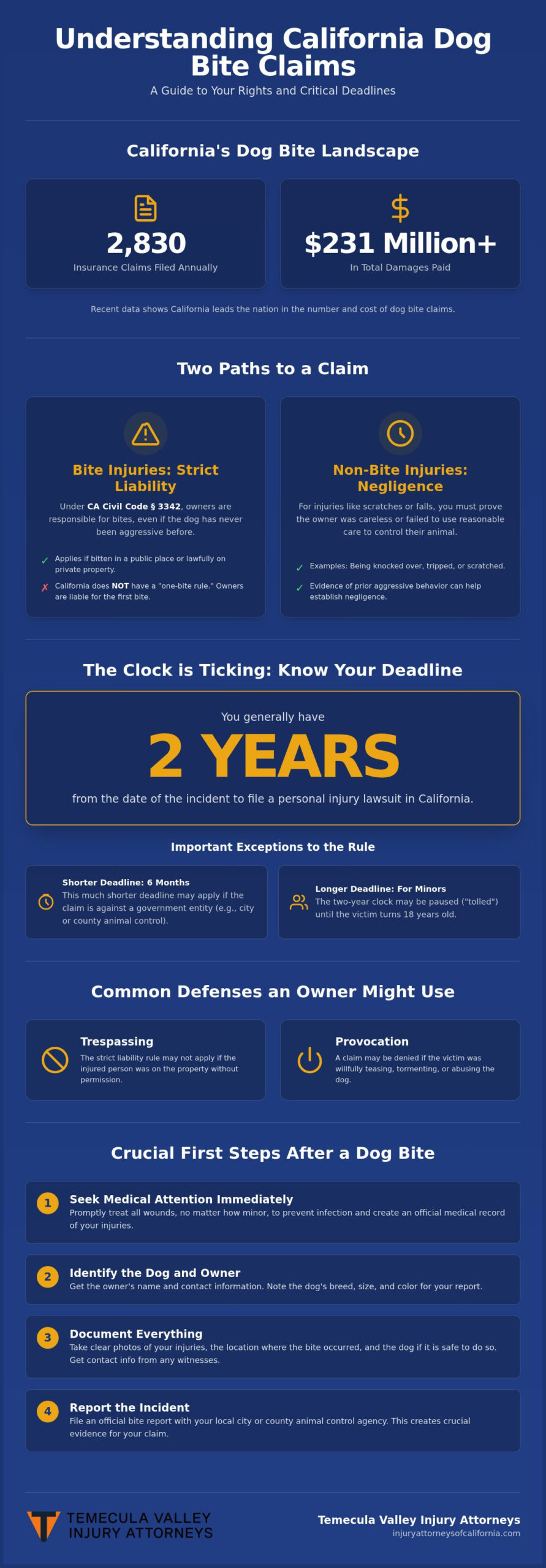
In 2025, California led the nation with 2,830 dog bite insurance claims, totaling more than $231 million in damages. This startling figure reflects a painful reality for many families across the state. If you’re dealing with a deep puncture wound or the fear of permanent scarring, you could be feeling overwhelmed by rising medical bills and complex legal questions. You might also feel anxious about how a claim could impact your relationship with a neighbor. Understanding the statute of limitations for dog bite California cases is your first step toward reclaiming your peace of mind. While you generally have two years to file, certain exceptions could require action in as little as six months.
At Temecula Valley Injury Attorneys, we believe you shouldn’t have to navigate this stress alone. We’re here to explain how California Civil Code Section 3342 holds owners strictly liable, even if their dog has never been aggressive before. This guide will walk you through the specific steps you should take to protect your recovery and hold responsible parties accountable. We’ll preview the critical legal deadlines for 2026, the difference between bite and non-bite injuries, and how a meticulous legal partner can handle insurance adjusters while you focus on your health.
Key Takeaways
- Learn how California Civil Code 3342 holds owners strictly liable for bites, even if the dog has no prior history of aggression.
- Understand the two-year statute of limitations for dog bite California claims, including how timelines may be extended for minors or shortened for government entities.
- Distinguish between strict liability for bites and the negligence standard used for non-bite injuries like scratches or falls.
- Identify common defenses like provocation or trespassing that may impact your ability to recover medical expenses.
- Review the essential medical and legal steps you must take immediately following an incident to protect your health and your claim.
Understanding California Civil Code Section 3342 and Strict Liability
California Civil Code Section 3342 serves as the primary shield for victims of animal attacks. This law establishes “strict liability.” It means a dog owner is responsible for damages if their animal bites someone in a public place or while the victim is lawfully on private property. You don’t have to prove the owner was negligent or careless. The simple fact that the bite occurred is often enough to establish a claim. This clarity is essential for your recovery, but remember that the statute of limitations for dog bite California cases generally gives you two years from the date of the incident to file a lawsuit. Waiting too long can jeopardize your ability to hold the owner accountable.
Many people believe in the “one-bite rule,” which suggests a dog gets one “free” attack before the owner is liable. In California, this is a myth. Owners are responsible for the very first bite, regardless of the dog’s prior behavior. It doesn’t matter if the dog never showed aggression before or if the owner believed the animal was perfectly safe. The law prioritizes the victim’s safety over the owner’s knowledge. At Temecula Valley Injury Attorneys, we’ve seen how this technical distinction provides vital protection for our neighbors in Southern California. If you’ve been hurt, you can learn more about your rights on our dog bite representation page.
What Constitutes a ‘Bite’ Under California Law?
A legal “bite” is more than just a visible wound. California courts have determined that the skin does not need to be broken for an incident to qualify. A bite occurs whenever a dog closes its jaws around a person, often described as the “clamping of teeth.” Even if the animal only grabbed your clothing and bruised the skin underneath, it can still meet the legal definition. We recommend documenting the immediate physical sensation and any marks. This evidence is critical when our team negotiates with insurance companies to ensure they respect the severity of the encounter.
Lawful Presence on Private Property
To benefit from strict liability, you must be in a public space or on private property lawfully. This includes guests invited for a backyard BBQ or neighbors stopping by to chat. The law also covers individuals performing a legal duty. For example, postal workers and delivery drivers for companies like Amazon or FedEx are protected while they are on a property to complete a delivery. However, your status could change if you enter a restricted area without permission. If a visitor transitions from a guest to a trespasser, the owner might no longer be held strictly liable. Understanding how these rules interact with the statute of limitations for dog bite California ensures that delivery professionals and guests alike don’t lose their right to compensation due to technical delays.
Does the ‘One-Bite Rule’ or Negligence Apply to Your Case?
While strict liability is the gold standard for bite cases, non-bite injuries require a different legal path. If a neighbor’s dog knocks you over in Murrieta or causes a fall in Temecula, you must prove negligence. This means demonstrating that the owner failed to exercise reasonable care in controlling their animal. It is a common situation; dog injuries actually account for one-third of all homeowners insurance liability claims. Even when a bite isn’t involved, the statute of limitations for dog bite California claims still applies to your personal injury filing. You generally have two years to act, so don’t let the lack of a “bite” delay your search for answers. Keeping track of the statute of limitations for dog bite California is essential to ensure you don’t lose the right to pursue compensation for medical bills or therapy.
Injuries Caused by Dog Behavior (Non-Bite)
Not every injury involves a puncture wound. A child might be traumatized by a dog jumping on them, or an elderly person could suffer a hip fracture after being tripped by an overexcited pet. In these scenarios, the law requires you to show the owner was careless rather than just being the owner of the dog. This is how Temecula Valley Injury Attorneys investigates these complex claims. We look for evidence that the owner knew the dog had a habit of jumping or was off-leash in an area where it should have been restrained. Our goal is to protect your recovery by proving the owner didn’t meet their responsibility to the community.
Negligence Per Se and Leash Law Violations
Local ordinances in San Diego or Fallbrook can make your case much stronger. If an owner violates a local leash law and their dog causes an injury, the court may apply “negligence per se.” This legal doctrine suggests that by breaking the law, the owner was automatically negligent. Whether the incident happened at a local park in Temecula or a sidewalk in San Diego, we check every local ordinance. For instance, Riverside County has strict leash requirements for dogs in public places. If a dog is roaming “at-large” and causes a bicycle accident or a pedestrian fall, the owner’s liability could be clear. We meticulously review animal control records and witness statements to establish these violations. If you’ve been hurt by an at-large dog, you can reach out to our team to discuss how local rules could impact your claim.
Common Defenses: Trespassing and Provocation in Dog Bite Claims
California’s strict liability rule is a powerful tool for victims, but it doesn’t mean an owner is automatically forced to pay in every situation. Legal defenses exist that can complicate your path to recovery. According to California Civil Code Section 3342, the owner is liable only if the victim was in a public place or “lawfully” on private property. This means trespassing is often used as a primary defense. If someone enters a yard without permission, they might lose the protection of strict liability. Additionally, the law provides exceptions for police or military dogs performing their duties. Even as you navigate these defenses, you must keep the statute of limitations for dog bite California in mind. Missing the two-year deadline can end your case before it even starts.
Comparative fault is another factor that could impact your claim. Under this doctrine, if a court finds you were 25% responsible for the incident, your final compensation could be reduced by that same amount. At Temecula Valley Injury Attorneys, we’ve seen insurance companies try to shift blame onto victims to save money. We work to ensure your story is told accurately so your recovery isn’t unfairly diminished. Staying organized and acting within the statute of limitations for dog bite California ensures we have the time needed to counter these tactics effectively.
What Legally Counts as Provocation?
Provocation is a common defense where the owner claims the victim teased or hit the animal. There’s a big difference between accidentally stepping on a tail and intentionally tormenting a dog. California law is particularly protective of young children; kids under five are generally considered incapable of legal provocation. They don’t understand the consequences of their actions the same way adults do. Witness statements are vital here. If a neighbor saw that you were simply walking by when the dog attacked, their testimony can debunk an owner’s claim of provocation. We prioritize gathering these accounts early while memories are fresh.
The Scope of Invitation in Residential Areas
Being a guest doesn’t give you an “all-access pass” to a neighbor’s property. An invitation to the front porch doesn’t always extend to the fenced backyard. If a guest wanders into a restricted area, the owner might argue they were no longer a “lawful” visitor. You might wonder if a “Beware of Dog” sign protects an owner. Usually, it doesn’t. A sign doesn’t cancel out strict liability if the victim was invited onto the premises. Children often don’t see fences as barriers, and the law sometimes treats them with more leniency. If your child was hurt, our dog bite legal team can help determine if the owner’s defenses hold water.
Practical Steps After a Dog Bite in Southern California
The moments following an animal attack are often chaotic and frightening. Your first priority must be seeking medical attention. Even a seemingly minor puncture wound carries a high risk of infection from bacteria like Pasteurella. Beyond your physical health, a doctor’s visit creates a formal medical record that serves as the foundation of your legal recovery. While you focus on healing, keep in mind that the statute of limitations for dog bite California is already running. Acting quickly ensures that your medical documentation is fresh and undeniable when it comes time to file a claim.
Once you are safe, identify the dog and its owner. Request their contact information and homeowners insurance details. If the owner is uncooperative, try to note the address where the dog lives or take a photo of the individual. Documenting the scene is equally vital. Take clear photos of the dog, the location of the attack, and your injuries from multiple angles. These images provide powerful visual evidence that insurance adjusters cannot easily dismiss during negotiations. This documentation helps us build a robust case well before the two-year statute of limitations for dog bite California expires.
Reporting to Local Animal Control Authorities
Reporting the incident is a critical matter of public safety. For those in Temecula or Murrieta, you should contact Riverside County Animal Services. If the bite occurred further south, reach out to San Diego County Animal Services. These agencies create an official report that documents the incident independently of your own account. In California, a bite report usually triggers a mandatory 10-day quarantine for the dog to monitor for rabies. This official paper trail is invaluable for establishing the facts of the case and ensuring the animal does not hurt anyone else in our community.
Preserving Evidence for Your Claim
Physical evidence is fragile and can disappear quickly. Keep the clothing you wore during the attack. Do not wash it; bloodstains, saliva, and torn fabric tell a vivid story of the attack’s violence. We also recommend starting a “pain journal.” Document your daily physical pain levels and any emotional struggles, such as new anxieties or sleep disturbances. This helps quantify your suffering later. Finally, look for digital surveillance. Neighbors often have Ring cameras, and local businesses may have security footage that captured the incident. This data is often overwritten within days, so securing it immediately is a top priority. If you need help gathering this evidence or communicating with animal control, contact Temecula Valley Injury Attorneys today for a free case evaluation.
Disclaimer: This information is for educational purposes and does not constitute legal advice. No attorney-client relationship is formed by reading this content.
Statute of Limitations and How Temecula Valley Injury Attorneys Can Help
California law sets a strict clock on your recovery. For most personal injury cases, including animal attacks, the statute of limitations for dog bite California is two years from the date of the incident. This deadline, established under California Code of Civil Procedure Section 335.1, is firm. If you fail to file a lawsuit within this window, you lose your right to seek compensation forever. However, if the dog involved belongs to a government entity, such as a K9 unit or a municipal animal shelter, the timeline is much shorter. You may only have six months to file a formal administrative claim. Acting with a sense of urgency is the only way to ensure these technicalities don’t derail your path to healing.
If a child was bitten, the rules change to protect the minor. The statute of limitations for dog bite California is typically “tolled,” or paused, until the child turns 18. Once they reach adulthood, the two-year clock begins to run. While this provides extra time, we don’t recommend waiting. Evidence disappears, and witnesses move away. At Temecula Valley Injury Attorneys, we take a proactive approach. We handle the complex paperwork and aggressive insurance adjusters so you can focus entirely on your physical and emotional recovery. Our team acts as your protective partner, ensuring every deadline is met with precision.
Navigating Claims with Neighbors and Friends
Many victims hesitate to take action because the dog belongs to a friend, family member, or neighbor. You don’t want to cause financial ruin for someone you care about. It’s vital to understand that in the vast majority of cases, homeowner’s or renter’s insurance pays for the recovery, not the individual. We maintain a professional, calm tone in every interaction to preserve your personal relationships while still seeking the fair compensation you deserve. Scheduling a free case evaluation early allows us to step in as a neutral third party, taking the “legal” weight off your shoulders and placing it on the insurance provider where it belongs.
The Role of Homeowners and Renters Insurance
Insurance adjusters are trained to minimize your claim. They might offer a quick settlement that barely covers your initial ER visit, ignoring the long-term costs of scar revision or psychological therapy. We intervene to stop these tactics. Our firm reviews common coverage limits and explores every avenue for recovery, even if the owner is uninsured. We maintain a direct, you-focused perspective in every step of the process. If you have questions about your specific situation, you can reach our Temecula office at 951-289-0628 to speak with a team that treats you like a neighbor, not a case number.
Disclaimer: This information is for educational purposes and does not constitute legal advice. No attorney-client relationship is formed by reading this content.
Take Control of Your Recovery Today
Navigating the aftermath of an animal attack is physically and emotionally draining. You’ve learned that California Civil Code Section 3342 protects you through strict liability. This means the owner is generally responsible even if the dog never showed aggression before. You also know that preserving evidence and reporting the incident to local authorities in Riverside or San Diego County is vital for a successful claim. However, the most critical factor is time. The statute of limitations for dog bite California sets a firm two-year deadline that you cannot afford to miss. Acting quickly ensures your legal rights remain intact while the evidence is still fresh.
At Temecula Valley Injury Attorneys, we provide personable and professional representation across Temecula, San Diego, and El Centro. We take the burden of insurance negotiations off your plate. Our team offers calm and practical guidance during these high-stakes situations. Our deep expertise in California’s specific animal statutes ensures your security remains our top priority. Schedule a free case evaluation with Temecula Valley Injury Attorneys to discuss your options with a team that truly cares about your well-being. You don’t have to face this alone; we’re here to help you move forward with confidence.
Disclaimer: This information is for educational purposes and does not constitute legal advice. No attorney-client relationship is formed by reading this content.
Frequently Asked Questions
What if the dog owner is a friend or a neighbor?
You are typically seeking compensation from their insurance company, not their personal bank account. Homeowners or renters insurance usually covers these incidents, which means your friend won’t be personally responsible for the payout. At Temecula Valley Injury Attorneys, we handle the process with a professional and calm tone to protect your relationship. This allows you to focus on your recovery while the insurance company handles the financial obligations of the claim.
How long do I have to file a dog bite lawsuit in California?
You generally have two years from the date of the incident to file a lawsuit. This period is the primary statute of limitations for dog bite California cases. However, if you are filing a claim against a government entity, you may only have six months to act. Acting quickly ensures you meet these strict legal deadlines and preserve vital evidence. Our team helps you track these dates to ensure your rights remain protected.
What happens to the dog after a bite report is filed in San Diego?
In San Diego County, a bite report usually triggers a mandatory 10-day quarantine period. This is a standard public health measure used to monitor the animal for signs of rabies. The dog may stay with the owner if they can provide secure confinement, or it could be held at a county facility. Reporting the incident is essential for community safety and creating a formal record that supports your legal case in Southern California.
Can I still recover compensation if the dog didn’t break my skin?
Yes, you could still be eligible for compensation even if the skin wasn’t broken. California law defines a “bite” as the clamping of teeth, regardless of whether a puncture occurred. Injuries like bruising, nerve damage, or emotional trauma are still valid grounds for a legal claim. We meticulously review the details of your encounter to determine how strict liability or negligence laws may apply to your specific situation in Temecula or Murrieta.
Who pays for my medical bills after a dog bite incident?
The dog owner’s homeowners or renters insurance policy typically pays for medical expenses and other damages. If the owner is found liable under California’s strict liability statutes, their insurance company should cover your treatment, therapy, and lost wages. Temecula Valley Injury Attorneys focuses on negotiating directly with these insurance adjusters. We work to ensure you receive a fair settlement that reflects the true cost of your recovery and any future medical needs.
What if the dog owner doesn’t have homeowners’ insurance?
If the owner is uninsured, you could potentially seek compensation from their personal assets or through other applicable insurance policies. In some cases, if the incident happened on a rental property, the landlord’s premises liability insurance might be involved if they knew the dog was dangerous. We explore every available avenue to identify potential sources of recovery. This ensures that your medical bills and lost wages don’t go unpaid due to a lack of coverage.
Can I sue for a dog bite that happened at a public dog park?
Yes, you can pursue a claim for a bite that occurs in a public place, including local dog parks. California’s strict liability law applies to public areas just as it does to lawful visitors on private property. The owner remains responsible for their animal’s behavior even in off-leash zones. It’s important to identify the owner and gather witness contact information immediately after the incident to support your legal case and protect your recovery.
What should I do if the owner flees the scene of the bite?
If the owner leaves the scene, contact local law enforcement or animal control in Riverside or San Diego County immediately. Try to document a physical description of the person and the dog, or take a photo if it’s safe. Our team can work with investigators to identify the responsible party. Prompt reporting is vital because the statute of limitations for dog bite California begins on the day of the attack, and delays can hurt your case.
Disclaimer: This information is for educational purposes and does not constitute legal advice. No attorney-client relationship is formed by reading this content.


