

A serious injury never happens to just one person; it reshapes the entire foundation of a marriage. You know that when your partner is hurt, your world changes too. The emotional strain and the loss of the partnership you once leaned on can feel just as heavy as any physical wound. It’s natural to feel uncertain about your rights when you aren’t the one who was physically injured, but California law recognizes that your relationship has inherent value.
You can seek justice for these intangible losses. This guide explains how a loss of consortium claim California allows you to recover damages for the companionship, support, and affection that have been taken from your home. Whether you’re dealing with the aftermath of a car accident or a life-altering fall, you deserve to understand the legal protections available to you and your spouse.
We’ll walk you through who is eligible to file under current 2026 standards, the specific evidence needed to document your emotional loss, and how our team helps families in San Diego and Riverside counties protect their future. You’ll learn how to navigate the legal process with confidence while focusing on what matters most: your family’s recovery and well-being.
Key Takeaways
- Understand that a loss of consortium claim California is specifically available to the legally married spouse or registered domestic partner of an injured person.
- Learn how to document “intangible” non-economic losses, such as the loss of companionship, moral support, and the enjoyment of sexual relations.
- Discover why these claims are derivative, meaning their success depends on the outcome of the primary personal injury lawsuit filed by your spouse.
- Identify the strict two-year statute of limitations for filing most claims and the critical exceptions that may apply to government entities.
- Find out how professional legal support helps you navigate sensitive marital discussions to accurately reflect the impact of the injury on your household.
What is a Loss of Consortium Claim in California?
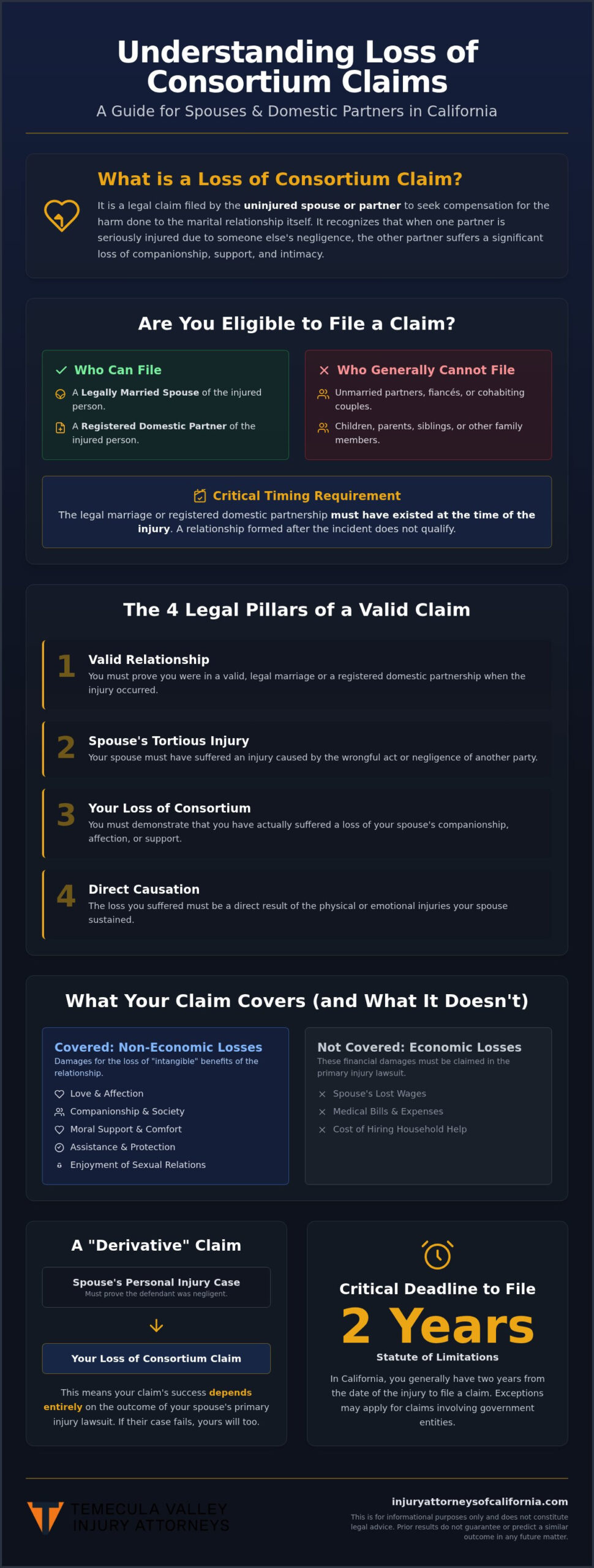
A Loss of consortium claim in California is a legal avenue for the spouse or domestic partner of an injured individual. While a standard personal injury lawsuit focuses on the victim’s physical pain or medical bills, this claim addresses the damage done to the marital relationship itself. It recognizes that when your spouse is seriously hurt in a car accident, you suffer a personal loss too. You lose their companionship, their help around the house, and the emotional intimacy that defines your union.
This is a stand-alone right to sue. You are seeking compensation for your own distinct losses, not your spouse’s. In Southern California, these claims frequently arise after catastrophic events involving truck accidents or motorcycle accidents. When a crash changes the way you and your partner interact every day, the law provides a way to hold the negligent party accountable for that shift in your family dynamic.
Who Has Standing to File a Claim?
To file a loss of consortium claim California, you must meet specific legal criteria. California law is strict about who can seek these damages. Only a lawfully wedded spouse or a registered domestic partner has the standing to file. This means that even if you’ve lived with someone for decades, you generally can’t file this claim unless you’re legally married.
Children, parents, and siblings are also excluded from this specific type of recovery in our state. The timing of the relationship is equally critical. You must have been married or in a registered partnership at the exact moment the injury occurred. If you married your partner after the accident, you generally lose the right to pursue these specific damages, even if the injuries are permanent.
The Role of Negligence in Your Claim
Your claim is “derivative” in nature. This legal term means your right to recover damages depends entirely on your spouse’s ability to prove their own case. If your partner was injured due to someone else’s negligence, we must first establish that the third party was legally at fault for the underlying incident.
If the primary injury case is dismissed or the defendant is found not liable, the consortium claim will usually fail as well. We work to prove that the defendant’s actions didn’t just cause a physical injury; they disrupted the harmony and support system of your entire household. Proving a loss of consortium claim California requires showing that the third party’s negligence was a substantial factor in causing you to lose the intangible benefits of your marriage.
Legal Requirements for a Valid Consortium Claim
Establishing a loss of consortium claim California requires meeting four specific legal pillars. While the emotional toll on your marriage is deeply personal, the court requires objective proof to award damages. First, you must have been in a valid, legal marriage or a registered domestic partnership at the exact time of the accident. Second, your spouse must have suffered a tortious injury. This means their harm was caused by another person’s negligence or wrongful behavior.
Third, you must prove that you have actually suffered a loss of consortium. This isn’t assumed just because an accident happened; you must demonstrate how the relationship has changed. Finally, the loss must be a direct result of the defendant’s actions. If these elements align, the uninjured spouse may have a strong foundation for recovery. If you are unsure if your situation meets these criteria, you can schedule a free case evaluation to review the facts of your case.
California Civil Jury Instructions (CACI 3920)
The California Civil Jury Instructions (CACI), specifically instruction 3920 in the 2026 edition, define what a jury should consider. Jurors are asked to evaluate the loss of “intangible” marital benefits. These include love, companionship, comfort, care, assistance, protection, affection, society, and moral support.
You must distinguish these from economic damages. A consortium claim is strictly for non-economic losses. It does not cover your spouse’s lost wages or the cost of hiring household help. Those financial impacts are recovered through the primary injury lawsuit. This claim focuses entirely on the internal, emotional bond between partners.
The Requirement of a ‘Significant’ or ‘Catastrophic’ Injury
California courts generally look for injuries that have a profound and lasting impact on the marital relationship. Minor injuries that heal within a few weeks rarely lead to successful consortium awards. The legal system typically reserves these damages for cases involving catastrophic injuries that permanently alter your life together.
- Traumatic brain injuries that change a partner’s personality or cognitive abilities.
- Spinal cord injuries resulting in paralysis or limited mobility.
- Amputations or permanent physical disabilities.
- Severe chronic pain that prevents a spouse from providing emotional or physical support.
When an injury is so severe that a spouse can no longer provide the companionship or intimacy they once did, the law recognizes the uninjured partner’s right to seek justice. We focus on documenting these permanent shifts to ensure the full scope of your family’s loss is acknowledged.
Proving Non-Economic Damages in Your Case
Proving a loss of consortium claim California requires more than just general statements about your sadness. You must provide concrete evidence that shows the jury how your life together has fundamentally changed. This process often feels personal and invasive; however, it’s a necessary step to secure the compensation your family deserves. We help you navigate these sensitive discussions with the dignity and professional care you expect from a local partner.
Your testimony is the foundation of the case. You’ll need to describe the loss of companionship, comfort, and care in detail. This includes addressing the loss of emotional support and, when applicable, the loss of sexual relations. To build a strong narrative, we often look for “before and after” evidence. This might include testimony from friends or family members who observed your active life together before the car accident and can speak to the limitations you face now. According to Plaintiff Magazine, successful claims often hinge on the ability to demonstrate a permanent shift in the marital dynamic through these specific, human stories.
Evidence Used to Support Your Claim
We gather several types of documentation to validate your experience. Personal journals or diaries can be powerful tools; they document daily struggles and missed milestones that a jury might otherwise overlook. We also use photographs and videos showing your couple’s active life prior to the injury. These visual aids contrast sharply with the current reality of caregiving and isolation. In many personal injury cases, we also utilize expert witness testimony. Psychologists or marriage counselors can provide an objective perspective on the long term psychological impact the injury has had on your partnership.
The Challenge of Subjective Valuation
One of the most difficult aspects of these claims is that there’s no fixed formula for calculating a “reasonable” dollar amount. California courts don’t use a spreadsheet to determine the value of a husband’s protection or a wife’s affection. Instead, a jury must use their best judgment based on the evidence presented. This makes the skill of your legal team vital. We understand the specific dynamics of Murrieta and Temecula courtrooms. We know how to present your story so that local jurors understand the true weight of your loss. Our goal is to ensure that the “intangible” benefits of your marriage are given the tangible value they deserve in a court of law.
Challenges and Deadlines for California Claims
Timing is a critical factor in a loss of consortium claim California. Generally, you have a two year window from the date of your spouse’s injury to file your lawsuit. This deadline is tied to the statute of limitations for the underlying personal injury case. If you miss this date, you lose your right to seek compensation forever. However, shorter deadlines apply if a government entity is involved. Under the California Tort Claims Act, you may have as little as six months to file a formal claim against a public agency. Exceptions also exist for cases involving minors, where the clock might be paused. Because these rules are complex, you should consult with our team as soon as possible to avoid losing your rights.
You should also understand how comparative negligence affects your recovery. California follows a “pure comparative negligence” rule. If the court finds your injured spouse was partially at fault for the accident, your award for loss of consortium will be reduced by that same percentage. For example, if a jury determines your spouse was 25% responsible for a collision, your final damages will be lowered by 25%. We work to minimize these findings of fault to protect the total compensation your family receives.
The ‘Privacy Price’ of a Consortium Claim
Filing this claim means opening your private life to legal scrutiny. The defense will likely investigate the health and history of your marriage. You may have to sit for a deposition where you’re asked sensitive questions about your physical intimacy and household roles. This can feel intrusive and stressful. Temecula Valley Injury Attorneys takes this responsibility seriously. We prepare you for these questions and set firm boundaries to protect your dignity. Our goal is to ensure you feel supported, not exposed, throughout the discovery process.
Impact of Wrongful Death
When an accident is fatal, the legal approach shifts. A loss of consortium claim is often integrated into a wrongful death lawsuit. In these tragic cases, you aren’t just recovering for a temporary shift in your household. You are seeking justice for the permanent loss of a partner’s future guidance, society, and protection. While no amount of money replaces a loved one, it provides the financial security necessary to protect your family’s future. If you are facing this difficult path, schedule a free case evaluation to discuss your rights under current California law.
How Temecula Valley Injury Attorneys Supports Your Family
Temecula Valley Injury Attorneys provides a calm and professional environment for you to discuss the sensitive marital issues that arise after a catastrophic injury. We understand that speaking about your physical intimacy and household support is difficult. Our team treats these conversations with the respect and confidentiality they deserve. We specialize in Southern California vehicle accidents, including car, truck, and motorcycle collisions. By meticulously preparing your evidence and documenting the daily shifts in your relationship, we aim to maximize the value of your non-economic losses.
We aren’t a distant national entity. We’re your neighbors, serving families throughout Temecula, Murrieta, San Diego, and El Centro. This local presence means we understand the specific court dynamics and jury expectations in our region. When you file a loss of consortium claim California, you need a partner who is deeply invested in your family’s security. We frame your security as a point of professional integrity. We take the responsibility of protecting your marriage’s value seriously. Our firm is built on traditional values and personal accountability.
Our Personable and Professional Approach
We prioritize your well-being during what is often a high-stress legal transition. You’ll have direct communication with our legal team throughout your case. You won’t get lost in a corporate phone tree or deal with a rotating cast of assistants. We don’t believe in unnecessary fluff; we believe in immediate value and clear action. We handle the technical legal hurdles so you can focus on your spouse’s recovery. We manage the complex paperwork so you can focus on your family’s stability. Our rhythmic and organized approach ensures that the breadth of your legal options is easy to navigate and digest.
Next Steps for Your Family
Taking action early is vital to preserving the evidence needed for a loss of consortium claim California. Memories of specific missed milestones can fade. Documentation of daily caregiving roles can become harder to track down as time passes. It’s also important to seek legal counsel before you speak to any insurance adjusters. They’re often highly trained to minimize the impact of the injury on your marriage. They might try to frame your losses as temporary or insignificant. We act as a protective partner, watching over your interests and ensuring your story is told with precision.
Protecting your family’s future starts with understanding your rights. Schedule a free case evaluation to discuss your situation and learn how we can help you recover the damages your partnership deserves.
Securing Your Family’s Stability
Your marriage is the foundation of your recovery, but a severe accident can strain even the strongest bonds. You’ve learned that a loss of consortium claim California provides a legal path to acknowledge these intangible losses. By documenting the shift in your companionship and emotional support, you can hold the negligent party accountable for the full impact on your household. This process ensures that the value of your partnership is recognized by the law.
Temecula Valley Injury Attorneys offers the professional authority and familial warmth you need during this transition. With verified offices in Temecula, San Diego, and El Centro, we bring specific experience in Southern California personal injury law to every case. You don’t have to navigate these sensitive marital discussions alone. We’re here to manage the technical legal hurdles so you can focus on your spouse’s well-being and your family’s future.
Take the first step toward securing the justice your relationship deserves. Schedule a free case evaluation with Temecula Valley Injury Attorneys today. We’re ready to listen and help you move forward with certainty.
Frequently Asked Questions
Can I file for loss of consortium if we were only engaged at the time of the accident?
No, you cannot file a loss of consortium claim California if you were only engaged. The law is very strict on this point. You must be legally married or in a registered domestic partnership at the exact moment the injury occurred. This requirement ensures that the legal bond being compensated actually existed when the harm was done. If you married after the accident, you generally don’t have standing to sue.
Does a loss of consortium claim cover lost wages for the uninjured spouse?
No, this claim does not cover lost wages for the uninjured spouse. It’s strictly for non-economic damages like the loss of companionship, affection, and moral support. If you took time off work to care for your partner, those financial losses aren’t recovered here. Instead, those costs are often addressed through the primary victim’s personal injury lawsuit. This claim focuses entirely on the emotional and relational impact on your partnership.
How much is an average loss of consortium settlement in California?
There is no standard average for these settlements because every marriage is unique. Juries determine the award based on the specific evidence of your loss. Some awards are modest, while others for catastrophic injuries in Temecula or San Diego have reached several million dollars. Factors include the length of the marriage and the severity of the partner’s disability. We build a personalized case that reflects the true value of your relationship.
Will I have to testify in court about my marriage?
You may have to testify if your case goes to trial. Most cases settle before that point, but you will likely participate in a deposition during the discovery phase. This involves answering questions under oath about your private life. You might discuss your physical intimacy and how your daily interactions have changed. We prepare you for this process to ensure you feel supported and that your privacy is protected as much as possible.
Can children file for loss of consortium if a parent is injured in California?
No, children cannot file for loss of consortium in California. Our state’s legal system limits this specific claim to the injured person’s spouse or registered domestic partner. While a parent’s injury deeply affects their children, the law doesn’t provide a way for them to recover damages for the loss of parental guidance or affection under this specific legal theory. It’s a right reserved exclusively for the marital or partnership bond.
What happens to the claim if the injured spouse was partially at fault for the accident?
If your spouse was partially at fault, your recovery will be reduced. California follows pure comparative negligence rules. This means if a jury finds your husband or wife was 30% responsible for the accident, your award for a loss of consortium claim California will be lowered by 30%. We work to prove the other party’s full liability to ensure you receive the maximum compensation allowed under the facts of your case.
Is there a limit or ‘cap’ on non-economic damages in California?
For standard personal injury cases like car or truck accidents, there is no statutory cap on non-economic damages. Juries have the discretion to award what they believe is reasonable based on the evidence. However, certain types of cases may have specific limits under 2026 laws. It’s vital to have an attorney review your specific situation to see if any legislative caps apply to your claim based on the nature of the underlying injury.
How long does it take to resolve a loss of consortium claim?
The timeline for your claim is usually tied to your spouse’s primary lawsuit. Because these are derivative claims, they move through the court system together. A typical personal injury case in Southern California may take anywhere from several months to a few years to resolve. The duration depends on the complexity of the accident, the length of the medical treatment involved, and whether the insurance company is willing to negotiate fairly.


