

Losing a family member to someone else’s negligence creates a void that no legal action can truly fill. Yet, the reality of mounting medical bills and lost future support often forces a grieving family to face the legal system sooner than they feel ready. Filing a wrongful death lawsuit in San Diego County requires managing a specific set of California statutes and local court procedures that can feel overwhelming during a deep period of mourning. You deserve a clear path forward that respects your loss while protecting your family’s future security.
We understand that you may feel caught between the need for legal accountability and the weight of immediate financial stress. This guide provides the clarity you need to understand the eligibility rules and procedural requirements for a claim under California law. We will walk through the specific steps for the San Diego Superior Court, from identifying who has the legal standing to file to meeting critical deadlines that could affect your case. By understanding these requirements, you can take the first step toward securing the financial stability your dependents need and holding the negligent parties accountable.
Key Takeaways
- Understand the strict hierarchy of eligibility under California Code of Civil Procedure 377.60 to determine if you have legal standing to pursue a claim.
- Learn the essential procedural steps for filing a wrongful death lawsuit in San Diego County, from evidence preservation to local court filing requirements.
- Identify the specific economic and non-economic damages your family may be entitled to, including lost financial support and loss of companionship.
- Gain practical insights into navigating common challenges, such as managing insurance company negotiations and protecting your case from social media risks.
- Discover how local legal expertise can help you manage the complexities of the San Diego Superior Court system while you focus on your family’s healing.
Understanding Wrongful Death Claims in San Diego County
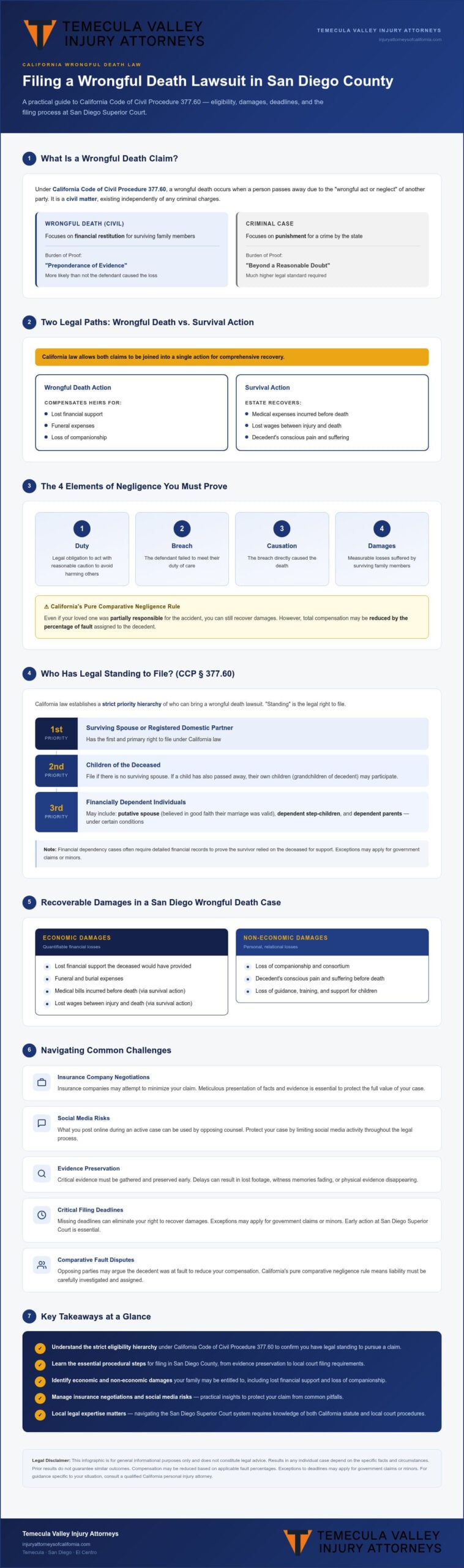
Under California Code of Civil Procedure 377.60, a wrongful death occurs when a person passes away due to the “wrongful act or neglect” of another party. When you are filing a wrongful death lawsuit in San Diego County, it’s vital to recognize that this is a civil matter. It exists independently of any criminal charges the state might bring against the responsible party. While a criminal case seeks punishment for a crime, a wrongful death claim focuses on providing financial restitution to the survivors who’ve been left behind.
Common tragedies leading to these claims in our region often involve car accidents on busy corridors like the I-5 or pedestrian incidents in high-traffic areas like Downtown San Diego. In these civil cases, the burden of proof is different than in criminal court. You don’t need to prove guilt “beyond a reasonable doubt.” Instead, we must show a “preponderance of the evidence,” meaning it’s more likely than not that the defendant’s actions caused the loss. This legal standard requires a meticulous presentation of facts and evidence.
Wrongful Death vs. Survival Actions
California law makes a technical but important distinction between two types of legal paths that often arise from the same tragedy. A wrongful death action compensates the heirs for their personal losses, such as lost financial support, funeral expenses, and loss of companionship. Conversely, a survival action allows the estate to recover damages the deceased person suffered before they passed. This includes medical expenses or lost wages incurred between the injury and death, and it can also include compensation for the decedent’s conscious pain and suffering. When you begin the process of filing a wrongful death lawsuit in San Diego County, California law allows us to join these claims into a single action to ensure a comprehensive recovery for your family.
The Role of Negligence in California Law
Most fatal accident claims hinge on the legal concept of negligence. To succeed, you must establish four specific elements: duty, breach, causation, and damages. In a San Diego context, duty of care is the legal obligation to act with the same level of caution that a reasonable person would use in similar circumstances to avoid harming others.
It’s also important to understand “comparative fault.” California follows a pure comparative negligence rule. This means that even if your loved one was partially responsible for the accident, you can still recover damages. However, the total compensation could be reduced by the percentage of fault assigned to the decedent. Temecula Valley Injury Attorneys focuses on investigating every detail to ensure liability is placed exactly where it belongs.
Eligibility: Who Can File a Wrongful Death Action in California?
California law is very specific about who can step into a courtroom to seek justice. When you’re considering filing a wrongful death lawsuit in San Diego County, the first hurdle is determining “standing.” Standing is the legal right to bring a lawsuit. Under California Code of Civil Procedure Section 377.60, the state establishes a strict hierarchy of who can file based on their relationship to the deceased person.
The law prioritizes those who were most closely related to the decedent. Generally, the surviving spouse or registered domestic partner has the first right to file. If there is no surviving spouse, the deceased person’s children are next in line. In cases where a child has already passed away, their own children (the decedent’s grandchildren) may have the right to participate in the claim. If you’re unsure where you stand in this hierarchy, we can help you review your family’s specific situation during a quiet, professional consultation.
Eligibility also extends to individuals who were financially dependent on the deceased. This group may include a putative spouse, which is someone who believed in good faith that their marriage was valid even if it wasn’t legally recognized. Dependent step-children and dependent parents also have rights under certain conditions. These cases often require detailed financial records to prove that the survivor relied on the decedent for housing, food, or other life necessities. Because these relationships can be legally complex, documenting dependency early is a critical part of filing a wrongful death lawsuit in San Diego County.
When Can a Personal Representative File?
If the decedent had a will, they likely named an executor. If they didn’t, the court can appoint an administrator. This person is known as the “personal representative” of the estate. While the heirs often file the suit themselves, the personal representative can file on behalf of all eligible heirs. This doesn’t mean the representative keeps the compensation; rather, they act as a central figure to manage the litigation and ensure any recovery is distributed correctly among the survivors according to California’s fatal accidents and wrongful death statutes.
Legal Standing and Complex Family Structures
If the deceased person had no spouse, domestic partner, or children, the right to file moves to those who would inherit the estate through “intestate succession.” This often includes parents or siblings. A vital rule to remember is the “one action rule.” California law generally allows only one wrongful death lawsuit to be filed for a single death. This means all eligible heirs must be joined in the same case. If an heir is left out, they might lose their right to recover damages entirely, making it essential to identify every potential claimant at the very beginning of the process.
Recoverable Damages in a San Diego Wrongful Death Case
The financial impact of a sudden loss often becomes clear only months after the funeral. In California, damages are designed to compensate the survivors for the pecuniary or financial value the deceased would have provided. While no amount of money replaces a loved one, filing a wrongful death lawsuit in San Diego County aims to restore the financial security your family has lost. These damages are split into two primary categories: economic and non-economic.
Economic damages are quantifiable losses with a specific dollar amount. These generally include funeral and burial expenses, medical bills related to the final injury, and the loss of financial support the decedent would have contributed to the household. A frequently overlooked claim is the reasonable value of household services. This accounts for the cost of hiring someone to perform tasks the decedent handled, such as childcare, home maintenance, or bookkeeping. Heirs should understand that while the fatal accidents and wrongful death laws are robust, California generally does not allow heirs to recover for their own emotional pain and suffering in a wrongful death claim, though these may be available in a separate survival action.
Economic Losses and Future Earnings
Calculating the loss of future earnings is a technical process that often requires input from forensic economists. These experts analyze the decedent’s age, health, career trajectory, and historical earnings to project what they would have earned over their remaining working life. In the San Diego Superior Court Civil Division, judges and juries rely on standard life expectancy tables to determine the duration of this support. We focus on ensuring these calculations include not just salary, but also lost benefits like health insurance, retirement contributions, and pension plans.
Non-Economic Damages: The Human Cost
Non-economic damages address the intangible losses that define a family’s daily life. For a surviving spouse, this includes loss of consortium, which covers the loss of intimacy, companionship, and affection. For children, the law recognizes the loss of moral support, guidance, and training that a parent provides. Because there is no fixed standard or price tag for these subjective losses, a jury must determine a value that is just and reasonable based on the evidence of the relationship’s depth. We work to present a complete picture of your loved one’s role in your life to ensure these human costs are fully recognized.
The Legal Process: Filing Your Claim in San Diego Superior Court
Moving from the weight of grief to the mechanics of a legal case is a significant transition. The process begins with a rigorous investigation. We immediately secure police reports from agencies like the San Diego Police Department or the California Highway Patrol. Preserving evidence, such as vehicle black box data and witness statements, is vital before memories fade or physical proof disappears.
The formal start of your case involves filing a wrongful death lawsuit in San Diego County. This is done by submitting a “Complaint” to the San Diego Superior Court. Depending on where the incident occurred, this might be filed at the Central Division’s Hall of Justice or the North County Division in Vista. Once the defendant is served, the discovery phase begins. This is a technical period where both sides exchange interrogatories and conduct depositions to uncover every fact regarding the accident.
Most cases eventually move toward mediation. This is a structured negotiation where a neutral third party helps both sides reach a settlement. While we aim for a resolution that provides your family with immediate security, we prepare every case as if it’s heading to trial. This dual approach ensures we’re ready for the courtroom if the insurance company refuses to offer a fair settlement. If you’re ready to start this process, you can schedule a free case evaluation with our team today.
San Diego County Statutes of Limitations
Timing is the most critical factor in protecting your rights. In California, you generally have two years from the date of the death to file a claim. However, if the death involved a government entity, such as a city vehicle or a dangerous public road, you must file a formal claim within six months. Exceptions exist for minors or in cases of “delayed discovery,” but waiting too long can permanently bar your family from seeking justice. We recommend acting quickly to ensure no deadlines are missed when filing a wrongful death lawsuit in San Diego County.
Local Court Logistics and Requirements
San Diego’s court system has specific local rules that govern how cases must proceed. The San Diego Superior Court requires mandatory e-filing for most civil actions, and there are strict guidelines for how documents must be served. Managing these administrative hurdles requires a deep familiarity with local procedures. A local attorney understands the specific rhythms of the Hall of Justice and ensures your case meets every technical requirement without delay. This localized knowledge keeps your case moving efficiently through a busy court system.
Navigating Challenges and Protecting Your Family’s Future
Seeking justice for a lost loved one involves more than just court filings. It requires a protective strategy against entities that don’t have your family’s best interests at heart. Insurance companies often move quickly after a tragedy to offer settlements that may seem helpful but rarely cover the long-term financial needs of surviving dependents. When you’re filing a wrongful death lawsuit in San Diego County, the presence of a steady, experienced partner helps you resist the pressure to settle for less than your family deserves.
One of the most modern challenges in these cases is the role of digital evidence. Insurance adjusters and defense attorneys frequently monitor the social media accounts of grieving family members. A seemingly innocent post about a family gathering or a memory of the decedent can be taken out of context to argue that the emotional impact of the loss is less severe than claimed. We advise all our clients to maintain strict privacy settings and avoid discussing the case or their emotional state online during the active litigation process.
Managing the financial burden during this time is equally critical. While the legal process unfolds, families often face immediate pressure from funeral costs and the loss of a primary income. Choosing a firm with deep local roots in San Diego and Temecula ensures you have accessible, responsive support when these practical questions arise. Our localized presence means we’re not just your legal representatives; we’re your neighbors who understand the specific stresses of our community.
Common Defenses in Wrongful Death Cases
Defendants often try to shift the blame to avoid full liability. They may argue “assumption of risk,” claiming the decedent knowingly engaged in a dangerous activity. Another common tactic is highlighting the decedent’s own potential negligence to reduce the award through comparative fault. Temecula Valley Injury Attorneys counters these tactics by conducting exhaustive investigations, utilizing accident reconstruction experts, and ensuring the narrative remains focused on the defendant’s wrongful actions.
Your First Meeting with a Wrongful Death Attorney
Preparation for your initial consultation helps us build a stronger foundation for your case. We suggest bringing the following documents:
- Official death certificates
- Police or accident reports
- Relevant medical records or final bills
- Proof of the decedent’s income, such as tax returns or pay stubs
- Photos or videos from the accident scene
This first meeting is a “free case evaluation” designed to determine your legal options without any financial obligation. We maintain a calm, practical approach to these sensitive discussions, ensuring you feel heard and informed rather than rushed. Our goal is to provide a clear roadmap for filing a wrongful death lawsuit in San Diego County so you can focus on your family’s healing while we handle the technical complexities of the law.
Securing Your Family’s Legal Future
The path toward legal accountability requires a clear understanding of California’s strict eligibility rules and the specific procedural steps of the San Diego Superior Court. By identifying the correct heirs under CCP 377.60 and documenting the full extent of your economic and non-economic losses, you take a vital step toward protecting your dependents. Filing a wrongful death lawsuit in San Diego County is a complex undertaking, but you don’t have to manage the technical hurdles or insurance negotiations alone.
Temecula Valley Injury Attorneys provides the professional, empathetic representation your family needs during this high-stakes period. We serve families throughout San Diego, Temecula, Murrieta, and El Centro, ensuring you have direct communication with your attorney at every stage. We focus on the legal details so you can focus on your recovery. Schedule a free case evaluation with Temecula Valley Injury Attorneys today. You deserve a partner who is as invested in your security as you are.
Frequently Asked Questions
Who is the first person eligible to file for wrongful death in San Diego?
The surviving spouse or registered domestic partner is generally the first person eligible to file. Under California law, the hierarchy of standing prioritizes those closest to the decedent. If there’s no surviving spouse, the right to file moves to the children. In situations where no spouse or children exist, parents or siblings may be eligible. Identifying the correct claimant is the first step when filing a wrongful death lawsuit in San Diego County.
How long does a typical wrongful death lawsuit take in San Diego County?
Most cases in our region take between 12 and 24 months to resolve. The exact timeline depends on the complexity of the investigation and the current backlog at the San Diego Superior Court. Simpler cases might settle in less than a year through mediation; however, complex litigation involving multiple parties can extend longer. We focus on moving your case forward efficiently while ensuring every piece of evidence is thoroughly documented.
What if the person responsible for the death was never charged with a crime?
You can pursue a civil claim even if the state never files criminal charges. Criminal and civil cases are entirely separate legal actions with different standards of proof. A criminal conviction requires proof beyond a reasonable doubt, but a civil claim only requires a preponderance of the evidence. This means you may still hold a negligent party accountable for your loss even if the District Attorney chooses not to prosecute a crime.
Can more than one family member file separate lawsuits for the same death?
California follows the one action rule, which generally prohibits multiple separate lawsuits for the same death. All eligible heirs must be joined in a single legal action to ensure the court can fairly distribute any recovered damages. If an heir is left out, they might lose their right to compensation. This rule prevents defendants from facing multiple trials for the same incident and helps the San Diego court system operate more efficiently.
Are wrongful death settlements taxable in California?
Settlement proceeds for compensatory damages in a wrongful death case are generally not taxable under federal or state law. The IRS typically considers these funds as compensation for a physical loss rather than earned income. However, certain portions of a recovery, such as punitive damages or interest earned on a settlement, might be subject to taxes. We recommend consulting with a tax professional to review the specific details of any potential award your family receives.
What happens if the statute of limitations has already passed?
If the deadline passes, you generally lose your legal right to seek compensation. The standard statute of limitations for these claims is two years from the date of death. If your claim involves a government entity, you must act within six months. While rare exceptions exist for minors or cases of delayed discovery, the court will almost always dismiss a late filing. Acting quickly is vital for protecting your family’s future security.
Do I have to go to court for a wrongful death claim in San Diego?
Many families never have to step into a courtroom because their claims are resolved through private settlements. We often reach a fair agreement during the mediation phase by presenting a compelling case to the insurance company. If the responsible party refuses to offer a reasonable settlement, filing a wrongful death lawsuit in San Diego County may lead to a trial. We prepare every case for the possibility of court to ensure you’re in the strongest position.
What is the difference between a wrongful death claim and a probate case?
A wrongful death claim is a civil lawsuit against a negligent party, while probate is the legal process of managing a deceased person’s estate. Wrongful death damages are paid directly to the survivors to compensate for their personal losses. Probate involves the court supervising the distribution of the decedent’s assets and the payment of their debts. While they often happen at the same time, they serve completely different legal purposes for the surviving family members.


