

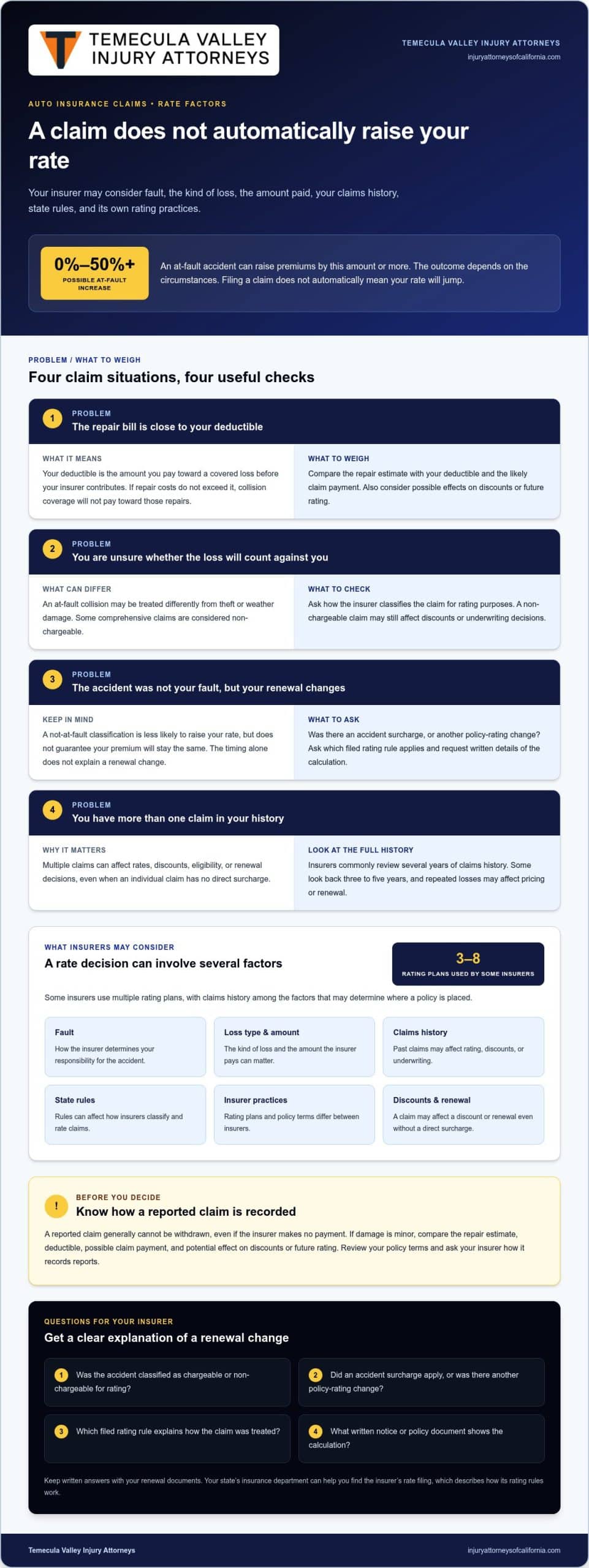
An at-fault accident can raise your premium by 0% to 50% or more, but filing a claim doesn’t automatically mean your rate will jump. Whether your car insurance rates will go up if you file a claim depends on fault, the type and severity of the loss, your claims history, state rules, and your insurer’s rating practices. A not-at-fault claim is less likely to increase your rate, but it doesn’t guarantee your premium will stay the same.
It’s understandable to worry that reporting an accident could cost you more later, especially when you’re already dealing with vehicle damage, injuries, or insurance calls. The effect can vary: even when a claim does not lead to a direct surcharge, it may affect a discount or how your policy is rated. A claim may also remain in your insurance history for several years.
This article explains how fault affects rates, when accident forgiveness may apply, and why claim type, past claims, and broader premium changes matter. You’ll also learn what to consider when deciding how to handle an accident claim, so you can better understand the possible insurance consequences.
Key Takeaways
- An at-fault accident can raise premiums by 0% to 50% or more, depending on the loss, driving history, state rules, and insurer practices.
- A not-at-fault claim is less likely to affect your rate, but claims history and insurer rating practices can still matter.
- Learn how insurers classify claims and why the type of loss and amount paid can influence whether a claim is chargeable.
- Claim forgiveness may limit a surcharge, but eligibility and the protection it provides depend on the policy’s terms.
- Compare the potential insurance impact with your deductible and the value of using coverage before deciding how to handle a claim.
What factors can impact my rate after filing an accident claim?
Your premium can change based on fault, loss type, claim amount, driving history, state rules, and insurer rating practices. Insurers also consider your claims history and how a particular loss fits their rating plan.
Insurer considerations after a claim
An insurer reviews the claim’s details to decide whether it affects your premium, discount, or policy rating. Your fault determination, the kind of loss, the amount paid, and your prior claims can all matter. Some insurers use three to eight rating plans, with claims history among the factors used to place a policy. An at-fault accident can raise rates from 0% to 50% or more, depending on the circumstances.
For example, an insurer may treat an at-fault collision differently from a theft or weather loss. Some comprehensive claims are considered non-chargeable, but may still affect discounts or underwriting decisions. These distinctions help explain why drivers with similar vehicle damage can see different rate outcomes.
Paying for repairs out of pocket
Paying out of pocket means covering repairs yourself instead of asking your insurer to pay under your coverage. It may be worth considering when damage is limited and the repair bill is close to your deductible. Compare your likely out-of-pocket cost with the potential claim payment and any possible effect on discounts or future rating.
Should you pay for repairs instead of filing a claim? If the damage is minor, compare the repair estimate with your deductible and policy terms before deciding. A reported claim generally cannot be withdrawn, even if the insurer makes no payment, so understand how your insurer records reports.
Rate changes after multiple claims
Multiple claims can affect rates, discounts, eligibility, or renewal decisions. Insurers commonly review several years of claims history, and some look back three to five years. Repeated losses may matter even when an individual claim has no direct surcharge, because insurers also consider your overall policy history and underwriting risk.
Can an insurer raise rates or nonrenew a policy after multiple claims? Yes. After multiple comprehensive claims within a short period, insurers may raise premiums or decide not to renew. Repeated theft or vandalism claims, for example, can affect renewal pricing or eligibility. The types and frequency of claims help shape the insurer’s decision.
Deductibles and filing decisions
A deductible is the amount you pay toward a covered loss before your insurer contributes. It matters because a claim may provide limited financial help when repair costs are only slightly higher than the deductible. Compare the estimate, deductible, and potential payment, then consider whether a claim could affect a discount or future rating.
How does a deductible affect whether filing is worthwhile? If repair costs don’t exceed your deductible, your collision coverage won’t pay toward those repairs. If they do, the insurer’s payment is generally based on the covered amount after the deductible, subject to policy terms. This comparison helps you weigh filing a claim against paying yourself.
How not-at-fault accidents affect premiums
A not-at-fault accident doesn’t automatically determine what your renewal premium will be. To understand a change, distinguish the insurer’s classification of the accident from the rules it applies when setting your premium. These decisions are related, but the classification alone may not explain every change at renewal.
Your state’s insurance department can help you find your insurer’s rate filing, which describes how its rating rules work. Look for information about claim treatment and accident surcharges. A filing can clarify whether the insurer’s stated approach matches how it handled your policy. This is a more specific reference point than another driver’s general experience.
When you speak with your insurer, ask focused questions about its decision and record the answers:
- Was the accident classified as chargeable or non-chargeable for rating purposes?
- Did the renewal reflect an accident surcharge, or another change to the policy rating?
- Which part of the insurer’s filed rating rules explains that treatment?
- What written notice or policy document shows the calculation?
These questions can help distinguish an accident-related change from other renewal adjustments. Keep the insurer’s written response with your renewal documents. If the explanation refers to a rating rule, compare it with the rate filing instead of relying only on a phone conversation.
For example, if your renewal changes after an accident caused by another driver, the timing alone doesn’t establish why the price changed. The insurer’s explanation and applicable rating rules provide more useful detail. If the insurer identifies a direct accident surcharge, focus on the classification and the rule applied. If it identifies another adjustment, ask for the basis of that change.
A not-at-fault classification can matter beyond the premium calculation. It records how the insurer treated your role in the accident, while a separate injury claim may involve questions about the other driver’s responsibility and your losses. Keep insurance notices, accident records, and injury-related documents organized so you can refer to the right information when discussing each issue.
At-fault and not-at-fault claim classifications
An insurer’s classification records how it views your responsibility for an accident within its claims process. That record may differ from your account, the other driver’s account, or the wording on an accident report. Ask which facts the insurer relied on and request its explanation in writing. A clear explanation gives you specific details to review instead of leaving you to guess how the decision was made.
For a multi-vehicle crash, write down your own sequence of events while it is still clear. Note where each vehicle was, which direction it moved, and what happened immediately before impact. Keep the description factual. For example, “my car was stopped before the impact” is more useful than a conclusion about who was legally responsible.
Organize relevant records by source and date. Useful materials may include:
- Photographs showing vehicle damage, road conditions, and the surrounding scene.
- Names and contact information for people who witnessed the collision.
- The accident report and any corrections or supplemental information.
- Messages or letters from the insurers handling the claim.
If the insurer’s account leaves out a detail, identify that specific point and provide the record that addresses it. A photo may clarify where damage occurred, while a witness may describe the vehicles’ movements. Explain what each item shows without overstating what it proves. Keep copies of anything you submit, along with the date and method of delivery.
Suppose the other driver says you changed lanes, while you say your vehicle stayed in its lane. A dated photo of vehicle damage may help describe the impact, while a witness may have seen the movement beforehand. Neither item tells the whole story on its own. The insurer’s written reasoning helps you understand how it weighed the available information.
Keep the insurance classification separate from questions about responsibility for injuries. An insurer’s internal claim decision addresses how it handles the policy claim; an injury claim may require a broader review of the crash evidence and resulting losses. For example, save medical and missed-work records with your accident documents, but label them separately from repair estimates and insurer notices. This organization makes it easier to respond accurately when different parts of the claim are discussed.
Claim forgiveness eligibility and limits
Accident forgiveness is a policy feature whose terms you need to understand before relying on it. Start with your declarations page, then review the endorsement or policy section describing forgiveness. The declarations page identifies coverage and listed policy features; the endorsement explains how the feature works.
Does accident forgiveness prevent a rate increase after a claim? It may prevent a qualifying accident from counting toward a surcharge, but the policy wording determines the scope of that protection. Read the conditions that apply to the driver, vehicle, and accident.
Check whether the policy includes forgiveness or adds it as a feature. Then identify any eligibility conditions, such as the driving or claims history described in the policy. Don’t rely on a general statement about forgiveness if the written terms contain specific requirements.
Large accident forgiveness deserves close review because the phrase alone does not explain what qualifies as a large accident. Look for the policy’s definition, covered circumstances, and exclusions. If an accident involves multiple vehicles or injuries, note those details when comparing the event with the policy language. Don’t assume the feature applies simply because the claim appears serious.
For a clear review, mark the relevant terms and note any questions they leave open. Ask the insurer to identify the exact provision that applies to your claim and explain any unclear condition. Keep the response with your policy documents. If the explanation differs from the written language, compare the two before deciding what to ask next.
Also note the renewal date and any policy changes made since the accident. A feature may be described in one policy version and changed in a later renewal document. Comparing the documents helps you identify which terms applied when the accident happened and whether the current policy describes the same protection.
Typical premium increase range
Premium changes after claims vary widely, so one percentage cannot predict your renewal. A single theft or vandalism claim with a moderate payout can lead to an increase of a few percent to a single-digit percentage at renewal. The amount depends on how the insurer treats the loss, your claims history, and its rating practices.
A reported example shows how different one policyholder’s experience can be. After a catalytic converter theft claim, one driver reported a 34% increase for the next policy period. That figure describes one reported outcome, not a standard increase for theft claims. The insurer’s rating decision and the policyholder’s circumstances shape the final premium.
Compare your renewal premium with your previous premium to identify the actual change. Then review the renewal documents for explanations, including changes to discounts or rating factors. If the insurer lists a surcharge, distinguish it from an overall rate adjustment. A claim-related change and a broader premium change can occur together at renewal.
Do minor claims or small payouts increase premiums? They can. A small payout may still be recorded as a claim, and insurers may consider claim frequency, loss type, and eligibility for a claims-free discount. A minor repair does not automatically mean a small rate change, because the insurer’s rating practices and your record also matter.
Claim amount is only one part of the calculation. For example, a moderate theft payout may affect a renewal differently from an at-fault collision. Some comprehensive losses may be considered non-chargeable, yet still influence discounts, eligibility, or underwriting. Repeated claims can also have a different effect from a single incident.
Your premium can rise for reasons unrelated to your individual claim. Higher repair or medical costs can contribute to broader rate changes, and insurers may adjust pricing across an area. If your renewal changes after an accident, compare the timing and listed reasons rather than assuming the claim caused every increase.
For a useful comparison, note your previous premium, renewal premium, claim type, and any stated discount changes. Ask the insurer which rating factors changed and whether the claim led to a surcharge. This helps separate the direct effect of a claim from other renewal adjustments.
If an accident also caused injuries, insurance rate questions may overlap with questions about documenting the crash and pursuing an injury claim. You can discuss your accident with our legal team to understand what information may matter to your situation.
Temecula Valley Injury Attorneys: Car Accident Attorney
Temecula Valley Injury Attorneys helps people understand their options after a car accident involving injuries, disputed fault, or difficult insurance communications. A rate increase is an insurance issue, but a crash may also raise questions about who caused your injuries and how to document your losses. Our team can discuss how the accident and available evidence relate to a potential injury claim.
Consider speaking with a car accident attorney if an insurer disputes responsibility, pressures you about a statement, or offers a settlement before you understand your losses. Contact Temecula Valley Injury Attorneys for a free case evaluation to discuss your situation and possible next steps.
Choose your next step with confidence
Insurance questions can feel harder when you’re also managing injuries, missed work, or uncertainty about what happens next. Whether your car insurance rates will go up if you file a claim is only one part of the picture. If the crash caused injuries, keep your records organized and consider how the insurance process may affect your ability to address the harm you experienced.
Temecula Valley Injury Attorneys represents people injured in car, motorcycle, and truck accidents. Our team can discuss your accident, the evidence you have, and questions about pursuing an injury claim. We can help you understand possible next steps without promising a particular outcome.
Contact Temecula Valley Injury Attorneys to discuss your situation. You deserve clear information as you decide what to do next.
Frequently Asked Questions
Will my insurance increase after a claim?
Yes, a claim can affect your premium, but the change depends on how the insurer rates the loss. Distinguish a direct surcharge from a lost discount or a general renewal adjustment. For example, if your renewal rises, compare the insurer’s listed changes with your prior policy documents. This can help show whether the claim, another rating factor, or broader pricing changes contributed.
How Much Does Insurance Go Up After an Accident?
There’s no single increase that applies to every accident. Insurers weigh fault, damage severity, claim payments, your driving and claims history, and their rating practices. An at-fault accident generally carries more rate risk than a not-at-fault loss. To understand your renewal, compare the new premium with your previous one and review the insurer’s explanation for any surcharge or changed discount.
Does hitting a deer count as an at-fault accident?
Hitting a deer is usually handled as a comprehensive claim rather than an at-fault collision claim. The classification can change if you swerve to avoid the animal and then hit another vehicle or object. In that situation, collision coverage typically applies, and fault may be considered. The point of impact and events immediately before it help explain which coverage applies.
Does my insurance go up if I hit someone or if someone hits me?
If you hit another vehicle, your insurer may consider the claim chargeable if it finds you at fault and the loss meets its criteria. If another driver hits you, a not-at-fault classification makes a rate increase less likely, but doesn’t rule one out. Keep photos, witness contact details, and the accident report together, especially if drivers give different accounts.
How much do car insurance rates increase after filing a claim?
The increase can range from no direct surcharge to a substantial premium change. For an at-fault accident, the amount depends on severity, claim payment, driving history, state rules, and insurer policies. A small payout doesn’t automatically mean a small rate effect, because claim frequency and discount eligibility can also matter. Review the renewal notice to identify what changed rather than relying on the payout alone.
How long does a car insurance claim affect your rates?
An accident can affect rates for three to five years on average in the United States. The period depends on the accident’s severity, fault determination, your driving history, and state rules. Insurers may weigh older claims differently as your record changes. For a practical view, note the accident date and ask how long that specific claim remains relevant to your policy rating.
Do rates go up after a not-at-fault accident?
They can, although a not-at-fault accident is less likely to raise your premium than an at-fault accident. Insurers may consider your overall claims activity, particularly when multiple claims occur within a short period. A rate change might also reflect reduced discount eligibility or broader renewal pricing. Check whether the insurer assigned fault, changed a discount, or applied another rating adjustment.
Will filing a comprehensive claim raise car insurance rates?
A comprehensive claim can affect your premium, though its impact may be smaller than an at-fault accident’s. Theft, vandalism, weather damage, glass damage, and animal impacts may be considered non-chargeable under insurer or state rules. Even without a direct surcharge, repeated comprehensive claims can affect discounts, eligibility, or renewal decisions. Review the claim category and renewal explanation to understand how the insurer treated it.


