

You might think every minor fender-bender requires a high-priced legal team, but for simple property damage claims, handling the process yourself can often save you time and money. However, the line between a straightforward DIY settlement and a legal disaster is thin; knowing when to hire a personal injury lawyer in California is the primary difference between a fair recovery and a denied claim. It’s completely natural to feel protective of your rights while feeling overwhelmed by 2026 DMV reporting requirements or the pressure of an insurance adjuster asking for a recorded statement.
We understand that you want to resolve your minor medical bills and car repairs without the stress of a complex legal battle. This guide provides the exact steps to navigate the California claims process on your own while avoiding common insurance traps that could bar your recovery. You’ll learn about the two-year statute of limitations for personal injury, the current $12,500 small claims court limit for individuals, and how California’s pure comparative negligence rules could impact your final settlement check.
Key Takeaways
- Identify if your case qualifies for a DIY approach by assessing liability and the severity of your injuries.
- Follow a structured 5-step process to meet California DMV reporting requirements and maintain a meticulous evidence file.
- Understand how California’s pure comparative negligence rule may reduce your settlement if you are partially at fault.
- Protect your right to recover by meeting the two-year statute of limitations and identifying shorter deadlines for government claims.
- Learn the specific red flags that signal when to hire a personal injury lawyer in California to avoid being underpaid by insurance adjusters.
Can You File a Personal Injury Claim Without a Lawyer in California?
You have the legal right to represent yourself in the California civil court system. This path is known as “pro se” representation. While the legal system is often complex, many Southern California residents choose this route for minor accidents where the stakes are manageable. If you’ve been in a low-speed fender bender in a parking lot, you might find that managing the insurance adjuster yourself is more efficient than involving a third party. It’s a practical choice for those who have the time to track every email and phone call.
There is a distinct difference between a property damage claim and a bodily injury claim. Property damage is usually objective; a body shop provides an estimate, and the insurance company pays it. However, personal injury law involves subjective elements like pain, suffering, and future medical needs. This distinction is often when to hire a personal injury lawyer in California because calculating the long-term value of an injury is much harder than quoting a bumper replacement. If your case involves more than just a dented door, the complexity increases significantly.
When DIY Representation Makes Sense
Handling your own personal injury claim is often practical when liability is clear and injuries are minor. If the other driver’s insurance company accepts 100% fault immediately and your medical bills are very low, you can likely manage the administrative paperwork yourself. This works best for “soft tissue” injuries that resolve with a few weeks of rest or physical therapy. You don’t need a legal team if there is no permanent impact on your lifestyle or ability to work. You’ll just need to stay organized and keep every receipt from your medical providers.
When Self-Representation Becomes a Legal Risk
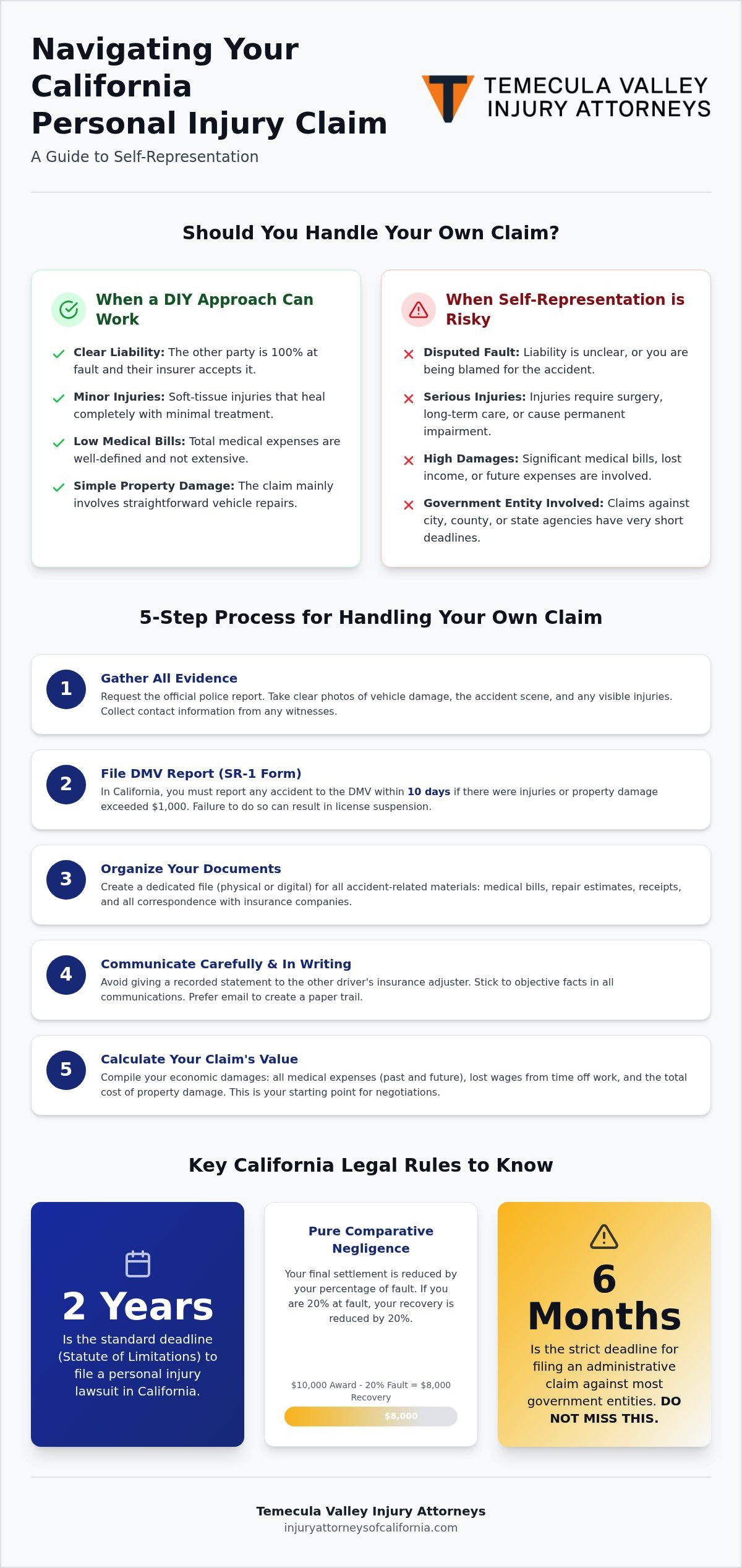
Self-representation turns into a major risk when the facts of the accident are messy. If you were involved in a multi-vehicle pileup on the I-15 or if the other driver claims you were partially at fault, California’s “pure comparative negligence” rules apply. Your compensation could be slashed by your percentage of fault based on a single wrong statement. Additionally, claims against government entities, such as a city bus in Murrieta or a county vehicle in Temecula, require an administrative claim to be filed within just six months. Missing this deadline bars your recovery entirely. Knowing when to hire a personal injury lawyer in California is vital if you face surgery, long-term rehabilitation, or a complex dispute over who actually caused the crash.
The 5-Step Process for Handling Your Own Injury Claim
Managing your own claim requires a disciplined approach to documentation. You’re essentially acting as your own project manager. Start by creating a dedicated folder, either digital or physical, for all accident-related materials. This should include medical receipts, repair estimates, and every piece of correspondence from insurance companies. Staying organized prevents you from losing leverage during the negotiation phase. If the administrative burden starts to feel like a second full-time job, it’s often a sign of when to hire a personal injury lawyer in California to protect your sanity and your claim’s value.
Evidence Collection and California DMV Reporting
Your first priority is gathering objective facts. Contact the Temecula Police Department or the local agency that responded to your accident to request a copy of the official police report. This document is the foundation of your liability argument. Simultaneously, you must comply with California law by filing an SR-1 form with the DMV. You generally have only 10 days to report an accident if someone was injured or if property damage exceeds $1,000. Failing to file this form can lead to a license suspension, regardless of who caused the crash. Ensure you also have clear photos of the vehicle positioning and any visible bruising or injuries immediately following the incident.
Managing Insurance Communications Safely
Insurance adjusters are trained to minimize payouts. They may sound friendly, but their goal is to protect their company’s bottom line. You should generally avoid providing a recorded statement to the other driver’s insurer. These recordings are often used to find small inconsistencies in your story that can be used against you later. Stick to the objective facts: the date, time, location, and the parties involved. If you’re unsure how to phrase your communications, you can schedule a free case evaluation to review your documentation with a professional.
Once you’ve completed your medical treatment, you’ll need to draft a professional demand letter. This letter should outline why the other party is liable and provide an itemized list of your specific damages, including medical bills and lost wages. Be prepared for a “low-ball” first offer. Adjusters often start with a minimal number to see if you’re desperate for a quick settlement. Knowing when to hire a personal injury lawyer in California becomes critical if the insurance company refuses to move toward a fair number or denies liability despite your evidence. Negotiation is a process of back-and-forth; don’t feel pressured to accept the first check they send.
Calculating the Value of Your Claim Under California Law
Valuing a personal injury claim involves more than basic math. You must categorize your losses into economic and non-economic damages. Understanding these categories is essential for deciding when to hire a personal injury lawyer in California, as miscalculating your future needs can leave you with unpaid bills. Economic damages are the concrete costs you can prove with a receipt; non-economic damages represent the emotional toll the accident took on your life.
Totaling Your Economic Losses
Start by compiling every medical invoice from your San Diego or El Centro healthcare providers. This includes ER visits, diagnostic imaging, and follow-up appointments. You should also calculate lost wages. Don’t just look at your base salary; include missed overtime, used vacation days, and even missed promotional opportunities if you were sidelined during a critical review period. If you’re a contractor or shift worker, ensure you document every hour of lost productivity. Small out-of-pocket costs, like prescriptions or rented medical equipment, should also be added to this total.
Estimating Pain and Suffering in Southern California
Insurance companies often use software like Colossus to assign a value to your suffering. To counter this automated approach, keep a daily “pain journal” to document how your injuries limit your routine. Note if you can’t lift your child or if you’ve missed community events in Temecula. Most adjusters use a “multiplier method,” multiplying your medical bills by a number between 1.5 and 5, or a “per diem” approach, which pays a set daily rate until you reach maximum medical improvement.
California’s pure comparative negligence rule is the most significant factor that can reduce your final check. Under this law, your total recovery is reduced by your exact percentage of fault. For example, if an adjuster determines you were 25% responsible for a crash, you will only receive 75% of the calculated damages. Insurance companies frequently use this rule to shift blame onto you, even in clear-cut cases. This complexity is often when to hire a personal injury lawyer in California, as fighting a 10% or 20% fault assessment can save you thousands of dollars. If your recovery isn’t complete, you must also account for future medical expenses. Settling before you know the full cost of future physical therapy or surgery means you cannot go back for more money later.
Common Pitfalls and California Legal Deadlines
Time is rarely on your side after a car accident or a slip and fall incident. While you’re focusing on your physical recovery, the legal clock is already ticking. In California, the general statute of limitations for a personal injury lawsuit is two years from the date of the injury. This deadline, found in California Code of Civil Procedure Section 335.1, is strict. If you miss it, the court will likely dismiss your case regardless of how clear the other party’s fault is. This pressure is often when to hire a personal injury lawyer in California, as a professional can ensure every filing meets these non-negotiable dates.
Strict Deadlines You Cannot Miss
The two-year rule isn’t the only deadline you need to worry about. If your claim involves a government entity, such as a city bus in San Diego or a county-maintained road in Murrieta, you must file an administrative claim within just six months. This requirement comes from California Government Code Section 911.2. There are also specific “tolling” rules for minors, where the clock might not start until they turn 18, but these exceptions are complex. Waiting until the final weeks of your deadline destroys your negotiation leverage; insurance adjusters know when you’re out of time and will use that desperation to offer a smaller settlement.
Insurance Adjuster Tactics to Watch For
Adjusters often use a “quick settlement” strategy. They might offer you a check within days of the crash before you’ve even seen a specialist or finished physical therapy. This is a trap. If you accept that money, you’ll have to sign a “General Release,” which permanently ends your right to seek more compensation. If a hidden injury like a herniated disc appears a month later, you’re responsible for those costs yourself. You should also be wary of requests for a broad medical release. Adjusters use these to dig through your entire medical history, looking for old injuries they can blame for your current pain.
Your digital footprint is another tool for the defense. Adjusters frequently monitor social media accounts to find photos of you at a family BBQ or a community event in Temecula. They’ll use these images to argue that your injuries aren’t as severe as you claim. Even a simple “I’m doing okay” post can be twisted to undermine your case. If you’re feeling pressured by constant calls or find yourself unsure of what documents to sign, it’s best to Schedule a free case evaluation. Understanding when to hire a personal injury lawyer in California is about recognizing when the insurance company’s interests have shifted from helping you to protecting their own bottom line.
When to Transition from DIY to Professional Representation
You’ve done the heavy lifting by organizing your records and communicating with the insurance company. For many minor property damage claims, this level of diligence is enough to reach a fair conclusion. However, there is a specific point where the insurance company’s resistance outweighs your available time and technical knowledge. Transitioning to professional help isn’t a sign of failure; it’s a strategic move to protect your financial future. Recognizing this tipping point is often when to hire a personal injury lawyer in California to ensure your recovery isn’t compromised by a short-term settlement offer.
A professional legal review does more than just handle phone calls. It uncovers details that are often invisible to the untrained eye. An attorney may identify umbrella insurance policies or additional liable parties that you hadn’t considered. Once you decide to transition, the process is seamless. Your legal team takes over all communication with the insurer, allowing you to focus entirely on your health. This shift immediately changes the dynamic of the negotiation, as adjusters realize they can no longer use delay tactics or complex legal jargon to minimize your claim.
Signs You Need an Advocate
There are clear red flags that indicate your case has outgrown a DIY approach. If the insurance company denies liability despite clear evidence from a police report, you’re facing a legal wall that requires professional intervention. Similarly, if you’re dealing with a permanent disability or a catastrophic injury, the long-term costs are too high to leave to chance. You should also seek help if the settlement offer doesn’t even cover your existing medical liens. In these high-stakes scenarios, the risk of a legal mistake that bars your recovery is simply too great.
- Liability is disputed despite your evidence.
- Injuries require surgery or long-term rehabilitation.
- The insurer refuses to pay for all related medical bills.
- Multiple parties are involved, creating a complex fault dispute.
The Temecula Valley Injury Attorneys Approach
At Temecula Valley Injury Attorneys, we view ourselves as your protective, community-oriented neighbor. We balance technical expert rigor with the familial warmth you expect from a local firm. Our goal is to provide certainty in an uncertain time for residents in Temecula, Murrieta, and the surrounding areas. We offer a risk-free way to check your DIY progress and see if there are gaps in your current strategy. If you’re feeling overwhelmed by paperwork or pressured by an adjuster, you can Schedule a free case evaluation. Understanding when to hire a personal injury lawyer in California starts with a simple conversation about your rights and the true value of your personal injury claim.
Secure Your Settlement with Confidence
You now have a practical roadmap for navigating the California claims process, from filing the essential SR-1 form to drafting a demand letter. While a DIY approach is often viable for simple property damage, bodily injury claims involving long-term care or disputed fault carry much higher stakes. Understanding when to hire a personal injury lawyer in California is the most important step in protecting your right to a full and fair recovery.
If you find the administrative burden overwhelming or an adjuster is pressuring you into a quick release, we’re here to help. Temecula Valley Injury Attorneys focuses exclusively on car, truck, and motorcycle accidents. Our experienced advocates provide direct, personable guidance from our local offices in Temecula, San Diego, and El Centro. We invite you to Schedule a free case evaluation with Temecula Valley Injury Attorneys to ensure no detail is overlooked. You’ve already taken the first step by getting informed. Let us help you finish the journey with certainty and peace of mind.
Frequently Asked Questions
Can I still recover money if I was partially at fault for the accident in California?
Yes, you can still recover compensation even if you were partially responsible for the accident. California follows a pure comparative negligence rule, which means your total settlement is reduced by your exact percentage of fault. If you are found to be 30% at fault, you will receive 70% of the total damages. This calculation is a common point of dispute and often signals when to hire a personal injury lawyer in California to fight unfair fault assessments that reduce your check.
How long do I have to file a personal injury claim in Temecula?
You generally have two years from the date of the accident to file a lawsuit in California under the statute of limitations. However, if your claim involves a government entity, such as a city vehicle in Temecula or a county road in Murrieta, you must file an administrative claim within six months. Missing these deadlines generally bars you from recovering any compensation. It’s best to start the process as soon as possible to preserve evidence and witness statements while they are fresh.
What happens if the other driver doesn’t have insurance?
If the other driver lacks insurance, you will likely need to file a claim through your own Uninsured Motorist (UM) coverage. This part of your policy is designed to protect you in these specific scenarios. Your insurance company essentially steps into the shoes of the at-fault driver’s insurer. While this is your own company, they may still try to minimize your payout. You must keep meticulous records of all your medical expenses and property damage to prove the value of your claim.
Do I have to pay taxes on a personal injury settlement in California?
Most personal injury settlements for physical injuries or sickness are not taxable under federal or California law. This includes compensation for medical bills and pain and suffering. However, if a portion of your settlement is specifically for lost wages, that amount could be subject to income tax. Punitive damages are also generally taxable. You should consult with a tax professional to understand how these rules apply to your specific settlement once it is finalized.
What is the difference between a claim and a lawsuit?
A claim is an informal request for compensation made to an insurance company, which usually happens shortly after the accident. Most cases are resolved during this negotiation phase. A lawsuit is a formal legal document filed in civil court if a settlement cannot be reached. Filing a lawsuit starts the litigation process, which involves stricter discovery rules and potentially a trial. Many people handle the claim stage themselves but decide that a lawsuit is when to hire a personal injury lawyer in California.
Should I sign the medical authorization form from the insurance company?
You should be very cautious about signing a broad medical authorization form provided by the insurance company. These forms often give adjusters access to your entire medical history, not just records related to the accident. They may use your past health issues to argue that your current pain is a pre-existing condition. It’s generally better to provide only the specific records and bills related to your current injuries rather than giving them unlimited access to your private medical data.
Can I handle a wrongful death claim without a lawyer?
While you technically can handle a wrongful death claim on your own, it is rarely advisable due to the extreme complexity. These cases involve specific legal requirements regarding who can file and how damages like loss of companionship are calculated. The emotional and financial stakes are exceptionally high. Insurance companies often fight these claims aggressively, making professional representation critical for ensuring the family receives the full support they are legally entitled to under California law.
How much does a personal injury lawyer cost if I decide not to go DIY?
Most personal injury attorneys work on a contingency fee basis. This means you don’t pay any upfront legal fees. Instead, the lawyer receives a percentage of your final settlement or verdict, which typically ranges from 33% to 40% in California. If the case doesn’t result in a recovery, you generally won’t owe attorney fees. This model allows you to access professional legal help without having to pay out of pocket while you are focused on your physical recovery.


