

Waiting for the right moment to seek legal answers after losing a loved one can inadvertently strip your family of its right to justice. We know that when you are grieving, the last thing you want to think about is a legal clock. It’s natural to feel overwhelmed by funeral costs and medical bills while trying to process a sudden loss. In most cases, the statute of limitations for wrongful death California claims is two years from the date of death. If this deadline passes, you generally lose the ability to hold the responsible parties accountable.
While two years might seem like enough time, some cases involve much shorter windows. For instance, claims against government entities in San Diego County may require action within just six months. Temecula Valley Injury Attorneys is here to help you navigate these conflicting deadlines. We believe professional authority should be paired with familial warmth to provide you with certainty during an uncertain time.
This guide explains the critical legal deadlines and eligibility requirements for filing a wrongful death claim. You will learn how to identify which timeline applies to your situation and how to protect your family’s right to financial stability. We provide a clear path through the legal system so you can focus on healing while we manage the technical complexities of your case.
Key Takeaways
- Identify who is legally eligible to file under California Code of Civil Procedure 377.60, including the priority given to surviving spouses and children.
- Understand that while the statute of limitations for wrongful death California is generally two years, specific exceptions for public entities may require action within six months.
- Learn why securing a San Diego Police Department or CHP accident report is a vital first step in preserving evidence for your family’s claim.
- Distinguish between civil claims for financial compensation and criminal proceedings to ensure you are seeking the correct form of justice in San Diego courts.
- Discover how Temecula Valley Injury Attorneys provides a protective legal environment by managing all interactions with insurance adjusters on your behalf.
Understanding Wrongful Death Claims in San Diego County
California Code of Civil Procedure 377.60 provides the legal foundation for families to seek justice. A wrongful death claim arises when a person dies due to the “wrongful act or neglect” of another party. In San Diego courts, these are civil matters, which differ significantly from criminal proceedings. A criminal case focuses on punishment or jail time; a civil claim focuses on the survivors’ losses. You don’t need a criminal conviction to pursue a civil case.
Proving liability requires establishing four technical elements. First, the defendant owed the deceased a duty of care, such as a driver’s obligation to follow traffic laws. Second, they breached that duty. Third, that breach was the direct cause of the death. Finally, the family suffered measurable damages. We look for the “direct cause” to ensure the link between the negligent act and the loss is undeniable. Generally, the statute of limitations for wrongful death California is two years, but these technical requirements take time to build correctly.
Common Grounds for San Diego Wrongful Death Claims
Fatal incidents often occur on busy San Diego arteries like the I-5, I-15, or I-805. These car accidents often involve high speeds or distracted driving. Other frequent scenarios we see in our community include:
- Fatal motorcycle accidents or pedestrian strikes near high-traffic areas.
- Premises liability cases, such as a slip-and-fall accident in a local retail center or hotel.
- Catastrophic dog bites or animal attacks leading to fatal complications.
The Purpose of a Civil Lawsuit After a Loss
A civil lawsuit provides a practical path forward for families facing sudden financial strain. While no amount of money replaces a loved one, seeking financial stability is a necessary step for surviving dependents. This process holds negligent parties accountable in a way the criminal system might not. It helps cover funeral expenses, lost future earnings, and the loss of companionship. Adhering to the statute of limitations for wrongful death California ensures you may preserve the right to these essential resources. We focus on the details of your claim so you can focus on your family. Temecula Valley Injury Attorneys helps families bridge the gap between their emotional loss and their future security by providing rigorous technical expertise with a compassionate touch.
Who is Eligible to File a Wrongful Death Claim in California?
Not every family member has the legal standing to file a lawsuit after a loss. Under California Code of Civil Procedure section 377.60, the state establishes a strict hierarchy of claimants. The primary right to file belongs to the surviving spouse, domestic partner, and children. If the deceased person had no spouse or children, the right moves to those who would inherit their property under California’s intestate succession laws, which usually includes parents or siblings.
California also recognizes “putative spouses,” who are individuals who believed in good faith that their marriage was valid even if it was legally void. Dependent stepchildren and parents who can prove financial reliance on the deceased may also qualify. Because California follows the “one action rule,” all eligible heirs must generally coordinate and join a single lawsuit. This prevents the court system from being bogged down by multiple separate claims for the same incident. If you are struggling to coordinate with other family members, speaking with a legal professional can help align everyone’s interests.
The Role of the Personal Representative
Sometimes, a personal representative of the deceased person’s estate files the claim instead of the individual heirs. In San Diego County, this often requires formal appointment through the probate division of the Superior Court. The representative doesn’t necessarily keep the award; they hold the responsibility of distributing the settlement or verdict to all legal heirs. This distinction is vital because failing to follow probate requirements can delay your case, making it harder to meet the statute of limitations for wrongful death California.
Survival Actions vs. Wrongful Death
You should distinguish between a wrongful death claim and a survival action. A wrongful death claim compensates you for your personal losses, such as the loss of financial support and emotional companionship. A survival action focuses on the deceased person’s losses before they passed away. This includes medical expenses and lost wages incurred between the time of the injury and the time of death. Unlike wrongful death claims, survival actions generally allow for punitive damages if the defendant’s conduct was particularly egregious. Both actions are subject to the statute of limitations for wrongful death California, so identifying the correct path early is essential for protecting your family’s future.
Gathering Evidence for a Successful Fatal Accident Claim
Securing evidence immediately is the most effective way to protect your family’s future. In San Diego, this often begins with obtaining the official accident report from the San Diego Police Department or the California Highway Patrol. These documents provide an objective baseline for what occurred. Beyond the police report, we look for physical evidence like vehicle defects or hazardous road conditions that may have contributed to the tragedy. Because the statute of limitations for wrongful death California is a strict deadline, gathering these details early ensures your claim is built on a solid foundation.
Local surveillance is a powerful tool often overlooked by national firms. We look for footage from local San Diego businesses, traffic cameras, or even San Diego Metropolitan Transit System (MTS) vehicles that might have captured the incident. Witness memories fade quickly, so identifying and interviewing bystanders is a priority. This thorough approach is essential for successful wrongful death lawsuits in California, as it prevents the defense from creating doubt about the facts.
Proving Economic and Non-Economic Damages
You must document every way this loss has affected your household. We collect employment records and tax returns to project the lost future income and benefits your loved one would have provided. Funeral and burial expenses are documented for full reimbursement. Non-economic damages, like “loss of consortium,” are more personal. We use family testimony to illustrate the emotional void left behind. A professional financial valuation of household services, like childcare or home maintenance, ensures no part of your loss is ignored.
Utilizing Expert Witnesses in San Diego
Complex cases require specialized technical expertise. For instance, in fatal truck accidents, we often employ accident reconstructionists to analyze black box data and skid marks. Medical experts testify regarding the exact cause and timing of death, which is critical when liability is contested. Finally, economists calculate the lifetime value of the deceased’s financial support. These professionals provide the rigorous evidence needed to meet the requirements of the statute of limitations for wrongful death California and secure the justice your family deserves.
Navigating the Statute of Limitations for Wrongful Death in California
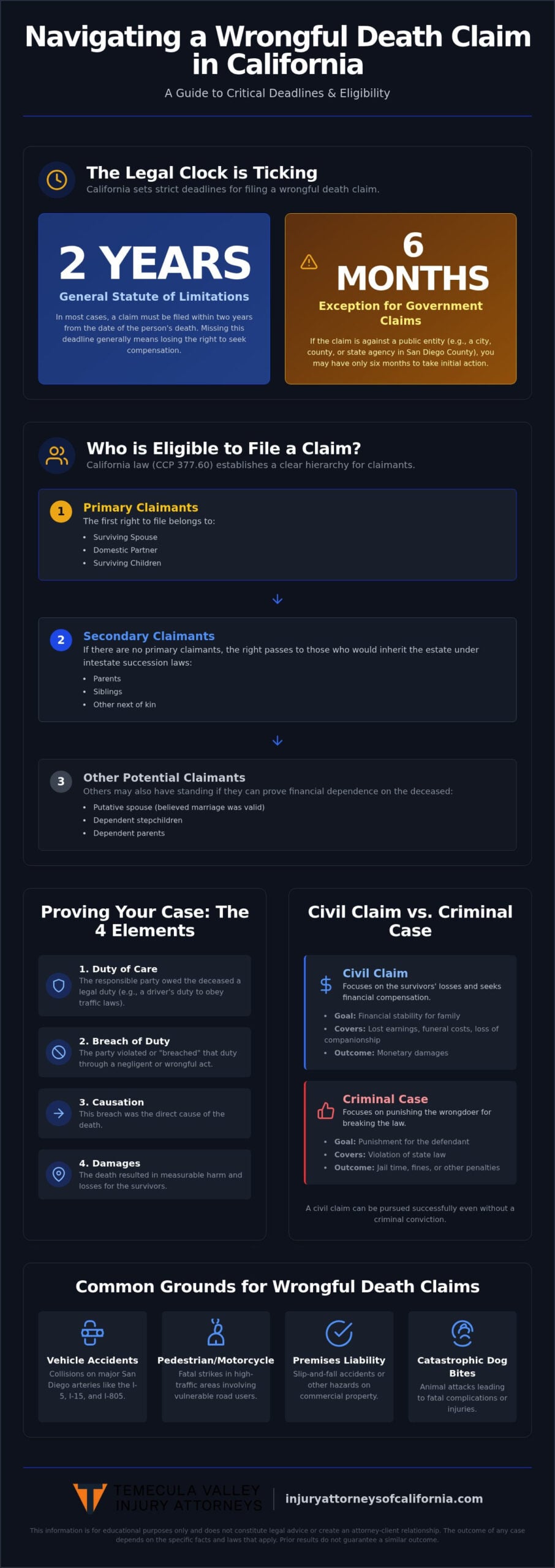
The legal timeline for your case is a strict boundary that the court rarely extends. Under California Code of Civil Procedure Section 335.1, the standard statute of limitations for wrongful death California is two years from the date of your loved one’s passing. This window is designed to ensure that evidence remains fresh and witnesses are still available. If you fail to file your lawsuit before this two-year mark, you will almost certainly lose your legal right to seek justice. The court generally dismisses late filings regardless of how clear the negligence may be.
Some situations allow for the “Discovery Rule” to apply. This occurs when the cause of death was not immediately apparent or was hidden by the negligent party. In these rare instances, the clock might not start until you discovered, or reasonably should have discovered, the facts pointing to a wrongful act. However, relying on this rule is legally complex and requires meticulous documentation. Because the stakes are so high, we recommend that you schedule a free case evaluation as soon as possible to verify your specific deadline.
The 6-Month Deadline for Government Claims
Many families in San Diego County are surprised to learn that their filing window can shrink from years to months. If the negligence involves a public entity, you must follow the California Government Tort Claims Act. This requires filing a formal administrative claim within just six months of the death. Common examples include accidents involving San Diego Metropolitan Transit System (MTS) buses, city-owned maintenance vehicles, or fatal incidents caused by poorly maintained state highways. Missing this six-month administrative deadline can permanently bar you from filing a lawsuit against the city, county, or state.
Deadlines for Minors and Delayed Discovery
The law provides specific protections for the youngest survivors. When the person eligible to file is a minor, the statute of limitations for wrongful death California is often “tolled” or paused. Generally, the two-year clock does not begin until the child reaches the age of 18. This ensures that their right to support is protected even if their guardians did not act immediately.
Despite these extensions, waiting until the final months to start a fatal accident claim is a significant risk. Physical evidence at a crash site can be paved over, and digital surveillance footage is often deleted after 30 days. Our team acts quickly to preserve these details so your family’s path to accountability remains clear. We take the responsibility of property and public safety seriously, ensuring no detail is overlooked while the clock is ticking.
How Temecula Valley Injury Attorneys Protects Your Family’s Future
Temecula Valley Injury Attorneys provides a steady hand during one of the most difficult times your family will ever face. We create a calm environment where you can explore your options under complex personal injury laws without feeling pressured or rushed. Our team understands that the statute of limitations for wrongful death California is a heavy burden to carry while grieving. We take that responsibility from you so you can focus on your family’s healing process.
We conduct an independent investigation that goes beyond standard police reports. Our goal is to uncover the true cause of the accident. This might involve looking into mechanical failures, hidden property hazards, or corporate negligence. Once we establish the facts, we manage all communication with insurance adjusters and defense attorneys. You won’t have to worry about high-pressure tactics or confusing legal jargon. Our commitment to the San Diego, Temecula, and Murrieta communities is rooted in our role as your detail-oriented neighbor and advocate.
A Collaborative and Compassionate Approach
You deserve direct access to your legal team throughout the entire process. We don’t hide behind automated systems or multiple layers of staff. Our approach balances technical expertise with genuine warmth. By handling the rigorous requirements of the statute of limitations for wrongful death California, we ensure your rights are protected without adding to your emotional stress. We build cases that are thorough, objective, and ready for the complexities of the Southern California court system. This meticulous preparation is designed to provide you with the certainty you need during an uncertain time.
Schedule a Free Case Evaluation Today
Your initial consultation is a time for us to listen. We provide a no-cost evaluation of your eligibility and the potential damages your family could generally recover under current law. We explain the legal process in plain language so you can make informed decisions about your future. There is no obligation, just clear answers and professional support. To get started, Schedule a free case evaluation by calling 951-289-0628. We are ready to stand by your side as a meticulous and protective partner.
Securing Your Family’s Legal Rights in San Diego
Your family’s future security depends on taking action while the law still allows. You now understand that the general statute of limitations for wrongful death California is two years; however, claims involving public agencies in San Diego County require a formal notice within just six months. Identifying eligible heirs and gathering evidence from sources like local surveillance or police reports are essential steps that ensure your right to justice remains fully protected.
Temecula Valley Injury Attorneys provides the rigorous technical expertise and compassionate representation your family needs during this difficult transition. With verified offices in San Diego, Temecula, and El Centro, we serve as your protective, community-oriented partner. We manage the high-stakes legal details so you can focus on your loved ones. You don’t have to face a complex legal system alone.
Schedule a free case evaluation with Temecula Valley Injury Attorneys to gain clarity on your next steps. We are here to help you move forward with confidence and professional certainty.
Frequently Asked Questions
How long do I have to file a wrongful death lawsuit in San Diego?
You generally have two years from the date of your loved one’s death to file a lawsuit in San Diego. This window is the standard statute of limitations for wrongful death California cases. While two years might seem like a long time, it’s vital to begin the investigation immediately. Evidence can disappear and witnesses often move away. If you miss this strict legal deadline, the court will likely dismiss your case regardless of the facts.
Who is legally allowed to file a wrongful death claim in California?
California law establishes a specific hierarchy for who can file a claim. The primary right belongs to the surviving spouse, registered domestic partner, or children of the deceased. If these relatives don’t exist, the right moves to parents or siblings. In some cases, individuals who were financially dependent on the deceased, such as stepchildren, may also be eligible. Coordinating with all legal heirs is necessary because California follows a “one action rule” for these claims.
What if the death was caused by a government vehicle or employee?
If a government entity or employee is responsible, your timeline is significantly shorter. You must file a formal administrative claim within six months of the death under the California Government Tort Claims Act. This applies to accidents involving MTS buses, city-owned vehicles, or dangerous road conditions. This administrative step is mandatory before you can file a lawsuit. Failing to meet this six-month deadline generally bars you from seeking any financial recovery from the government.
Can I still file a claim if my loved one was partially at fault?
Yes, you can generally still file a claim even if your loved one was partially responsible for the accident. California follows a “pure comparative negligence” system. This means your total recovery will be reduced by the percentage of fault assigned to the deceased. For example, if a jury determines your loved one was 20% at fault, your family would receive 80% of the total damages awarded. Our team meticulously investigates to ensure fault is assigned fairly.
What is the difference between a wrongful death claim and a survival action?
A wrongful death claim compensates the family for their own personal losses, such as lost financial support and companionship. A survival action allows the estate to recover damages the deceased person suffered before they passed away. This includes medical bills and lost wages incurred between the injury and death. While survival actions may allow for punitive damages, wrongful death claims generally do not. Both actions are subject to the statute of limitations for wrongful death California.
What kind of compensation can my family recover in a wrongful death case?
Families can generally recover both economic and non-economic damages. Economic damages include reimbursement for funeral and burial costs, lost future financial support, and the value of household services the deceased provided. Non-economic damages compensate for the loss of love, companionship, comfort, and guidance. While no amount of money can replace a family member, these awards are designed to provide financial stability and hold the negligent party accountable for the full scope of your loss.
Does the statute of limitations change if the claimant is a minor?
Yes, the statute of limitations is often “tolled” or paused for claimants who are minors. Generally, the two-year clock doesn’t begin until the child reaches the age of 18. This protection ensures that children don’t lose their right to justice due to a guardian’s inaction. However, waiting many years is rarely advisable. Early investigation is still the most effective way to secure physical evidence and witness testimony that proves liability in a fatal accident case.
Do I need to go to court for a wrongful death lawsuit in San Diego?
Not necessarily. Many wrongful death claims are resolved through settlements with insurance companies before a trial ever begins. However, our team prepares every case as if it is going to court. This technical thoroughness often encourages the defense to offer a fairer settlement. If the insurance company refuses to provide a just amount, we are ready to represent your family’s interests in a San Diego courtroom. We handle the technical legal burden so you can focus on healing.


