

Suffering a serious fall or injury on your rental property doesn’t automatically mean your landlord has to pay for your damages. Under California premises liability law, holding management accountable requires proving that the owner or property manager knew—or reasonably should have known—about the dangerous condition and delayed fixing it. When you’re managing painful injuries alongside rising medical bills, dealing with an unresponsive leasing office only adds to the stress. If you’re questioning whether your lease protects the landlord from responsibility, consulting an experienced apartment building injury attorney Temecula tenants turn to can help clarify your legal standing.
You shouldn’t have to carry the physical and financial consequences of a property owner’s neglected maintenance. California landlords have a strict legal duty to maintain reasonably safe, habitable common areas, and you generally have the right to seek compensation when their negligence causes you harm. In this guide, you’ll learn how California premises liability standards apply to rental properties, which specific steps you need to take to document evidence before management repairs the hazard, and how to protect yourself against unfair retaliation after reporting an incident.
Key Takeaways
- California Civil Code Section 1714 legally obligates landlords and property managers to maintain reasonably safe conditions across all common areas.
- Lease clauses that attempt to waive landlord liability do not automatically void your claim, and California pure comparative negligence rules still allow you to seek damages if you share partial responsibility.
- Promptly photographing hazardous stairs, walkways, or lighting before management makes repairs is critical to preserving evidence for your injury claim.
- Personal injury claims in California generally carry a two-year filing deadline, but incidents occurring on government-managed rental properties require an administrative claim within six months.
- Working with a qualified apartment building injury attorney Temecula tenants trust helps protect you against unfair eviction threats while holding negligent property owners accountable.
Understanding Landlord Liability for Apartment Injuries in Temecula
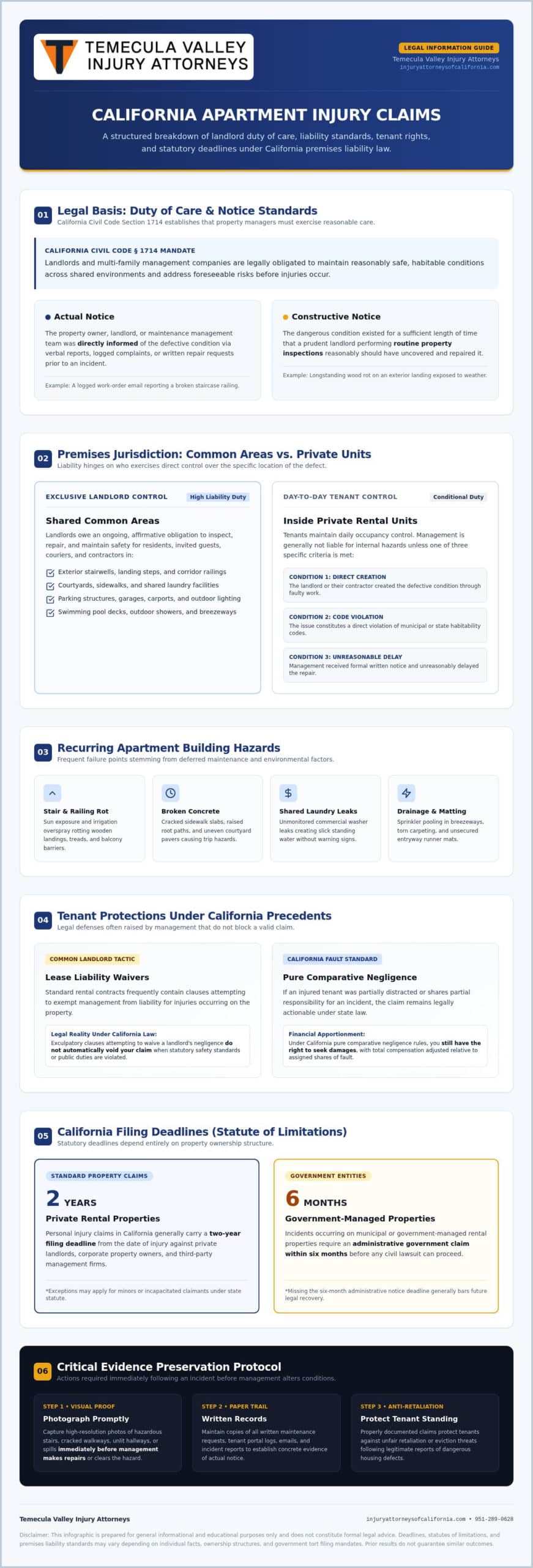
Under California Civil Code Section 1714, property owners must manage their property with reasonable care. In a multi-family complex, this responsibility means taking active steps to prevent foreseeable risks to residents and visitors. When an injury happens, liability doesn’t automatically fall on the owner. You generally must prove that the landlord or property manager had actual notice (they were directly informed) or constructive notice (the defect existed long enough that regular inspections should have uncovered it) and failed to take corrective action.
Duty of Care Owed to Tenants and Guests
Landlords owe a legal duty of care not just to the individuals named on a lease, but also to visiting guests, contractors, and delivery couriers lawfully on the property. Prudent Temecula property managers must perform periodic inspections to identify hidden structural issues or slip hazards before someone gets hurt. Because third-party management companies usually handle the daily operations and maintenance contracts for apartment communities, they generally share legal responsibility alongside the property owner. If you were hurt in a complex, consulting a dedicated team handling personal injury claims like Temecula Valley Injury Attorneys helps determine every party accountable for your damages under foundational principles of Premises Liability Law.
Common Areas vs. Private Rental Units
Understanding where the hazard occurred is a crucial element of your case. Landlords maintain exclusive control over shared common areas. This gives them an ongoing legal obligation to inspect and maintain:
- Exterior stairwells, landing steps, and corridor railings
- Courtyards, sidewalks, and shared laundry facilities
- Parking garages, carports, and outdoor lighting fixtures
Inside private rental units, tenants generally exercise daily control. A landlord is usually not liable for internal hazards unless they created the defect, violated local habitability codes, or received a written maintenance request and unreasonably delayed making repairs. Documenting your maintenance requests in writing establishes clear evidence of notice, which an experienced apartment building injury attorney Temecula residents rely on can use to build a compelling claim.
Common Apartment Building Hazards That Lead to Injury Claims
Rental communities experience constant foot traffic, which accelerates wear and tear on shared amenities. When property owners defer basic maintenance to save on overhead, everyday structural and environmental conditions turn into dangerous hazards. Understanding how these issues arise helps clarify property management liability under official California Tenant Rights guidelines.
Structural Defects and Poor Maintenance
Corporate landlords often postpone structural repairs until an incident occurs. In Southern California’s climate, sun exposure and irrigation overspray frequently rot wooden staircases, second-story landings, and balcony railings. When a tenant leans against a deteriorating railing or steps on a compromised stair tread, the resulting collapse can cause catastrophic injuries. Broken concrete walkways and sunken courtyard pavers also present major hazards. In Temecula, violating municipal building codes or California safety mandates during property upkeep can establish negligence per se, simplifying your path to proving liability.
Slip, Trip, and Fall Hazards in Shared Spaces
Spills and wet surfaces represent another frequent source of residential injuries. Common culprits include:
- Unmonitored puddle accumulation around apartment swimming pools and outdoor showers
- Leaking commercial washers in shared laundry rooms
- Poorly drained breezeways after sprinkler cycles
- Torn or bunched hallway carpeting and unsecured entryway mats
Our firm routinely assists tenants hurt in preventable slip and fall accidents caused by ignored spills or inadequate lighting along dark outdoor walkways and parking garages.
Negligent Security and Failure to Protect
A landlord’s legal duty extends beyond physical trip hazards; it also includes protecting residents from foreseeable criminal conduct. Under California law, property managers may face liability for assaults or robberies occurring on the premises if they failed to maintain reasonable security measures. Key vulnerabilities include broken perimeter gates, broken security doors, and unlit subterranean parking structures. If management knew about prior criminal activity in the immediate neighborhood and failed to repair security hardware, that inaction establishes the foreseeability needed to pursue damages.
Uncovering whether management ignored prior warnings requires swift action. If an apartment hazard caused you physical harm, schedule a free case evaluation with a dedicated apartment building injury attorney Temecula tenants trust to investigate your claim.
Proving Fault and Overcoming Common Landlord Defense Tactics
Property managers and their insurance carriers rarely accept liability without a fight. Instead, they routinely deploy aggressive legal defenses designed to shift the blame onto injured residents or dismiss valid claims altogether. Successfully holding them responsible requires concrete proof of notice, which often comes down to tracking past work orders, maintenance logs, emails, and complaints filed by other tenants.
The Truth About Lease Liability Waivers
Most residential lease agreements contain exculpatory clauses stating that management isn’t liable for personal injuries on the grounds. In California, these blanket liability waivers have strict legal limits. Landlords cannot legally contract away responsibility for gross negligence, safety code violations, or failures affecting habitability. While waivers might shield landlords regarding voluntary amenities like fitness centers under specific circumstances, they generally don’t apply to basic common area safety. You should always have a qualified apartment building injury attorney Temecula tenants trust examine your lease before assuming you’ve signed away your legal rights.
Addressing Open and Obvious Defense Arguments
Insurance adjusters frequently argue that a cracked walkway, uneven threshold, or missing lightbulb was “open and obvious,” claiming you simply failed to watch where you were walking. However, California law recognizes that if a defect exists along an unavoidable path, such as the only walkway to your front door or mailbox, the landlord must still take reasonable measures to remedy it. Momentary distractions, like carrying groceries or holding a child’s hand, don’t automatically excuse a landlord’s ongoing failure to repair a recognized hazard. Meeting the standard for Proving Fault in a Premises Liability Claim means proving that the owner had a duty to make the path reasonably safe regardless of whether the defect was visible.
How Comparative Fault Operates in California
Even if an adjuster insists you share blame for your fall, California’s pure comparative fault rule protects your right to seek compensation. Under this doctrine, your recovery is simply reduced by your percentage of responsibility. For instance, if a Riverside County jury determines your damages total $100,000 but finds you were 25% responsible because you were texting, you could still recover $75,000 from the negligent property owner. At Temecula Valley Injury Attorneys, we regularly resolve multi-party personal injury claims by challenging attempts to unfairly inflate your comparative fault.
Essential Steps to Take Immediately After an Apartment Building Injury
The moments immediately following a fall or property accident are critical. In rental communities, dangerous conditions rarely remain static. On-site crews often clean spills, patch broken stairs, or replace faulty bulbs quickly once an incident occurs, inadvertently erasing physical evidence. Acting quickly to preserve proof protects your claim before property records or physical conditions change.
Documenting the Scene and the Hazardous Condition
Take extensive photos of the exact defect from multiple vantage points before leaving the area. Capture wide angles showing where the hazard sits within the complex, alongside close-up shots that reveal height differentials, pooled fluids, or cracked concrete. If an incident happens at night, record video footage that shows broken fixtures or pitch-black corridors without using your phone flashlight. Be sure to note the time, date, and weather conditions. You should also preserve the exact shoes and clothing you were wearing, keeping them unwashed in a secure bag.
Formal Reporting and Communication Guidelines
Alert property management in writing as soon as possible. Avoid verbal-only discussions with on-site staff. Instead, take these concrete steps:
- Submit a clear, factual written summary through the tenant resident portal or by certified mail.
- Request an official, time-stamped copy of the incident report for your own records.
- Gather names and phone numbers of neighboring tenants, guests, or delivery couriers who saw the fall or previously complained about the hazard.
- Decline to give recorded statements to the landlord’s claims adjuster until you have legal guidance.
Keep a dedicated file containing all your lease paperwork, maintenance requests, rent receipts, and written messages with office personnel.
Medical Documentation and Follow-Through Care
Seeking a prompt medical evaluation protects both your health and your legal rights. Visit an urgent care clinic or local emergency department right away, even if you feel your symptoms might resolve on their own. Traumatic injuries like concussions, torn ligaments, and hairline fractures often worsen over the first 48 hours. Report every affected body part to the treating physician so your medical chart reflects the full scope of your trauma from day one. Follow all doctor instructions diligently, attend scheduled physical therapy sessions, and keep copies of intake notes, radiology reports, and medical billing receipts.
Before insurance representatives attempt to downplay your injuries, schedule a free case evaluation with an experienced apartment building injury attorney Temecula residents rely on to review the facts of your injury.
California Statutes of Limitations and Legal Representation in Temecula
Filing an injury claim against a negligent property owner requires strict adherence to California procedural deadlines. Even when liability seems clear, waiting too long can permanently bar your recovery. Knowing these timelines helps you protect your rights from day one.
Critical Deadlines Governing Your Injury Claim
Under California Code of Civil Procedure Section 335.1, you generally have two years from the date of your injury to file a personal injury lawsuit against private landlords and property management corporations. Certain exceptions can alter this timeline:
- Injuries involving minor children typically toll the two-year deadline until the child turns 18.
- Injuries occurring on property owned or operated by a government entity, such as municipal public housing authorities, trigger the California Tort Claims Act. In these situations, you must file a formal administrative claim within six months of the incident.
Missing these rigid deadlines usually results in an immediate dismissal of your case by the court.
Navigating Insurance Settlements and Riverside County Courts
Corporate residential property owners maintain substantial commercial liability insurance policies. Their adjusters and legal teams work diligently to reduce financial payouts by challenging medical treatment costs or questioning injury severity. When negotiations fail to yield a fair resolution, your case may proceed to formal litigation within the Riverside County Superior Court system. Most cases resolve through negotiated out-of-court settlements, but formal jury trials remain an essential pathway when insurers refuse to take responsibility. When property neglect leads to catastrophic losses or a tragic wrongful death, comprehensive court filings ensure all responsible entities face accountability.
How Temecula Valley Injury Attorneys Advocates for You
Complex corporate ownership structures often hide who actually owns and operates multi-family housing developments. We conduct detailed investigations to identify property titles, corporate entities, maintenance contracts, and safety violation histories. We review local building permits and city inspection reports to uncover patterns of deferred repairs.
Our team works closely with residents throughout Temecula, Murrieta, and Fallbrook to ensure their voices are heard. Working alongside an apartment building injury attorney Temecula tenants trust gives you the space to heal while we handle the legal legwork. Schedule a free case evaluation with Temecula Valley Injury Attorneys by calling 951-289-0628 to explore your options.
Protecting Your Rights as an Injured Temecula Tenant
Recovering from a severe fall or property accident while managing unexpected medical costs shouldn’t be made harder by an uncooperative landlord. Under California law, property owners have an ongoing duty to keep common areas safe, and standard lease waivers rarely shield management from liability when basic maintenance is neglected. Acting quickly to preserve photographic proof, document medical visits, and secure written repair requests provides your claim with the solid evidentiary foundation it needs.
Temecula Valley Injury Attorneys is committed to standing up for local renters. With our office located directly in Temecula serving Riverside and San Diego Counties, our practice focuses specifically on California premises liability and tenant injuries. We handle claims on a contingency fee basis with no upfront legal fees, and case costs are explained transparently during every stage of the process. Partnering with a dedicated apartment building injury attorney Temecula tenants trust ensures your rights stay protected against corporate landlords and insurance adjusters.
You don’t have to carry this burden on your own. Call our team today at 951-289-0628 or schedule a free case evaluation to explore your legal options.
Frequently Asked Questions
Can I sue my landlord if I was injured inside my own apartment in Temecula?
Yes, you can sue your landlord for an injury inside your unit if the incident stemmed from their negligence or failure to maintain habitability standards. While tenants generally control their private living quarters, landlords remain liable if they created a defect, performed faulty repairs, or ignored written requests regarding dangerous conditions such as broken floorboards, leaking pipes, or faulty wiring.
How long do I have to file an apartment injury lawsuit in California?
In most situations, California Code of Civil Procedure Section 335.1 gives you two years from the date of the injury to file a lawsuit against private property owners. However, exceptions exist. If a minor child suffers harm, the deadline is generally paused until their 18th birthday. Acting promptly gives an apartment building injury attorney Temecula residents trust time to preserve critical physical evidence before it disappears.
What happens if my lease agreement includes a clause waiving landlord liability for injuries?
Lease liability waivers rarely protect landlords from basic premises negligence or habitability violations under California law. The courts routinely invalidate lease provisions that attempt to excuse a landlord’s gross negligence, violation of local building codes, or failure to maintain safe common paths. You should have an attorney review your lease before assuming you’ve signed away your right to pursue a claim.
Can I still recover damages if I was partially at fault for my slip and fall?
Yes, California follows a pure comparative negligence system that allows you to seek damages even if your own actions contributed to the incident. Under this rule, your total financial award is simply reduced by your percentage of fault. For example, if you are found 20% responsible for looking at your phone during a fall, you can still collect 80% of your total awarded damages.
Who is legally responsible if an apartment building visitor gets injured on the property?
Landlords and property management companies owe the same basic duty of reasonable care to invited guests, couriers, and visitors as they do to leaseholders. If a guest trips over broken walkway concrete or falls due to an unlit stairwell, both the property owner and the third-party management company may be held liable. Consulting an apartment building injury attorney Temecula visitors turn to helps identify every responsible insurance policy.
What if my apartment building is owned or managed by a government entity?
If your apartment complex is operated by a public housing authority or municipal government, you face a significantly shorter filing deadline. Under the California Tort Claims Act, you must file a formal administrative claim with the responsible agency within six months of the incident. Missing this six-month administrative window will permanently bar you from filing a subsequent civil lawsuit in court.


