

After a grocery-store fall, one key question is how long the hazard had been there. If you experienced a slip and fall at grocery store El Centro, the store may be legally responsible if it knew or reasonably should have known about a dangerous condition and failed to take reasonable steps to address it. The fall alone doesn’t establish responsibility. The hazard, what the store knew, and the evidence available may all matter.
It’s understandable to worry that surveillance video or witness details could disappear, or to feel unsure about what to document after an injury. This article explains factors that may affect a California grocery-store fall claim and practical steps that could help preserve useful evidence, without assuming fault. It also explains why medical records may matter and what filing deadlines to consider. Many personal injury lawsuits generally have a two-year deadline, but a fall on public property may involve a much shorter government-claim deadline. Exceptions may apply, including for minors. Knowing these basics can help you decide what questions to ask next.
Key Takeaways
- A fall by itself doesn’t establish grocery-store liability. The condition, notice, and connection to your injury may matter.
- For a slip and fall at grocery store El Centro, record the date, time, specific area, and names of potential witnesses while details are fresh.
- Seek appropriate medical care and keep records related to your injury and treatment.
- Being partly responsible for a fall doesn’t automatically end a California claim, but it may affect how responsibility is assessed.
- A concise timeline and relevant records can help explain what happened and identify questions that still need answers.
Slip and fall at a grocery store in El Centro: what facts may matter?
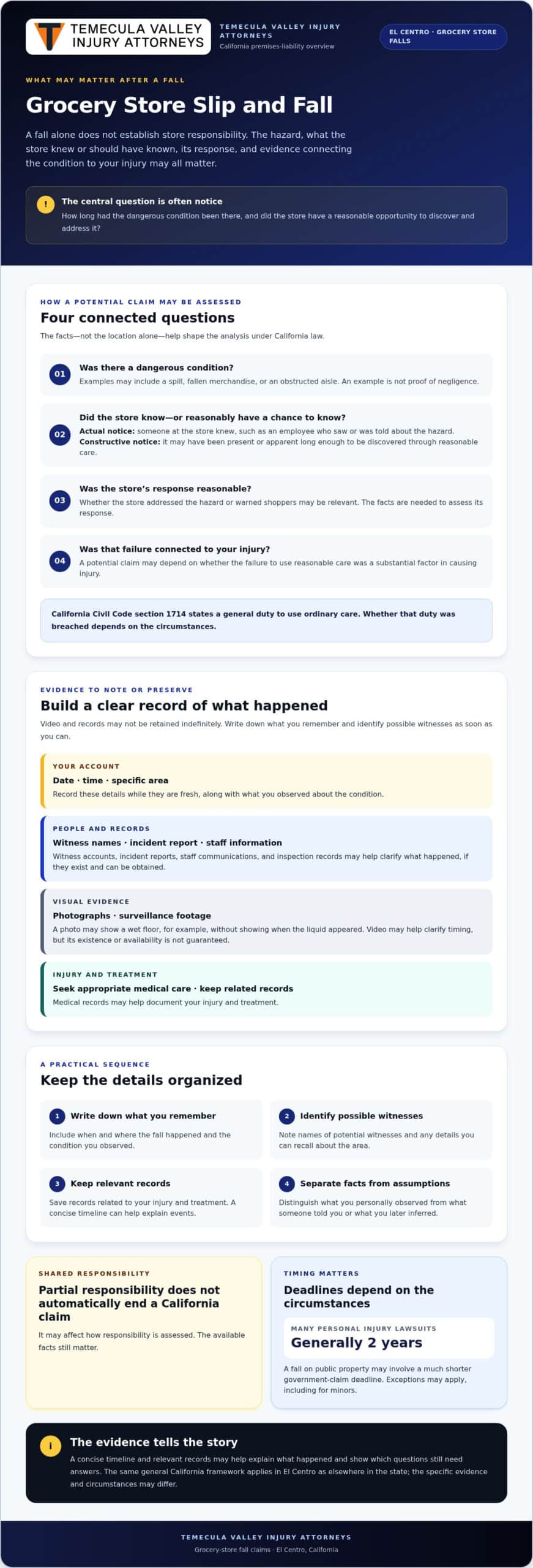
A fall alone doesn’t establish that a grocery store is legally responsible. A potential claim may depend on whether a dangerous condition existed, whether the store knew or reasonably should have known about it, whether it acted reasonably, and whether the condition caused your injury. Premises liability is the area of law that may hold a property operator responsible when a failure to use reasonable care on its property causes harm. The premises liability concept provides a general overview, but the specific facts and California law guide how a claim is assessed.
For a slip and fall at grocery store El Centro, the same general California legal framework applies as elsewhere in the state. The location helps identify the store and potential witnesses, but a fall in El Centro does not create a separate local liability standard. You can learn more about the firm’s slip and fall legal services.
What counts as a potentially hazardous grocery-store condition?
Examples may include a spill on the floor, fallen merchandise, or an obstructed aisle. These are illustrations, not proof that a store acted negligently. The existence of a hazardous condition does not, by itself, show how it arose, how long it was there, or whether store staff had a reasonable opportunity to discover and address it.
Those details matter. A spill that appeared moments before a fall may raise different questions from one that remained for a longer period. The store’s response after learning about a hazard, such as whether it cleaned the area or warned shoppers, may also be relevant. Don’t assume a particular inspection practice or safety-rule violation without supporting evidence.
Why does the store’s notice of a hazard matter?
“Actual notice” generally means the store knew about the hazard, for example, because an employee saw it or someone reported it. “Constructive notice” generally means the condition existed long enough, or was apparent enough, that the store may have discovered it through reasonable care. California Civil Code section 1714 sets out a general duty to use ordinary care, though whether that duty was breached depends on the circumstances.
Liability depends on evidence about the hazard and the store’s response, not merely on the fact that you fell. The timing and condition of the area, witness accounts, inspection or incident records, and available video may help clarify what happened and what the store knew. Video and records may not be retained indefinitely, so write down what you remember and identify potential witnesses as soon as you can.
How California premises-liability rules may apply to a grocery-store fall
California law generally requires people and businesses to use ordinary care to avoid causing injury to others. California Civil Code 1714 states this general principle. For a grocery-store fall, the question is not simply whether a shopper fell. The facts may need to show that a dangerous condition existed, the store failed to use reasonable care in addressing it, and that failure was a substantial factor in causing injury.
For a slip and fall at grocery store El Centro, the same state-law framework applies as elsewhere in California. The store’s responsibility cannot be determined from its location alone. The condition, what the store knew or reasonably should have known, the steps it took, and the connection between the condition and the injury all matter. For incidents in El Centro, Temecula, Murrieta, San Diego, and Fallbrook, the applicable California framework is the same, but the specific evidence and circumstances may differ.
What evidence can help show what the store knew or should have known?
Depending on what exists and can be obtained, useful evidence could include an incident report, witness accounts, photographs taken near the time of the fall, or surveillance footage. Inspection records or staff communications may also help clarify when the condition appeared or whether someone reported it.
Don’t assume that video or a particular record exists, will be retained, or can be accessed. Separate what you personally observed from what you were told or later inferred. A photo, for example, may show a wet floor without establishing when the liquid appeared. That distinction may matter when assessing whether the store had a reasonable opportunity to discover and address the condition.
How do causation and injury fit into a potential claim?
A potential claim generally involves more than documenting that a fall occurred. Evidence must connect the alleged hazardous condition to the fall and resulting harm. Your account, witness observations, photographs, and relevant records may help explain that sequence. Avoid guessing about where the hazard came from or how long it was present.
Proof that you fell is not, by itself, proof that a store hazard caused your injury. If you’re hurt, seek appropriate medical guidance and keep relevant records, such as visit summaries or instructions you receive. These materials may document the timing and effects of your injury, but they don’t alone establish what caused the fall or whether the store failed to use reasonable care.
Common grocery-store fall claim challenges: notice, evidence, and shared fault
A claim may be disputed even when you remember the fall clearly. The store may challenge whether a hazard existed, how long it was present, whether staff had a chance to address it, or whether that condition caused your injury. California’s general duty of ordinary care appears in California Civil Code § 1714, but applying that standard depends on the evidence in the particular incident.
Missing or conflicting information can make those questions harder to assess. A witness may recall seeing liquid before the fall, while a video angle may not show when it appeared. Neither gap automatically proves or defeats a claim. For a slip and fall at grocery store El Centro, keep your account factual and distinguish what you observed from what you suspect.
| Allegation | Potentially relevant evidence | What remains unproven |
|---|---|---|
| A spill was present before the fall. | Witness accounts, photographs, video, or incident records. | When the spill appeared and whether the store knew or should have known about it. |
| The store did not respond reasonably. | Records or accounts that help establish when staff learned of the hazard and what happened next. | Whether the response was unreasonable in the circumstances. |
| The hazard caused the reported injury. | Your description of the fall and relevant medical records. | Whether the hazard caused the fall and the nature or extent of resulting harm. |
What if the store says it did not know about the spill?
The dispute may turn on timing: when the condition appeared, when anyone noticed it, and whether the store had a reasonable opportunity to respond. Inspection records, witness observations, an incident report, or surveillance footage may help clarify that timeline if available. No single item necessarily settles whether the store had notice or used reasonable care. A report may document what was reported after the fall without establishing how long the hazard existed beforehand.
Can a shopper’s own actions affect the claim?
They may be considered, but being partly at fault does not automatically end a California claim. California follows a pure comparative negligence approach: if an injured person is found partly responsible, potential damages may be reduced according to that share of fault. The circumstances matter. For example, people may dispute whether a condition was visible, whether the shopper could see the walking area, or whether an obstruction affected the fall. These are questions to assess from the evidence, not assumptions about blame or predictions about a particular outcome.
Steps to Take After a Grocery Store Fall in El Centro
After a grocery-store fall, focus first on your safety. Once immediate needs are addressed, write down what happened and preserve relevant information while details are fresh. These steps can help create a clearer record without assuming who was at fault.
Immediate safety needs
- Check your condition and seek appropriate help. Move only if it’s safe to do so. If you need medical attention, seek it and follow the guidance you receive.
- Tell store staff about the fall. If you’re able, report what happened and where. Ask whether the store will document the incident and how to request a copy of any report available to you.
- Note potential witnesses. If someone saw the fall or the area beforehand, ask for their name and contact information if they’re willing to share it.
Later documentation
- Write down the details. Record the date and approximate time, store location, precise area where you fell, what you observed, and any changes you noticed afterward. Separate what you saw yourself from what someone else told you.
- Photograph the area if it’s safe and lawful. Images of the floor, lighting, nearby objects, or warning signs may help document conditions. Don’t put yourself at risk to take pictures.
- Keep relevant records. Save communications with the store, any incident documentation you receive, and records related to care for your injury. Preserve original photos and messages where possible. Don’t alter, stage, or exaggerate images or statements.
If you experienced a slip and fall at grocery store El Centro, consider making a prompt, factual request that potentially relevant evidence be preserved. You could ask about surveillance footage, incident records, or information identifying witnesses. A request doesn’t guarantee that records exist, will be retained, or can be provided directly to you. Access may depend on the circumstances and applicable process. You may wish to discuss how to make a preservation request with an attorney.
If you’d like to discuss the timeline, location, and evidence you have, Schedule a free case evaluation with Temecula Valley Injury Attorneys.
Discussing an El Centro grocery-store fall with Temecula Valley Injury Attorneys
An initial case evaluation with Temecula Valley Injury Attorneys can help organize what happened and identify questions that remain open. The discussion may cover when and where you fell, what you observed, how the store responded, what evidence you have, and what information may still need clarification. It’s a chance to review facts and possible next steps, not a promise about liability or an outcome.
What information may help during a case evaluation?
Start with a concise account in your own words. Include the approximate date and time, the part of the store where you fell, what you recall seeing, and what happened afterward. Be clear about what you personally observed and what you learned from someone else. If you’re unsure about a detail, say so rather than guessing.
If available, you may bring or describe:
- Photographs of the area or the condition you noticed.
- Names or contact details for potential witnesses.
- Any incident paperwork you received from the store.
- Relevant messages or other communications with store representatives.
- Records related to medical care after the fall.
You don’t need every item before discussing your situation. Missing records or photographs don’t automatically determine whether it can be evaluated. A clear timeline and an honest account can help identify what is known, what is uncertain, and what may be useful to review further.
What should you understand before deciding on next steps?
Every grocery-store fall involves its own facts. An evaluation can help assess the information available, but no result can be guaranteed. Deadlines also matter. Many California personal injury lawsuits generally must be filed within two years, but a claim involving public property may have a much shorter government-claim deadline. Different rules or exceptions may apply, including for minors. Don’t assume a general deadline applies to your circumstances.
This article provides general information, not individualized legal advice. A discussion with an attorney may help you understand which questions to consider, even if you don’t have a complete file or a final decision about what to do next.
Take a clear next step after a grocery-store fall
A slip and fall at grocery store El Centro doesn’t establish store responsibility by itself. The condition, how long it may have existed, the store’s response, and evidence connecting it to an injury can all matter. Your own actions may also be considered, but partial responsibility doesn’t automatically resolve a potential claim.
Write down what you remember, keep relevant records, and identify possible witnesses. If you’re unsure whether video or incident documentation exists, avoid making assumptions. Reviewing the timeline, location, available evidence, and unanswered questions may help you understand what options to consider.
Deadlines can depend on the circumstances. A government-claim deadline may be shorter than the general deadline for a personal injury lawsuit, and exceptions may apply, including for minors. Consider getting guidance promptly rather than relying on a general timeline.
Temecula Valley Injury Attorneys can review the information you have without promising a particular outcome. Schedule a free case evaluation to discuss your situation and possible next steps. You can take the process one question at a time.
Frequently Asked Questions
Is a grocery store automatically responsible if I slip and fall there?
No. A fall inside a store doesn’t, by itself, establish legal responsibility. A potential claim may depend on whether a hazardous condition existed, whether the store knew or reasonably should have known about it, and whether it used reasonable care to address it. The evidence must also connect the condition to an injury. The facts of each situation matter, so avoid drawing conclusions from the fall alone.
How can I prove a grocery store knew about a spill in El Centro?
You may be able to use witness accounts, photographs, incident documentation, surveillance footage, or other information about when the spill appeared and how the store responded. No single item automatically proves notice, and video or records may not exist or be available. Write down what you personally observed, separating it from assumptions about timing. An attorney can help assess what evidence may be relevant and how to address preservation.
Can I bring a claim if I may have been partly responsible for my fall?
Possibly. California generally applies comparative-fault principles, so your share of responsibility may affect a claim rather than automatically prevent one. If a person is found partly at fault, potential damages may be reduced based on that share. How the law applies depends on the facts and current law. Don’t assume you have no claim or that the store must be responsible without reviewing the circumstances and available evidence.
What should I do immediately after slipping in a grocery store?
Prioritize your immediate safety and seek appropriate medical attention. If you can do so safely, report the fall to store staff and note the date, time, exact area, and names of potential witnesses. Photographs of the condition may help if you can take them safely and lawfully. Keep copies of paperwork and relevant communications. Stick to what you observed, and don’t speculate about fault or exaggerate what happened.
How long do I have to file a grocery-store slip-and-fall claim in California?
For most California personal injury lawsuits, including slip-and-fall cases, the general deadline is two years from the injury date. A fall on public property may require a formal government claim within six months. Different rules and exceptions can apply, including for minors, and the deadline may depend on the circumstances. Don’t rely on a general article to calculate your time limit. Ask a qualified attorney to review it promptly.
Should I talk to an attorney if the grocery store has no video of my fall?
You may still ask an attorney to evaluate what evidence is available. Witness accounts, photographs, incident records, communications, and other facts may help explain what happened, even if footage is unavailable. For a slip and fall at grocery store El Centro, the absence of video doesn’t automatically establish or defeat a claim. Be accurate about what you know, preserve available records, and don’t assume what any unseen footage would have shown.


