

Trip and Fall on Uneven Sidewalk Lawyer Fallbrook: Your Guide to California Sidewalk Claims
Could a public agency be responsible for a fall on a broken sidewalk, or could liability rest with a nearby property owner? If you’re searching for a trip and fall on uneven sidewalk lawyer Fallbrook residents can consult, the answer depends on who controlled the area, whether the responsible party knew or should have known about the hazard, and how serious the defect was. A duty to maintain a sidewalk doesn’t automatically establish liability for an injury, so the details matter.
Medical bills and missed work can add pressure while you’re trying to determine whether the sidewalk was public or private property. This guide explains how California premises liability rules may apply in Fallbrook, what evidence can help show notice of a dangerous condition, and why a defect’s size is only one factor courts may consider. It also covers key deadlines: claims against public entities generally must be presented within six months, while injury lawsuits against private parties generally have a two-year deadline. Exceptions may apply, so acting promptly can help protect your options.
Key Takeaways
- Sidewalk repair responsibility and legal responsibility for an injury are separate questions under California law.
- Notice of a hazard and the surrounding conditions may affect a claim, beyond the sidewalk’s height difference alone.
- Preserving details about the sidewalk defect, the scene, and your injuries can help document what happened.
- A trip and fall on uneven sidewalk lawyer Fallbrook residents consult can help assess whether a public entity or private party may be responsible.
- Government-claim deadlines differ from the general deadline for a personal injury lawsuit against a private party.
Understanding Sidewalk Liability Laws in Fallbrook
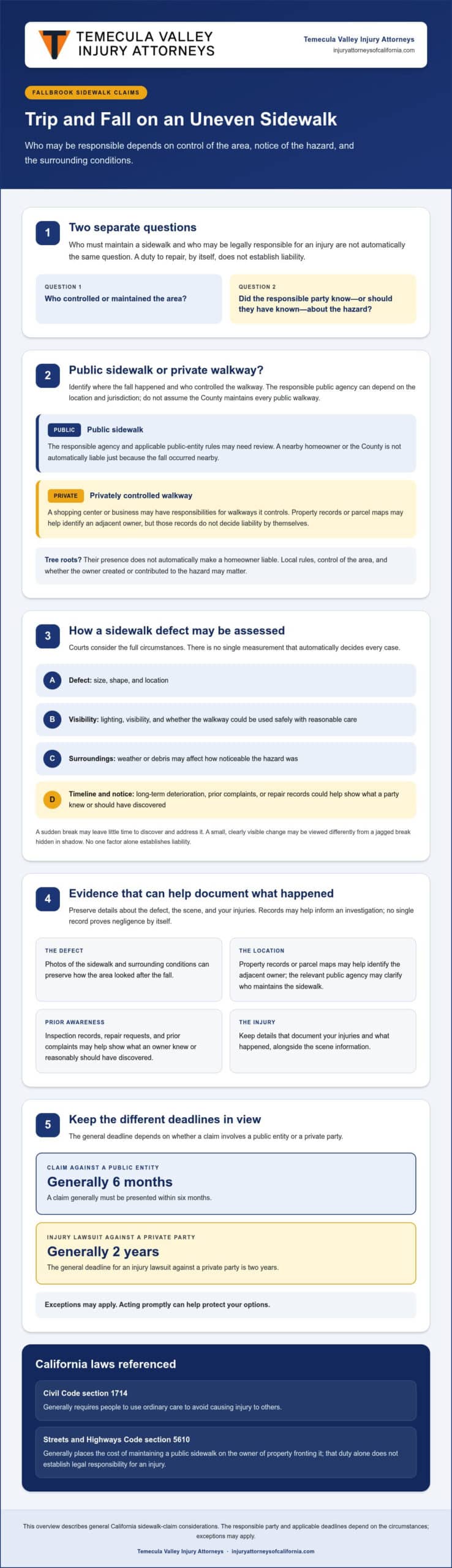
A fall on an uneven sidewalk doesn’t automatically mean a property owner or public agency is legally responsible. California premises liability law generally asks whether the responsible party failed to use reasonable care and whether that failure contributed to the injury. Sidewalk claims can be more complicated than falls inside a store because the walkway’s ownership, maintenance history, and applicable public-entity rules may all matter.
California Civil Code section 1714 generally requires people to use ordinary care to avoid causing injury to others. For a property owner, that can include taking reasonable steps to address hazards on property they control. But responsibility for maintaining a sidewalk and liability for an injury are separate questions. If your fall happened on a public walkway, the applicable local rules and the identity of the responsible public entity may also need review. For more on the general legal concept, see Understanding Premises Liability. You can also learn about slip-and-fall claims.
The Duty of Care for Fallbrook Property Owners
Premises liability is the area of California law that may hold a property owner responsible when a failure to use reasonable care to keep property reasonably safe causes someone’s injury. Regular inspections can help identify hazards before someone gets hurt, but the circumstances matter. Inspection records, repair requests, and evidence of prior complaints may help show what an owner knew or reasonably should have discovered. The absence of a record alone doesn’t establish negligence.
When Is an Uneven Sidewalk Considered Dangerous?
Courts look at the full circumstances, not just whether a sidewalk has a crack or height difference. They may consider the defect’s size and shape, its location, lighting, visibility, and whether the walkway could be used safely with reasonable care. A small, clearly visible change may be treated differently from a jagged break hidden in shadow. There is no single measurement that automatically decides every case.
Weather and visibility can affect how noticeable a defect was. Rain, debris, or poor lighting may make a hazard harder to see, but those details don’t by themselves establish liability. Photos of the sidewalk and surrounding conditions can help preserve what the area looked like after the fall.
The timeline also matters. A sudden break may leave little time for anyone to discover and address it. Long-term deterioration, prior complaints, or repair records could help show that a responsible party knew or should have known about the hazard. This notice question, combined with the public-versus-private property distinction, is one reason a trip and fall on uneven sidewalk lawyer Fallbrook residents consult may need to investigate more than the defect’s appearance.
Determining Liability: Who is Responsible for Your Fall?
A sidewalk fall in Fallbrook doesn’t automatically make the nearest homeowner or the County of San Diego liable. California Streets and Highways Code section 5610 generally places the cost of maintaining a public sidewalk on the owner of property fronting it. But a duty to repair does not, by itself, establish that the owner is legally responsible for a pedestrian’s injuries. Liability may depend on who controlled the area, whether a local ordinance shifts responsibility, and whether the relevant party had notice of the hazard.
Public vs. Private Property Claims
First, determine whether the fall occurred on a public sidewalk or on a walkway controlled by a private property owner, such as a shopping center. In Fallbrook, the responsible agency can depend on the location and jurisdiction, so don’t assume the County maintains every public walkway. Property records or parcel maps may help identify the adjacent owner, while the relevant public agency may be able to clarify who maintains the sidewalk. These records can inform the investigation, but they don’t decide legal liability on their own.
Tree roots can lift sidewalk panels, but their presence doesn’t automatically make the homeowner liable. Potential responsibility may depend on applicable local rules, control of the area, and whether the owner created or contributed to the hazard. The same distinction matters at commercial properties: a business may have responsibilities for walkways it controls, while a public sidewalk outside its boundary raises separate questions about maintenance and liability.
The Role of Notice in Proving Negligence
Notice helps establish whether a potentially responsible party had a fair opportunity to address a dangerous condition. Actual notice means the party knew about the specific defect, perhaps through a complaint or inspection. Constructive notice means the condition may have existed long enough, or been apparent enough, that reasonable inspection could have uncovered it. Evidence must connect the notice to the party being held responsible.
Maintenance logs, inspection records, repair requests, and prior complaints may help show what a party knew and when. Photographs can preserve details of the defect and its surroundings. If a public entity may be involved, identifying it promptly matters because government claims generally have a shorter filing deadline than lawsuits against private parties.
For public-entity claims, California Government Code section 830.2 addresses when a condition may be considered trivial. The assessment depends on the circumstances, not just a measurement. You can review the California statute on trivial defects.
The Trivial Defect Rule: Why One Inch Matters
A sidewalk crack doesn’t automatically make a property owner or public entity liable. California courts may find a defect too minor to support liability, but there is no fixed “one-inch rule” that decides every case. Courts consider the full setting, including the defect’s size, shape, location, lighting, and any evidence of prior accidents.
Trivial vs. Actionable Defects
A difference of less than 3/4 inch may be viewed differently from one greater than 1.5 inches, but neither measurement determines the outcome by itself. California courts have treated defects around 3/4 to 7/8 of an inch as trivial in some circumstances. A jagged edge, hidden gap, poor lighting, or debris nearby could change how the hazard is assessed. Aggravating factors may help show that even a small defect created a dangerous condition under the circumstances.
That’s why “one inch matters” should not be mistaken for a bright-line legal test. A raised edge in a well-lit, open walkway may present a different situation from a sharp break partly concealed by shadow. The California statute on trivial defects addresses public-entity claims, while the facts and applicable law shape the analysis in any particular case.
Photographs can preserve details that may change after repairs or weather. If you can do so safely, take wide shots showing the walkway and lighting, then close-ups from different angles. Place a ruler or tape measure beside the height difference without changing the scene. Record the location and date, and keep the original images.
Common Defenses in Sidewalk Trip and Fall Cases
A defendant may argue that the defect was open and obvious, meaning a person using reasonable care could have noticed and avoided it. The conditions at the time, including visibility and the path available, may matter. A claim may also involve comparative negligence. If you’re found partly responsible for the fall, that could reduce compensation rather than automatically prevent recovery.
When assessing a sidewalk claim, the defect’s measurements are only one part of the picture. Photographs, lighting, surrounding conditions, and available notice evidence may all matter. A careful review can help address an argument that the defect was trivial without assuming that a particular measurement proves liability. If you’re looking for a trip and fall on uneven sidewalk lawyer Fallbrook, consider asking how the investigation will address both the physical condition and the circumstances of your fall.
Critical Steps to Take After a Fallbrook Sidewalk Accident
Put your health first. Get medical care for injuries, and follow the guidance of your healthcare provider. If you can safely do so, document the scene before the sidewalk is repaired or changes. These early details may help clarify where you fell, what the hazard looked like, and who may have maintained the area.
Evidence Collection Checklist
Take photos promptly, but don’t put yourself at risk or delay medical care to do so. Capture the defect from close and wider angles, including nearby landmarks, the surrounding walkway, and lighting conditions. If practical, photograph the height difference with a ruler or tape measure without altering the scene. Keep original images and note the date and location. If you live in Fallbrook or a nearby community such as Temecula, Murrieta, San Diego, or El Centro, record the precise location rather than relying on a city name alone. A street address, intersection, or nearby landmark may help identify the correct sidewalk and agency.
- Get witness details. Ask anyone who saw the fall or knows how long the defect was present for their name and contact information.
- Keep what you wore. Set aside your shoes and clothing as they were after the incident, and avoid cleaning or repairing them before photographing their condition.
- Save relevant records. Keep medical paperwork, communications about the incident, and any reports you made to a property owner or public agency.
For more practical information about slip-and-fall injuries, review the steps that may help protect your records and document what happened.
Filing a Claim Against the County or City
If a public entity may be responsible, California’s Government Claims Act generally requires you to present a written claim within six months of the injury. This is a separate step from filing a lawsuit. If the entity formally rejects the claim, a different deadline generally applies to filing suit. Exceptions may apply, and the rules can depend on the circumstances, so don’t assume the usual two-year deadline for many injury lawsuits gives you more time to start a public-entity claim.
Identify the correct public entity before submitting a claim. Fallbrook sidewalk locations may involve different maintenance responsibilities, and the exact agency and filing instructions should be verified rather than guessed. A lawyer handling a government claim may help investigate responsibility, gather supporting records, prepare the required paperwork, and track applicable deadlines. Keep copies of everything you submit and any response you receive.
If you’re looking for a trip and fall on uneven sidewalk lawyer Fallbrook residents can consult about a potential claim, use the available contact information to ask about next steps.
How an Attorney Can Help with Your Claim
A sidewalk injury claim may involve more than showing where you fell. You may need to identify who controlled the walkway, document the defect, determine whether the responsible party had notice, and meet any deadlines that apply. An attorney familiar with premises liability claims may review the facts and explain how the applicable rules could affect your situation. For an overview of related legal topics, see personal injury practice areas.
An investigation may include reviewing photographs, witness accounts, maintenance or repair records, and information about the sidewalk’s location and condition. If the defect raises technical questions, consultation with an engineering expert may help assess its characteristics. The evidence needed depends on the facts, and no investigation can guarantee a particular result.
Questions to Ask When Discussing a Sidewalk Claim
A focused conversation can help you understand what remains uncertain and what records may be useful. Consider asking how the investigation would identify the responsible party, what evidence could help establish notice, and which deadlines might apply if a public entity is involved. You can also ask how comparative fault or a claim that the defect was trivial could affect the analysis. These questions can help keep the discussion tied to the specific sidewalk, conditions, and timeline in your case.
Responsibility for a sidewalk can be unclear, particularly when a public walkway borders private property. A review may consider the condition of the sidewalk, how long it may have existed, the surrounding visibility, and any available records of inspections or complaints. These details can help assess questions raised earlier in this guide, including notice and whether a defect may be considered trivial. Responsibility and potential recovery depend on the evidence and applicable law.
Getting Clear Information About Next Steps
Before deciding how to proceed, ask what information is needed to evaluate the claim and which deadlines require attention. You may also ask how communications with an insurer or public entity should be handled and what fee arrangement and case costs would apply. Request clear explanations of any terms before making a decision.
If you’re searching for a trip and fall on uneven sidewalk lawyer Fallbrook, you don’t have to sort through the property, evidence, and deadline questions alone. A thoughtful review may help you understand your options and make informed decisions about what comes next.
Take the Next Step With Clear Information
A sidewalk injury claim in Fallbrook can turn on details that aren’t obvious at first: who was responsible for the walkway, whether they knew or should have known about the hazard, and whether the defect was more than trivial under the circumstances. Photos, witness details, and prompt attention to deadlines may help preserve important information. Claims involving a public entity generally have a six-month claim-presentation deadline, so confirm which rules apply to your situation as soon as possible.
If you’re looking for a trip and fall on uneven sidewalk lawyer Fallbrook residents can speak with, seek guidance from a qualified California attorney about the facts, potential responsibility, and deadlines that may apply. A careful review can explain possible next steps without promising a particular result.
Contact an attorney to discuss what happened and ask whether further review may help. A clear understanding of your options can make the path forward feel more manageable.
Frequently Asked Questions
How long do I have to file a sidewalk-fall claim, and should I report it?
For an injury claim against a private party, California generally allows two years from the date of injury to file a lawsuit. If a public entity may be responsible, you generally must present a written claim within six months before filing suit. A formal denial may trigger another deadline. Report the incident to the relevant property owner or public agency when appropriate, but a report does not replace a required government claim. Exceptions may apply, including for minors.
Can I recover compensation if I was looking at my phone when I tripped?
Possibly. Looking at your phone doesn’t automatically bar a claim, but it may affect how fault is assessed. Under California’s comparative-fault rules, compensation could be reduced if you’re found partly responsible. The circumstances matter, including what you could see, the conditions around the sidewalk, and the conduct of any potentially responsible party. A trip and fall on uneven sidewalk lawyer Fallbrook residents consult may review the available evidence, but cannot promise a particular outcome.
What if the sidewalk crack was less than an inch high?
A crack under an inch isn’t automatically too small to support a claim. Courts generally consider the overall circumstances, which may include the defect’s shape, location, visibility, lighting, and evidence of prior incidents. A jagged edge or a gap that was difficult to see may be assessed differently from a smooth, clearly visible change in height. Measurements and photographs can document the condition, but no single measurement determines the outcome in every case.
Who may be responsible for a sidewalk broken by a tree root or located in front of a business?
Neither a nearby homeowner nor a business is automatically liable based on proximity alone. California law generally places public-sidewalk repair costs on the adjacent property owner, but that duty doesn’t by itself establish responsibility for an injury. Control of the walkway, applicable local rules, notice of the hazard, and whether a public entity is involved may matter. The exact location and property boundaries can help identify who should be investigated.
What compensation could be available after a trip-and-fall injury?
Depending on the evidence and applicable law, compensation may include medical expenses and lost wages related to the injury. Other damages could also be available in some cases. The losses you can document, the severity and effects of the injury, and questions of liability may affect a claim. Any recovery is not guaranteed and could be reduced if you’re found partly at fault.
Will my sidewalk-fall case settle or go to trial?
It’s not possible to know at the outset whether a claim will settle or proceed to trial. The decision may depend on the evidence, disputed issues, and whether the parties can reach an agreement. A lawyer can explain the steps and options based on the circumstances, but no one can guarantee a settlement or predict a trial result with certainty.
Disclaimer: This FAQ provides general information about California law and is not legal advice. It does not create an attorney-client relationship. Laws and deadlines may depend on the facts and can change. Consult a qualified attorney about your specific circumstances.


