

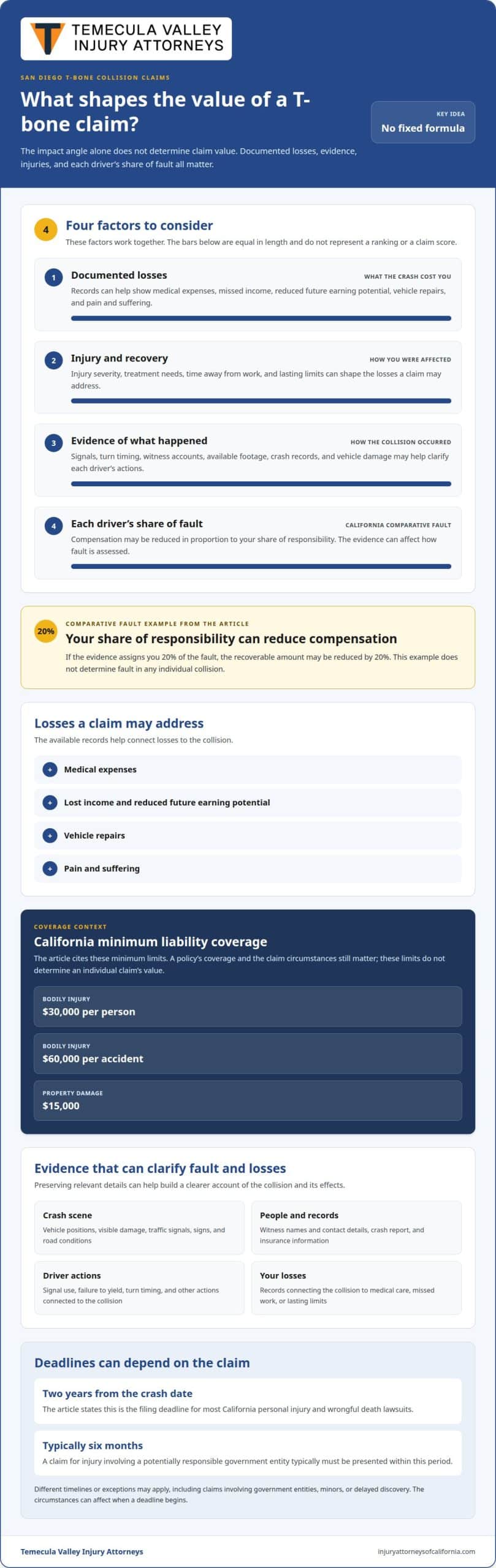
The impact angle alone doesn’t determine what your San Diego T-bone claim is worth. Its value depends on your documented losses and how fault is divided. Under California’s comparative fault rule, compensation may be reduced by your share of responsibility. A T-bone accident attorney in San Diego can assess how evidence of negligence relates to these factors.
It’s understandable to want a clear estimate while you’re dealing with treatment, missed work, and questions from insurers. The amount you may recover depends on your injuries and financial losses, the available evidence, and each driver’s actions.
This article explains how fault is assessed in side-impact collisions, which losses a claim may cover, and what can affect its value. It also outlines records and evidence that may help clarify what happened, and when legal guidance may be useful.
Key Takeaways
- A T-bone collision’s impact alone does not determine claim value; documented losses and evidence of how the crash happened also matter.
- Signal violations, failure to yield, and other driver actions may help establish responsibility, but the evidence must connect those actions to the collision.
- Photos, witness accounts, available footage, and crash records can help clarify disputed fault.
- A claim may include medical expenses, lost income, reduced future earning potential, vehicle repairs, and pain and suffering.
- Understanding how California’s comparative fault rule may affect compensation can help you assess settlement discussions and decide whether legal guidance may be useful.
T-bone and side-impact collision causes and risks
California’s minimum liability coverage includes bodily injury limits of $30,000 per person and $60,000 per accident, plus $15,000 for property damage, according to the California Department of Motor Vehicles. In a T-bone crash, the at-fault driver’s liability policy may apply, subject to its coverage and the claim circumstances.
A T-bone collision occurs when two vehicles strike at a right angle, often as they cross paths at an intersection. It is also called a side-impact or broadside collision. A car may strike another vehicle’s side as it travels straight through a junction, turns across traffic, or enters from a side street. The point and direction of impact can help investigators reconstruct the sequence of events.
Driver decisions often contribute to these crashes. A driver who runs a red light or stop sign may enter another vehicle’s path. An improper left turn without yielding, misjudging another vehicle’s speed, or failing to check for oncoming traffic can also cause a side-impact collision. Speeding can reduce reaction time, while distraction or fatigue can interfere with noticing a signal or approaching vehicle. These actions may be relevant when evaluating negligence.
San Diego County recorded 17,685 fatal and injury collision victims in 2022. That year, the county also recorded 3,653 speed-related fatal and injury collisions. San Diego reported 5,522 car accidents in 2022. Local crash data identifies speeding, improper turns, traffic-signal or sign violations, and failure to yield among collision factors. For example, a witness who saw a driver enter on a red signal could help clarify a disputed account.
Side impacts pose particular risks because a vehicle’s sides offer less protection than its front and rear. The force can injure occupants even if the visible vehicle damage seems localized. Reported side-impact injuries include whiplash, traumatic brain injuries, broken bones, spinal cord damage, and internal organ damage. Some injuries affect movement or daily activities, making medical records important for documenting the crash’s effects.
After a collision, take practical steps when it is safe. Call 911 if anyone needs emergency assistance, and get medical attention. Photograph vehicle positions, visible damage, traffic signals, signs, and road conditions. Collect witness names and contact details, and preserve the crash report and insurance information. Avoid guessing about fault at the scene. These details can help show what each driver did before impact and support a clearer investigation of your claim.
How Much Money is My San Diego Car Accident Claim Worth?
A claim’s value depends on documented losses, injury severity, available evidence, and each driver’s share of fault. No single collision statistic can determine the value of an individual claim. For example, people injured in similar side-impact crashes may have different treatment needs, time away from work, and recovery paths. Those details shape the losses a claim may address.
California’s traffic collision figures show why injury severity matters. In 2015, traffic collisions in California produced more than 162,000 collisions, almost 231,000 injuries, and more than 3,000 deaths. Those statewide figures describe the scale of the problem, not the value of your claim. For your case, records connecting the collision to medical care, missed work, or lasting limits can provide a more useful picture of its personal impact.
California follows comparative negligence, which means compensation may be reduced in proportion to your share of responsibility. If the evidence assigns you 20% of the fault, the recoverable amount may be reduced by 20%. A driver’s signal, the timing of a turn, witness accounts, and vehicle damage can all affect that assessment. Disputed fault matters because an insurer may argue that your actions contributed to the crash, even when another driver also made a mistake.
For most California personal injury and wrongful death lawsuits, the filing deadline is two years from the crash date, according to California Legislative Information. Different timelines may apply to claims involving government entities or minors. A claim for injury involving a potentially responsible government entity typically must be presented within six months, according to California Legislative Information. Delayed discovery can also affect when a limitations period begins, and a child’s timeline may differ if a parent or guardian does not file on their behalf. Identifying the correct deadline early helps protect your ability to pursue a claim.
When evaluating legal representation, ask how the lawyer will explain the basis for a claim valuation and keep you informed as evidence develops. Clarify who will answer questions about insurer communications and how proposed settlement documents will be reviewed. You can also ask which records would help assess your losses and what issues could change that evaluation. Clear answers can help you decide whether the lawyer’s approach suits your needs.
Investigating and negotiating an accident claim
A thorough claim investigation does more than gather records. It tests whether the evidence supports the account of how the collision happened and the losses that followed.
Legal Help With T-Bone Claims
An accident lawyer can organize the claim file, identify unanswered questions, and handle insurer discussions. During a consultation, ask how the lawyer plans to evaluate conflicting accounts and explain proposed settlement terms. The review may also identify whether a government entity could be involved, such as an entity connected to a traffic signal or vehicle. Claims involving government entities may follow different procedures, so identifying that possibility early matters.
Before choosing representation, consider whether the lawyer explains the investigation in plain language and identifies what information is still needed. A useful case review connects the collision evidence to disputed issues rather than relying on broad promises about results.
Intersection Collision Claims
At an intersection, a central question is often the sequence of events: which vehicle entered, where each vehicle was positioned, and whether either driver had time to respond. Investigators can compare each account with physical damage and available records. For example, a left-turning driver’s description may need to be assessed against the crossing vehicle’s direction and the point of impact.
Negotiations are stronger when each factual conclusion has a clear basis. Keep a written timeline of what you remember, separating direct observations from assumptions. If an insurer relies on a conclusion you dispute, ask what evidence supports it and respond to that specific point rather than debating fault in general.
Comparative Negligence and Claim Value
If an insurer assigns you a share of fault, ask which specific action it says contributed to the collision and what evidence supports that position. Address that evidence directly. For example, if the insurer argues that you entered the intersection late, records about signal timing or vehicle movement may help test its claim.
Fault discussions can affect settlement negotiations, so keep a record of the insurer’s position and your response. A lawyer can assess whether the evidence supports the proposed allocation and explain how disputed responsibility may affect the claim’s value.
Steps After a T-Bone Accident
After a T-bone accident in San Diego, create one organized claim file. Keep the collision report, insurance letters, treatment records, work documentation, and repair paperwork together. After each insurer call, add a dated note with the representative’s name, questions asked, and any requested documents. This gives you a reliable record during negotiations.
Review each settlement offer against the losses and issues it addresses. Ask whether it resolves vehicle damage only or also injury claims, and read any release before signing. If the other driver’s account changes or the insurer disputes responsibility, preserve the relevant correspondence and respond to the specific disagreement. These steps help keep claim discussions focused and documented.
Compensation for medical expenses, lost wages, and pain
A claim for accident-related losses is stronger when records show what changed after the crash and connect that change to your injuries. Keep documents in date order, and note questions about missing records or charges so you can address them while reviewing the claim.
Medical Expense Compensation
Keep itemized statements, visit summaries, prescription records, and explanations of benefits together. Each serves a different purpose: a provider’s record describes the care, while billing paperwork identifies related charges and payments. If a statement lists an unfamiliar service, ask the provider for an explanation and save the response. Consistent records make it easier to review whether each claimed expense relates to the collision.
Use a simple treatment log to record appointment dates, providers, and interruptions in care. If you miss an appointment or change providers, preserve the related correspondence. A gap in treatment can raise questions during claim review, so a clear, accurate explanation supported by your records can help put the timeline in context.
Lost Wage Compensation
For missed work, gather pay statements and employer records showing the dates you were absent. If you’re self-employed, keep existing business records reflecting work you couldn’t complete, such as schedules, invoices, or canceled appointments. Don’t rely on estimates from memory when records are available. Matching missed-work dates to your treatment timeline can help clarify how the injury affected your job.
If you returned to work with changed duties, save written instructions or schedule changes that document the adjustment. A brief personal note can explain how the restriction affected a normal workday, while employer records provide context. Keep the information factual and consistent with what you’ve told your providers.
Other Accident-Related Losses
Keep repair assessments, completed repair records, and transportation receipts for a car towed after an accident together. If the vehicle’s condition or repair timing changed your daily plans, note the dates and save supporting records. For a claim involving pain and suffering, a private journal can describe changes in sleep, movement, or activities you previously managed. Specific, dated entries are more useful than broad descriptions written much later.
A claim for reduced future earning ability may require information about your work before the crash and the restrictions affecting your ability to continue. Preserve relevant job descriptions, schedules, and written workplace communications. Before evaluating a settlement, compare the documents you’ve gathered with the losses the offer addresses. Clear records help identify unanswered questions and explain the injury’s effects.
Proving negligence and liability
Damage from a T-bone collision does not, by itself, prove who caused it. To establish negligence in a San Diego side-impact claim, evidence must support four elements: duty of care, breach, causation, and measurable damages. The key is to connect a driver’s specific conduct to the crash and your documented losses, rather than relying only on the impact angle or either driver’s account.
Duty of care concerns a driver’s responsibility to use reasonable care on the road. Breach means the driver failed to meet that responsibility. Running a red light, making an unsafe turn, or failing to yield may help show a breach when evidence supports it. Causation connects that conduct to the collision. Measurable damages establish the resulting losses, such as those documented in treatment records or missed-work records. A T-bone accident attorney in San Diego can help organize those records around the legal issues.
Build a timeline using independent evidence. A traffic camera recording may show which vehicle entered the intersection first. A witness may describe the signal, vehicle speed, or movement before impact. Vehicle damage and final positions can help test whether the drivers’ accounts fit the physical evidence. Preserve original photos and recordings, note when and where they were taken, and keep witness contact details with your crash records.
Then examine alternative explanations without treating assumptions as proof. A driver may say the signal was green, while a witness describes a late entry into the intersection. A recording may clarify the timing, but a blocked camera view may leave questions unanswered. Distracted driving, speeding, and failure to yield matter only when evidence connects the conduct to the collision. A lawyer can compare each account with available records and identify gaps that may need investigation.
Liability may also be shared. California comparative negligence reduces compensation in proportion to the injured person’s share of responsibility. If evidence supports that both drivers contributed, the fault analysis should account for each person’s actions rather than automatically blaming one driver. A T-bone accident attorney in San Diego can assess how evidence of shared responsibility may affect recovery. Document facts that support your account, and avoid guessing about fault in recorded statements.
A clear claim ties each piece of evidence to a specific issue: what the driver did, how it caused the collision, and what losses followed. If the insurer disputes liability or assigns you a share of fault, contact our legal team to discuss your claim and the evidence that may support it.
Temecula Valley Injury Attorneys: Car Accident Attorney
Temecula Valley Injury Attorneys can help assess a car accident claim when injuries, disputed fault, or insurer questions make next steps difficult. We can review available collision evidence, explain how liability may affect your claim, and help you understand which documented losses matter. If a motorcycle accident claim involving injuries and damages, truck, or pedestrian collision is involved, we can also discuss the relevant accident claim.
Legal guidance may be useful when witness accounts conflict, an insurer disputes responsibility, or a settlement offer does not address your documented losses. We can discuss your concerns and explain potential next steps without promising a particular result.
Contact Temecula Valley Injury Attorneys to discuss your accident and claim.
Take the Next Step With a Clear Plan
You don’t need to resolve every question before seeking guidance. Start by organizing the documents and questions you want to discuss, including insurer messages, treatment records, or concerns about responsibility. Speaking with a T-bone accident attorney in San Diego can help you understand how your circumstances may shape the next steps.
Temecula Valley Injury Attorneys represents people with car, motorcycle, and truck accident claims in Temecula, Murrieta, San Diego, El Centro, and Fallbrook. We can discuss your concerns, explain how we may assist, and help you consider a practical path forward. You remain in control of whether to proceed.
Contact Temecula Valley Injury Attorneys to discuss your accident claim. A thoughtful conversation can help you move forward with greater clarity.
Frequently Asked Questions
How long do I have to bring a car accident lawsuit in California?
For most California personal injury lawsuits, the deadline is two years from the crash date, according to California Legislative Information. Different timelines may apply when a government entity is involved, the injured person is a minor, or an injury is discovered later. Don’t rely on the standard deadline without considering those circumstances. Save the crash date and any important claim notices, then seek legal guidance promptly about the timeline that applies.
What should I do if the insurance company calls me?
Confirm the caller’s name, company, and claim number, then take notes about the call. Answer basic factual questions carefully, but don’t guess about speed, signals, or injuries if you’re unsure. You can ask for questions or requests in writing and keep copies of messages. Before agreeing to a settlement or signing a release, make sure you understand which claims the document resolves and whether it covers all the losses you intend to claim.
What types of compensation are available to car accident victims?
Compensation may address injury-related medical care, income lost from missed work, reduced future earning ability, vehicle repairs, and pain and suffering. Keep a separate record for each category. For example, keep repair documents with vehicle photographs and employer records with pay information. Connecting each claimed loss to the crash helps explain what happened and how it affected your health, work, transportation, and daily activities.
What will it cost to hire a car accident lawyer?
Temecula Valley Injury Attorneys offers a free initial consultation, and consulting doesn’t commit you to legal action. Before deciding whether to hire a lawyer, read the written representation agreement and ask what it covers, how case expenses are handled, and what responsibilities you would have. Make sure you understand the terms before signing. Use the consultation to discuss your questions and decide whether representation is right for you.
What if the other driver is uninsured?
Notify your own insurer and review your policy documents to see what coverage may apply if the other driver has no insurance. Keep the crash report, photographs, witness details, and injury records together. Tell the insurer about any other policies that may relate to the vehicle or household. Coverage depends on the policy language and circumstances, so ask the insurer to identify the specific provisions it is applying.
Who’s liable for a car accident?
Liability depends on whose conduct caused the collision, and responsibility may be shared. A driver who failed to yield, turned unsafely, or ignored a signal may bear responsibility if evidence connects that action to the crash. California comparative negligence can reduce compensation according to an injured person’s share of fault. An insurer’s conclusion doesn’t replace the evidence, so compare each account with the records supporting it.
Will insurance cover my car accident damages?
Coverage depends on the policies involved, their limits and terms, and the facts establishing responsibility. The at-fault driver’s liability insurance may address covered injury or property claims. Your own policy may also include coverage relevant to vehicle damage or injuries. Review the declarations and policy language, report the collision as your policy requires, and request a written explanation if an insurer denies or limits part of your claim.
Who is liable in a San Diego T-bone accident, and how is fault determined?
Fault in a San Diego T-bone crash depends on what each driver did before impact and how that conduct contributed. Investigators can compare signal timing, vehicle movement, witness accounts, and the damage pattern. For example, a driver’s claim of entering on green may conflict with a witness’s description. Evidence establishing the sequence can clarify whether one driver or multiple parties share responsibility.


