

A head-on collision settlement in San Diego depends mainly on injury severity, treatment needs, lost income, fault, and the evidence supporting the claim. More serious injuries and lasting effects can increase the damages sought, while disputed responsibility or gaps in documentation can complicate negotiations.
It’s understandable to want a clear estimate when medical bills and missed work add pressure. But the details of the collision matter as much as the type of crash. An example involving neck, shoulder, and back injuries without surgery shows why the injury records and their effects deserve careful attention.
This article explains how injury severity and other factors affect settlement value, which California accident steps can help protect a claim, and how an injury example puts those factors into context. You’ll also learn what evidence can support your account and how a claim may move from investigation to negotiation.
Key Takeaways
- Injury severity, lasting effects, treatment needs, and time away from work all help shape a claim’s potential value.
- Fault and evidence matter. Medical records, witness accounts, and collision documentation can help address disputes with an insurer.
- California’s insurance rules and claim deadlines can affect what steps to take after a crash, so acting promptly can help protect your options.
- The Del Mar example shows why injuries still deserve careful consideration even when treatment does not involve surgery.
- Understand how an insurer’s offer compares with the documented injuries and losses before deciding how to move forward.
Settlement ranges by injury severity
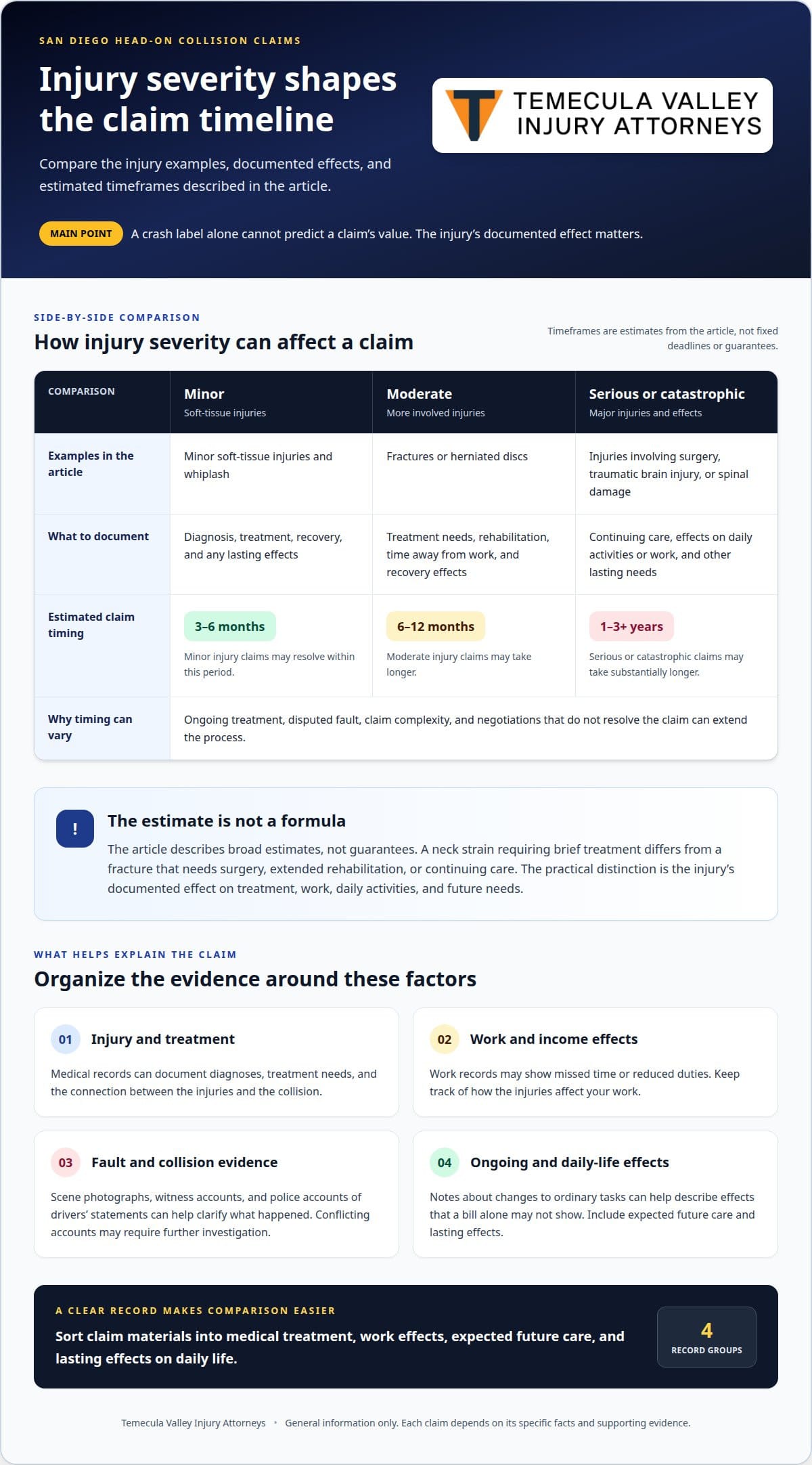
Injury severity is a major factor in a head-on collision claim, but the crash label alone cannot predict its value. San Diego estimates vary widely: minor soft-tissue injuries and whiplash fall into one range, moderate injuries such as fractures or herniated discs into another, and serious injuries involving surgery, traumatic brain injury, or spinal damage into a much higher range. These estimates are not guarantees or fixed formulas.
The practical distinction is the injury’s documented effect. A neck strain requiring brief treatment differs from a fracture requiring surgery, extended rehabilitation, or continuing care. A traumatic brain injury or spinal cord injury may affect daily activities, independence, and future work. Serious injuries can also require assistive devices, in-home care, or changes to a person’s living space. A wrongful death claim involves different losses for surviving family members.
Settlement timing often tracks injury severity and the claim’s complexity. Minor injury claims may resolve in 3-6 months, moderate injury claims in 6-12 months, and serious or catastrophic claims in 1-3+ years. A head-on collision settlement in San Diego can take longer when treatment is ongoing, fault is disputed, or negotiations do not resolve the claim. The usual process begins with investigation and claim presentation, followed by negotiations; a lawsuit may follow if talks do not produce a resolution.
Local details matter, too. The San Diego County Superior Court generally handles personal injury matters arising in San Diego. Crash-scene photographs, witness accounts, medical records, and police accounts of drivers’ statements can help establish what happened and connect injuries to the accident. For example, evidence that a vehicle crossed into oncoming traffic may clarify fault, while conflicting accounts may require further investigation.
California’s general filing deadline also affects the time available to pursue a claim. According to the California Legislature, most personal injury lawsuits must be filed within two years of the accident date. A claim against a California government or public entity generally has a six-month administrative filing deadline, so identifying who owns or controls the property or vehicle involved can matter. Exceptions may change the applicable deadline.
For a useful estimate, organize records by category: diagnosis and treatment, missed work, expected future care, and lasting effects on daily life. A moderate collision involving a fracture may require different documentation than a soft-tissue injury that resolves quickly. These steps help distinguish immediate losses from continuing needs, giving negotiations a clearer factual basis.
What Factors Affect Your Car Accident Settlement?
Averages can provide context, but they can’t predict what an individual claim is worth. Focus on how reported cases differ from yours, what evidence supports your losses, and whether the figure describes a settlement or a court verdict.
California Settlement Averages
A reported average combines claims involving different injuries, fault disputes, and evidence. It may include cases resolved through negotiation as well as those that proceeded through litigation. Before using an average as a comparison, identify what it measures and whether the underlying cases resemble yours. A statewide figure provides context, not an individualized estimate.
A settlement is an agreement between parties. A verdict is a decision reached through a court process. Because these outcomes arise differently, treating them as interchangeable can give a misleading impression of what a claim might resolve for.
San Diego Settlement Ranges
Reported San Diego ranges can cover claims with substantially different circumstances. Compare the injury type, treatment, recovery effects, and disputed issues rather than relying only on a broad range. A claim involving continuing limits on daily activities may require different evidence than one involving a brief recovery.
Local collision statistics describe crashes in the area, not the likely outcome of a particular claim. They cannot establish who caused your accident or what losses you experienced. Your records and the evidence available are more useful for assessing those questions.
Settlement negotiations also depend on how clearly the claim explains each loss. Medical records can document treatment, while work records may show missed time or reduced duties. Notes about specific changes, such as difficulty completing ordinary tasks, can help describe effects that a bill alone does not show.
Reported case outcomes need careful interpretation. A high-profile verdict may involve a trial, contested evidence, or circumstances unlike yours. It does not establish what an insurer will offer in a different claim. Ask what the reported result represents, which injuries and losses were involved, and whether it was a negotiated settlement or a verdict.
San Diego crash counts and injury totals may describe local traffic patterns, but they do not determine liability or compensation. They also cannot establish that a particular driver acted negligently. Evidence specific to your collision helps assess responsibility and the connection between the crash and your losses.
Deadlines are another practical consideration. The time available to take legal action can depend on the claim and the parties involved. A government entity, for example, may involve a separate administrative process. Identify potentially responsible parties early, preserve relevant records, and get advice about the deadlines that apply to your circumstances.
Before evaluating an offer, sort the claim materials into medical treatment, work effects, and other documented losses. This can reveal which parts of the claim are supported and which need clarification, without treating broad averages as a substitute for your own evidence.
What to Do After a Personal Injury Accident in California?
After a California collision, prioritize immediate safety, medical attention, and reliable records. These steps can help document the crash, identify possible liability, and preserve information for an insurance claim. If driving conditions or injuries make the scene unsafe, focus on getting help rather than gathering evidence.
California’s SB 1107 raised minimum auto liability coverage to $30,000 per person, $60,000 per accident, and $15,000 for property damage, effective January 2025, according to the California Legislature. These minimums describe required coverage, not the value of your personal injury claim. If several people are injured, the per-accident limit may affect the amount of coverage available to address their claims.
California follows pure comparative negligence. A person may seek recovery even if their own conduct contributed to the accident, but compensation is reduced by their share of fault. For example, an insurer may argue that a driver’s lane position contributed to a head-on collision. The evidence, not the accusation alone, helps establish how each person’s actions relate to the crash.
After addressing immediate medical needs, take these practical steps as circumstances allow:
- Report the collision to law enforcement and provide a clear account. Record the report details and preserve any information about responding officers.
- Photograph vehicle positions, visible damage, road conditions, and relevant signs. Keep original files and note when and where each image was taken.
- Exchange contact and insurance details with the other driver. Collect names and contact information from witnesses who saw the collision.
- Keep medical visit summaries, prescriptions, work absence records, and insurer communications together. These records can connect treatment, missed income, and physical suffering to the accident.
Do not guess about details you cannot recall. A consistent account helps. Save messages from the insurer and make notes after calls, including the date, representative’s name, and information requested. Before giving a recorded statement or accepting an offer, understand what the insurer is asking you to resolve and which documented losses the offer addresses.
Filing deadlines require attention, too. According to the California Legislature, most California personal injury lawsuits generally must be filed within two years of the accident date. A claim against a California public entity generally has a six-month administrative filing deadline. A government vehicle or public property may involve different notice requirements, so identifying the parties promptly matters.
A law firm evaluating a California injury claim may organize crash evidence, assess comparative negligence, and document medical and income losses. Keep records as treatment continues, and learn how to get your car out of an impound lot after an accident before vehicle repairs or changing road conditions make details harder to establish.
How Much Money is My San Diego Car Accident Claim Worth?
Your claim’s value depends on evidence of fault and the losses caused by the crash. Medical bills, lost wages, and pain and suffering are assessed through records showing treatment, missed work, and effects on daily life, not through one fixed calculation.
Disputed Liability and Medical Damages
A disputed claim requires evidence linking a driver’s conduct to the collision and your injuries. Medical damages are supported by treatment records, bills, and documentation of continuing care. For example, records showing when back pain began, what care followed, and how it affected work can help connect the injury to the crash.
Insurers may also question whether treatment was necessary or related. In a reported San Diego rear-end case, the insurer accepted liability but disputed the claimant’s injuries and the reasonableness of treatment, citing a low vehicle-damage estimate. Vehicle damage alone does not establish that an occupant’s injury is unlikely or unrelated.
Collision Liability Investigation
Investigating a collision means piecing together how the crash happened. Police accounts, driver statements, witness testimony, photographs, and video can clarify vehicle positions, traffic conditions, and the sequence of events. In a head-on crash, investigators examine whether a driver crossed into opposing traffic and whether the available evidence supports that account.
Medical documentation answers a different question: what harm followed? Treatment records, hospitalization, and descriptions of ongoing limitations help show injury-related losses. Keeping records in date order can make it easier to compare the collision timeline with the onset of symptoms and care.
Comparative Fault
California’s pure comparative negligence rule allows an injured person to seek damages even when partly responsible. Any recovery is reduced by that person’s percentage of fault. For example, if the evidence supports shared responsibility for a crash, the assigned fault share affects the damages recovered rather than automatically ending the claim.
Insurers may dispute a driver’s account or point to actions that allegedly contributed to the collision. Witness statements, scene images, and consistent records help assess those arguments. Evaluate each driver’s conduct against the available evidence rather than assuming an initial blame decision is final.
Evidence of Driver Liability
Proving driver liability means showing how the driver’s actions contributed to the crash and resulting injury. Police reports can record statements and observations, while photographs or video may capture vehicle positions, traffic controls, and roadway conditions. A witness who saw a vehicle enter the opposing lane can provide another account to compare with the drivers’ versions.
Organize evidence around the collision, the injury, and its effects. Keep medical records with work documents showing missed time, and preserve messages from insurers. This helps distinguish documented losses from disputed claims and gives negotiations a clearer factual basis for assessing compensation.
Head-On Collision Settlement Example
A reported collision example involved a person with neck, shoulder, and back injuries who did not undergo surgery. It illustrates why an injury claim cannot be assessed by surgery alone. Records describing symptoms, treatment, and effects on daily activities help explain the harm the person experienced.
Each injured area can affect daily life differently. Neck symptoms may make turning difficult, while shoulder or back pain may interfere with other movements. Medical records can document when symptoms were reported and what care followed. Records about changes to work or everyday tasks can add context to the person’s account.
The absence of surgery does not, by itself, describe the full recovery. Treatment history, reported symptoms, progress, and documented restrictions each provide useful context. A clear timeline can show how the person’s condition changed and which effects continued.
Organizing records by date can make a claim easier to understand. A treatment note describing difficulty lifting, for example, may help explain how a shoulder injury affected a routine task. Work records or other contemporaneous notes can provide additional context for reported limitations.
For a claim involving similar injuries, consider whether records describe each affected area, the treatment received, and changes to daily activities. These details can help identify what the documentation supports and which points may need clarification. The aim is to accurately describe the person’s experience, not to assume another person’s outcome applies.
This reported example does not establish a settlement amount or predict the result of a San Diego claim. The information describes the person’s injuries and lack of surgery, not a settlement outcome or a result achieved by Temecula Valley Injury Attorneys. Its value is the reminder that each person’s record matters.
Every claim should be evaluated on its own evidence and circumstances. A careful review of the injury documentation and the account of the person’s experience can help clarify the issues involved.
Temecula Valley Injury Attorneys
Temecula Valley Injury Attorneys helps injured people assess car accident claims, organize supporting evidence, and understand insurance disputes. If a collision left you facing medical bills, missed work, or questions about fault, our team can review your records and explain potential next steps. We handle car accident cases and can help you consider how injury documentation, liability evidence, and available insurance relate to your claim.
Legal guidance may be useful when an insurer disputes your injuries, challenges responsibility, or makes an offer that does not account for documented losses. A car accident attorney can evaluate the claim evidence and communicate with insurers on your behalf.
Our team can help you understand the issues affecting your claim and consider a practical path forward.
Take the Next Step With a Clearer Claim Plan
The value of a head-on collision settlement in San Diego depends on how the evidence connects the collision, your injuries, and their effects on your life. Your claim’s potential value depends on its specific facts, available insurance, and documented losses. A careful review can help clarify which issues remain open and what information may help address them.
Temecula Valley Injury Attorneys represents people injured in car, motorcycle, and truck accidents. If you’re weighing an offer, dealing with disputed fault, or unsure how to document ongoing effects, our team can discuss your circumstances and explain possible next steps. You don’t need to have every answer before starting the conversation.
Request a discussion about your accident claim with Temecula Valley Injury Attorneys. A clear understanding of your options can help you move forward with greater confidence.
Frequently Asked Questions
What Is the Average Car Accident Settlement in California?
Reported California car accident settlements vary, with one listed range of $15,000 to $80,000 and a median around $23,000 for cases that resolve without litigation. These figures describe different groups of claims, not a guaranteed amount for your case. Compare your circumstances by injury, treatment, fault, documented income loss, and available insurance, rather than treating an average as a personal estimate.
Can I get a settlement if I was partially at fault?
Yes. California’s pure comparative negligence rule allows an injured person to seek compensation even when partly responsible. The damages recovered are reduced according to that person’s share of fault. For example, if the other driver disputes who entered the opposing lane, photos, witness accounts, and vehicle positions may help assess each person’s role. An insurer’s fault assessment is not itself a final court decision.
Injured or Lost a Loved One in a Head-On Collision?
If you were injured, preserve medical and work records and keep insurer communications together. If a loved one died, surviving family members may have a wrongful death claim, depending on the circumstances and their relationship to the person. Records about funeral-related losses and the family relationship may matter. A lawyer can explain who may bring a claim and what losses the family may be able to pursue.
Is There a Deadline For Filing a Car Accident Claim in California?
In most California personal injury cases, a lawsuit generally must be filed within two years of the accident date, according to the California Legislature. A claim against a government entity generally has a six-month administrative deadline. These are different requirements, and missing an applicable deadline can affect the claim. If a public vehicle or agency may be involved, identify that promptly and get case-specific legal guidance.
Should You Try to Settle Without a Lawyer?
You can consider handling a straightforward claim yourself, but first review what the offer covers and whether your injury-related losses are documented. A claim is harder to evaluate when the insurer disputes fault, questions treatment, or your symptoms continue. Before agreeing to a settlement, understand whether it resolves future claims as well as current ones. A lawyer can review the offer and explain the issues to consider.
What is the average settlement for a head-on collision in San Diego?
There is no reliable single average for every San Diego head-on collision. Reported San Diego car accident claims span a broad range, but those figures include different crash types and injury circumstances. A head-on collision involving continuing limitations is not directly comparable to a minor injury claim. Evaluate the injuries, treatment, fault evidence, lost income, and available coverage in the specific case.
What factors affect head-on collision settlement value in California?
Key factors include the nature and duration of the injuries, treatment records, missed work, lasting effects, and evidence showing how the collision happened. Available insurance and fault disputes can also affect negotiations. For example, a witness account or video may help resolve conflicting descriptions of which vehicle crossed the center line. Keep records that connect each claimed loss to the crash and its effects.
What is California’s comparative negligence rule for head-on collisions?
California’s comparative negligence rule allows an injured person to pursue damages even if they share responsibility for a head-on collision. The court or parties assess each person’s contribution to the crash, and the injured person’s recovery is reduced by their assigned share of fault. Evidence such as scene images, witness statements, and vehicle damage can help assess competing accounts. Partial fault does not automatically prevent recovery.


