

A collision outside a marked crosswalk doesn’t automatically prevent you from pursuing a claim. If you’re looking for a pedestrian accident law firm in El Centro, the key questions are what caused the crash, whether a driver failed to use reasonable care, and how the injuries affected you.
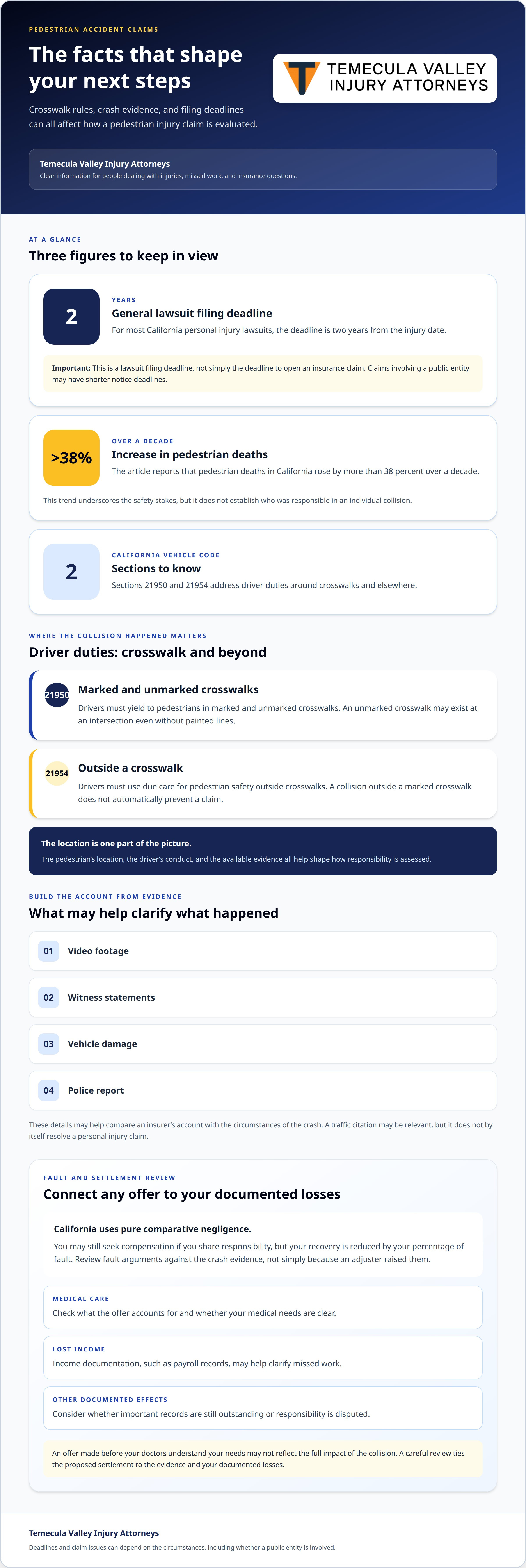
California’s general deadline to file a personal injury lawsuit is two years from the injury date, according to the California Legislature. Different deadlines may apply to claims involving a public entity, so it’s important to understand which rules fit your situation.
Driver inattention, failure to yield, and unsafe driving can contribute to pedestrian crashes. Afterward, medical care, missed work, insurance discussions, and uncertainty about fault can make next steps difficult. You deserve clear information before deciding whether an insurance offer reflects your losses.
We can help you understand common causes of pedestrian accidents, California drivers’ duties, filing deadlines, and what to consider when reviewing a settlement offer. Legal representation in El Centro may also help investigate the crash, preserve relevant evidence, and assess your options.
Key Takeaways
- Review an insurance offer against your documented injuries, losses, and available evidence before deciding whether to accept it.
- California drivers must yield to pedestrians in marked and unmarked crosswalks, and use due care outside crosswalks.
- The general deadline for a California personal injury lawsuit is two years from the injury date, but claims involving public entities can have shorter deadlines.
- Evidence about driver conduct, crash circumstances, and shared fault can affect how a pedestrian injury claim is evaluated.
- A pedestrian accident lawyer can help assess settlement discussions, investigate the crash, and explain potential next steps.
Should I Take a Settlement Offer From the Driver’s Insurance Carrier?
Don’t judge a settlement offer by its amount alone. Compare it with your documented injuries, related losses, and the evidence supporting your pedestrian accident claim.
Attorney Help With Insurance Negotiations
An attorney can organize medical records, income documentation, crash reports, and witness accounts for the insurer. This evidence can show how the collision caused your injuries and affected daily life. Before evaluating an offer, identify which losses it covers and whether your medical needs are clear. An offer made before your doctors understand those needs may not reflect the full impact.
During negotiations, an attorney can review the insurer’s reasoning, respond with supporting evidence, and communicate on your behalf. For example, payroll records may help clarify missed work if an adjuster questions it. Negotiations may resolve a claim, but a case can proceed to court if the parties cannot reach a fair settlement.
Comparative Fault Arguments
California follows pure comparative negligence. You may still seek compensation if you share responsibility, but your recovery is reduced by your percentage of fault. An insurer might argue that you crossed outside a marked crosswalk or failed to notice approaching traffic. Assess those claims against the crash evidence rather than accepting them as fact because an adjuster raised them.
Video footage, witness statements, vehicle damage, and the police report may help establish where everyone was and what happened. An attorney can compare the insurer’s account with that evidence and challenge unsupported claims about fault. A driver may still bear responsibility when a pedestrian was outside a marked crosswalk, depending on the circumstances and the driver’s conduct.
Before accepting an offer, review how it accounts for medical care, lost income, and other documented effects. Consider whether important records are still outstanding or the insurer disputes responsibility. A careful review connects the proposed settlement to the evidence and the collision’s actual consequences. Personal injury law provides a framework, but the facts of your claim shape negotiations.
California Driver Duties and Pedestrian Right-of-Way Laws
California law sets out drivers’ duties at crosswalks and elsewhere. Those rules help explain how conduct, evidence, and liability are assessed after a pedestrian collision.
Pedestrian Right-of-Way Laws
Under California Vehicle Code sections 21950 and 21954, drivers must yield to pedestrians in marked and unmarked crosswalks. A marked crosswalk has visible road markings; an unmarked crosswalk may exist at an intersection even without painted lines. The location of the pedestrian and vehicle can therefore matter when reviewing a crash.
Crosswalk rules do not mean a pedestrian’s actions are irrelevant. California Vehicle Code section 21954(b) requires drivers to use due care for pedestrian safety outside crosswalks. A driver may still face liability for striking someone outside a marked crosswalk. For example, the investigation may examine the driver’s actions and the pedestrian’s location before impact.
California Pedestrian Laws
California pedestrian laws call for a fact-specific review of how the collision occurred. Relevant details may include whether a crosswalk was marked, where the pedestrian was crossing, and how the driver responded. A traffic citation may be relevant, but it does not by itself resolve a personal injury claim or determine compensation.
California pedestrian deaths rose by more than 38 percent over a decade. That trend makes the safety consequences of driver conduct especially serious, but it does not establish liability in any individual case. An injury, including a traumatic brain injury, must be considered through the evidence and the circumstances of the collision.
Insurance companies may examine the same details when evaluating a claim. A careful review compares the driver’s duties under California Vehicle Code sections 21950 and 21954 with the crash evidence. If a driver failed to yield in a crosswalk, that conduct may support a liability argument. If the collision happened outside one, the duty of due care still matters.
These rules guide the legal analysis; they do not dictate an automatic outcome. The pedestrian’s location, the driver’s behavior, and the available evidence all shape how responsibility is assessed. Crosswalk duties and the broader duty to use care are distinct, and both can matter when evaluating a pedestrian accident claim.
California Pedestrian Accident Filing Deadlines
An attorney can identify the deadline, prepare required claim documents, and file a lawsuit in the proper court. Counsel can also assess whether a government entity or vehicle contributed to the crash, since those claims may have shorter notice deadlines.
For most California personal injury lawsuits, the filing deadline is two years from the injury date, according to the California Legislature. This deadline applies to filing a lawsuit, not simply opening an insurance claim. A serious injury, including a catastrophic injury after a crosswalk collision, does not automatically extend the deadline.
Some circumstances can affect how a deadline applies. A lawyer can assess whether the injured person’s age, delayed discovery, or other facts change the filing timeline. When a child is injured, for example, the applicable deadline may require a different analysis. Don’t assume the standard two-year period applies to every pedestrian accident case.
Claims involving a public entity have separate steps. A California injury claim against a public entity generally must be presented within six months from the injury, according to the California Legislature. If the entity rejects that claim in writing, a lawsuit generally must be filed within six months after rejection, also according to the California Legislature.
A shorter process may apply when a public entity, government vehicle, or unsafe public road is involved. An accident lawyer can investigate who controlled the location, identify the relevant entity, and track claim and lawsuit deadlines. Missing an early claim-presentation deadline can affect your options, even if the usual two-year period has not passed.
Wrongful death claims have a separate deadline. A lawsuit after a pedestrian accident generally must be filed within two years, according to the California Legislature. The date and circumstances that start the period can matter, so families should have an attorney assess the timeline rather than rely on a general estimate.
To assess filing dates, an attorney reviews the crash date, injury records, government involvement, and any written claim response. This helps distinguish an ordinary injury lawsuit from a public entity claim. A consultation can clarify which documents support the filing and what steps may follow. These deadlines concern legal claims, not how quickly insurers negotiate.
Pedestrian Accident Representation in El Centro
A pedestrian accident law firm in El Centro can investigate a collision, preserve evidence, handle insurer communications, and explain possible next steps. After a crash, that support can help you understand the claims process while you focus on recovery.
Local context matters. Pedestrians account for around 22 percent of fatalities from vehicle-related collisions in El Centro, and the city is among California’s ten most dangerous cities for pedestrians. Those figures describe broader risk, not who caused a specific crash. A lawyer assesses your collision’s facts, including the driver’s actions and your injuries.
A pedestrian accident lawyer can gather records that help establish how the crash happened. These may include a police report, witness accounts, photographs, available camera footage, and vehicle damage. If a driver was distracted, witness observations or other relevant evidence may clarify what occurred. The investigation should connect evidence to the collision rather than rely on assumptions.
Legal representation can also help organize your claim. An attorney may document medical care, missed work, and how pain affects daily activities. These details explain the practical consequences of an injury. For example, records showing a change in mobility can support your account of how recovery affects everyday routines.
An attorney can communicate with insurers and respond to disputed fault. A driver’s lack of a citation does not prevent you from filing a claim; negligence remains central. The lawyer can compare the insurer’s position with available evidence and address unsupported claims that you contributed to the crash.
After a pedestrian accident in El Centro, an attorney can help preserve evidence, identify potentially responsible parties, and prepare a claim. You can share information about the collision, medical care, and work disruptions. Your lawyer can organize those details for negotiations or litigation.
If you’re comparing options, a pedestrian accident law firm in El Centro can assess the evidence, injuries, available insurance, and applicable law. Representation cannot promise a particular result. A lawyer’s role is to explain your options and represent your interests as the case develops.
Free Consults: El Centro Pedestrian Accident Lawyers
Temecula Valley Injury Attorneys offers free initial consultations. A consultation does not commit you to legal action. Use the meeting to explain what happened, ask what information may matter, and discuss your concerns before deciding what to do next.
A first meeting can help you explain the collision and understand what information may matter. Describe where the vehicle struck you, whether a police report exists, and what injuries doctors have identified. If you have follow-up appointments or missed work, mention those effects. The attorney can discuss how those facts relate to a potential pedestrian injury claim.
Prepare a short timeline before the conversation. Include the crash date, where you were crossing, what you remember about the driver, and any contact with insurers. Gather available documents, such as the incident report, photographs, witness details, and medical records. You don’t need every record in hand to explain what happened.
Use the consultation to understand what the attorney would review next. Ask how the lawyer evaluates fault, identifies useful evidence, and communicates with insurers. If the driver disputes your account, ask how the attorney would assess that disagreement. Clear answers should explain the process in plain language, without promising a particular result.
Before sharing sensitive records, understand how the meeting works and what information the attorney needs. You can ask whether the discussion is an initial case review or includes advice about specific documents. An insurance letter, for example, may raise questions about a deadline or settlement. The attorney can explain what the letter appears to address and what further review may involve.
A free consultation is an opportunity to discuss your situation, not a guarantee of representation or recovery. Consider your immediate concerns, such as disputed fault, medical bills, or missed work, as you decide whether to take the next step.
Temecula Valley Injury Attorneys’ Pedestrian Accident Attorney
Temecula Valley Injury Attorneys helps people consider what to do after a pedestrian collision. Our team reviews your concerns, explains potential legal options, and clarifies what representation involves. You can describe what has changed since the crash, including treatment needs, work disruptions, or challenges with daily routines. We’ll use those details to focus on the questions that matter to you.
Our attorneys handle pedestrian accident claims involving people struck while walking. We focus on understanding the collision, your injuries, and the issues affecting your claim. We can explain how the process may unfold, what decisions could arise, and what information may be useful. Ask your questions in plain language and discuss your concerns before deciding whether to move forward.
Temecula Valley Injury Attorneys also handles car, motorcycle, and truck accident matters. The appropriate practice area depends on the vehicle involved and the circumstances of the crash. A collision involving a commercial truck, for example, may raise different questions from one involving a passenger car. Our team can clarify which type of accident claim fits the facts you describe.
If you’re considering a pedestrian accident law firm in El Centro, consider how clearly the legal team explains its role. We can discuss who would handle communication about your claim, how you can receive updates, and which decisions remain yours. Clear expectations help you understand the working relationship before choosing how to proceed.
You can share documents you already have, such as insurer letters or records related to missed work. You don’t need to organize every detail before starting a discussion. Our team can identify what information would help assess your situation and explain next steps. This keeps the conversation focused on your circumstances rather than a generic checklist.
A pedestrian accident law firm in El Centro should help you understand possible next steps and the questions that remain. We can review the information available, explain practical considerations, and discuss how representation may address your concerns. The decision to pursue a claim is yours. Our role is to provide clear guidance as you weigh your options.
If you’d like to discuss your situation, contact Temecula Valley Injury Attorneys.
Frequently Asked Questions
Can I still file a claim if the driver who hit me was not cited for the accident?
Yes. A citation is not required to begin a civil injury claim. Write down the responding agency’s information and request the collision report when it becomes available. Keep the claim number and insurer correspondence together. If the report leaves out an important detail, note the specific omission and preserve supporting records, such as a dated photograph or a witness’s contact information.
Can I still recover if the driver says I was partly at fault?
Possibly. California’s comparative fault rule allows recovery even when the injured person shares responsibility, with compensation adjusted for that share. A driver’s statement alone does not establish your responsibility. Preserve information that gives context, such as your route, visibility conditions, and any messages or photographs from the time. An attorney can assess how those details relate to competing accounts of the collision.
Which law firms in El Centro handle pedestrian accident cases?
Temecula Valley Injury Attorneys handles pedestrian accident cases and offers free initial consultations, so there is no risk for you to get started. Consulting does not commit you to legal action. Use the conversation to explain your main concerns, ask who would handle your case, and learn what information the legal team needs to evaluate your situation.
What experience and track record do El Centro pedestrian accident lawyers have?
Temecula Valley Injury Attorneys states that it has over 13 years of experience and reports prior case recoveries. Ask how the firm would apply its case-handling process to your circumstances, rather than treating past outcomes as a forecast. Prior results do not guarantee a similar outcome. Every case depends on its specific facts, evidence, applicable law, and available insurance coverage. Past results do not guarantee a similar outcome. Every case is different. Amounts shown are gross recoveries before fees and costs.
What compensation can victims recover after a pedestrian accident in California?
Potential compensation may include losses supported by evidence, such as treatment expenses, income lost during recovery, and the effects of an injury on daily activities. Useful documentation may include bills, pay records, and notes describing changes to your routine. Keep copies organized by date. Recoverable losses depend on the facts and evidence, so an estimate should reflect your circumstances.
What is California’s statute of limitations for pedestrian accident injury claims?
The general deadline for filing a California personal injury lawsuit is two years from the injury date, according to the California Legislature. A claim involving a public entity can have a separate, shorter claim-presentation deadline. Keep a written record of the collision date and any government correspondence. A lawyer can identify the applicable deadline and assess whether circumstances such as a minor’s age affect the timeline.
How does California comparative negligence affect pedestrian accident compensation?
California’s comparative negligence rule reduces compensation based on the injured person’s share of responsibility rather than automatically barring recovery. The assessment should consider all the circumstances, not just one person’s description. Records about sightlines or traffic signals, for example, may help clarify conflicting accounts. Your attorney can explain how evidence may support or challenge a proposed allocation of fault.
How long do pedestrian accident cases typically take to settle?
There is no fixed settlement timeline for every pedestrian accident case. The process may take longer if records are incomplete, injuries need ongoing evaluation, or the parties disagree about responsibility. The timing may also depend on how promptly insurers review submitted documentation. Ask which specific information or decision remains outstanding to understand what is delaying negotiations, rather than relying on an assumed deadline.


