

Pedestrians don’t always have the right of way. The rights of pedestrians in California depend on where and how someone crosses. Under California law, drivers must yield to pedestrians in marked crosswalks and unmarked crosswalks at intersections. Pedestrians crossing outside a crosswalk must yield to vehicles close enough to pose an immediate hazard. Both pedestrians and drivers must use care.
That distinction can affect more than a traffic ticket. California’s Freedom to Walk rules limit when officers may stop pedestrians for certain crossing violations, while a pedestrian’s share of fault can reduce compensation after a crash. Understanding the rights of pedestrians in California helps clarify when drivers must yield, how crossing rules relate to tickets, and how fault may affect an injury claim. Evidence and deadlines can also shape what happens next.
Key Takeaways
- Drivers generally must yield to pedestrians in marked crosswalks and unmarked crosswalks at intersections, but pedestrians also have duties to use care.
- California’s Freedom to Walk rules limit stops for certain crossing violations when there is no immediate danger of a collision.
- Pedestrian accident compensation may depend on the evidence, the injuries, and whether another party shares responsibility.
- Filing deadlines can differ, especially when a government agency may be involved, so identify the circumstances that could affect your claim.
- Special rules protect blind pedestrians using a cane or guide dog, and shared fault can reduce compensation without necessarily eliminating it.
Pedestrian right of way at marked and unmarked crosswalks
California’s crosswalk rules depend on where you cross and the surrounding traffic. Drivers and pedestrians each have a duty to use care.
Driver Yielding Duties
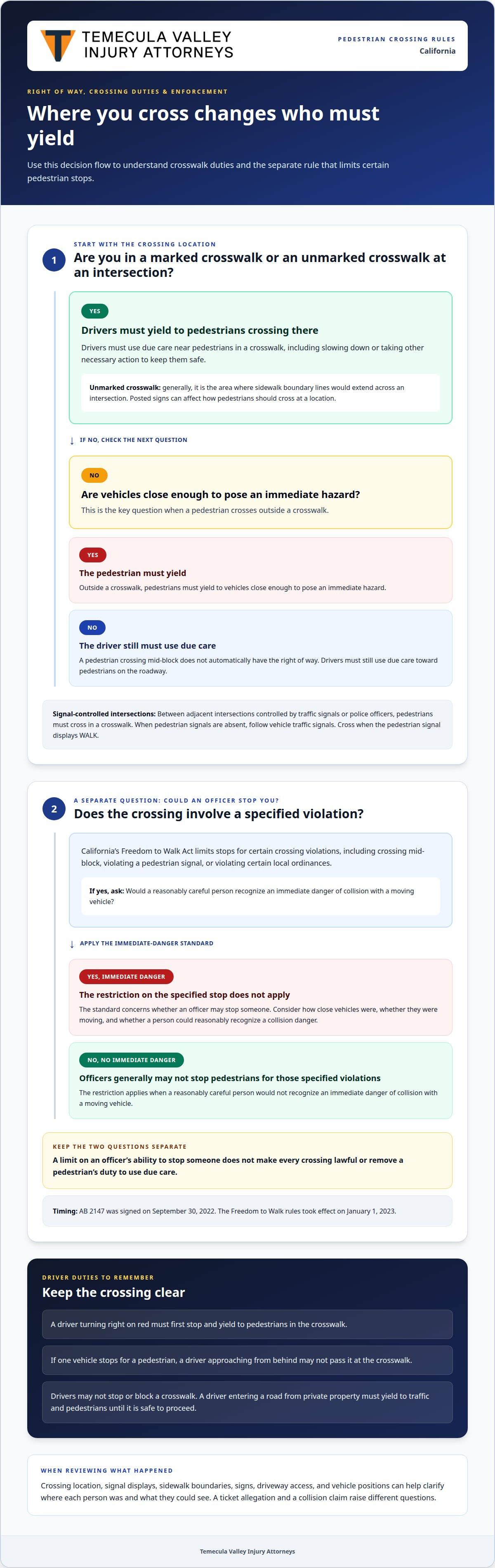
According to the California Legislature, drivers must yield to pedestrians crossing within a marked crosswalk or an unmarked crosswalk at an intersection under §21950(a). An unmarked crosswalk generally lies where sidewalk boundary lines would extend across an intersection, except where lines extend from an alley. Posted signs can affect how pedestrians should cross at a location.
Drivers must use due care near pedestrians in a crosswalk, slowing down or taking other necessary action to keep them safe. A driver proceeding on a green light, including when turning, must yield to pedestrians lawfully in the intersection or adjacent crosswalk. A driver turning right on red must first stop and yield to pedestrians in that crosswalk.
If one vehicle stops for a pedestrian, a driver approaching from behind may not pass it at the crosswalk. Drivers also may not stop or block a crosswalk. These rules help keep the crossing path clear, including when traffic moves through an intersection from several directions.
What penalties apply when a driver fails to yield? A driver who fails to yield to a pedestrian and injures someone commits an infraction. The circumstances, including the pedestrian’s location and the driver’s actions, help establish what happened.
Crossing Outside a Crosswalk
Outside a crosswalk, pedestrians must yield to vehicles close enough to pose an immediate hazard. They do not automatically have the right of way when crossing mid-block. Drivers must still use due care toward pedestrians on the roadway, even outside a crosswalk.
Between adjacent intersections controlled by traffic signals or police officers, pedestrians must cross in a crosswalk. Cities and counties may also adopt ordinances prohibiting crossings outside crosswalks. Signals matter: when pedestrian signals are absent, pedestrians should follow vehicle traffic signals; when a pedestrian signal displays WALK, they should cross.
Pedestrians are protected on a sidewalk when a driver crosses it to enter a driveway. A driver entering a road from private property must yield to traffic and pedestrians until it is safe to proceed. A vehicle turning across a sidewalk must account for people walking there, not just vehicles on the road.
Can pedestrians walk on highways or roads without sidewalks in California? Where walking on a roadway is permitted, pedestrians should face oncoming traffic if there is no sidewalk. Outside a business or residence district, they should walk close to the left edge, subject to safety exceptions. A pedestrian should not cross a bridge or highway unless it has a sidewalk and crossing is permitted.
At a crash scene, the crossing location can help distinguish a marked crosswalk from an unmarked crosswalk or a mid-block crossing. Signal displays, sidewalk boundaries, signs, driveway access, and vehicle positions can help reconstruct where each person was and what they could see.
California Freedom to Walk rules and jaywalking tickets
California’s Freedom to Walk Act changed when officers may stop pedestrians for certain crossing violations. It limits specified stops, but does not remove pedestrian safety duties or make every crossing lawful.
Jaywalking Enforcement and Stops
California’s Freedom to Walk Act, AB 2147, was signed on September 30, 2022. Since January 1, 2023, officers generally may not stop pedestrians for crossing mid-block or violating a pedestrian signal unless a reasonably careful person would recognize an immediate danger of collision with a moving vehicle.
The restriction also covers stops for certain local ordinance violations. Under Vehicle Code §21961(b), an officer may not stop a pedestrian for a signal violation or local ordinance violation without an immediate danger of collision. Vehicle Code §21954(c)(1) similarly limits stops for crossing outside a crosswalk when a reasonably careful person would recognize that danger. The standard concerns whether an officer may stop someone, not whether the crossing complied with every rule.
That distinction can matter if an officer issues a ticket after a mid-block crossing. Relevant circumstances include how close approaching vehicles were, whether they were moving, and whether a person could reasonably recognize an immediate collision danger. A ticket allegation and a collision claim raise different questions. The circumstances of a stop do not, by themselves, determine who caused an injury.
The Act preserves a pedestrian’s duty to use due care. A person cannot treat the rule as permission to step suddenly into a vehicle’s path or ignore surrounding traffic. California Vehicle Code §21456 addresses pedestrian signals, so signal displays remain important when crossing at a signal-controlled intersection. At a diagonal crossing, pedestrians may travel in any direction only when the walk signal permits it.
Local Pedestrian Laws
Are pedestrian laws different across California? Statewide pedestrian rules apply throughout California, but cities and counties may adopt ordinances prohibiting crossings outside crosswalks. Local rules can therefore differ. The Freedom to Walk Act limits specified enforcement stops; it does not erase local ordinances or make every crossing lawful.
For a particular ticket, identify the alleged violation and whether it involves a pedestrian signal, crossing outside a crosswalk, or a local ordinance. Then consider the location, signs, signal display, and nearby vehicle movement. Those details help distinguish the underlying rule from the separate question of whether an officer could make a stop under the Act. California Highway Patrol must report on the Act’s effect on pedestrian safety to the Legislature by January 1, 2028.
What compensation is available in a pedestrian accident?
Compensation depends on the injuries, documented losses, and evidence of how the collision happened. California deadlines also affect how long you have to pursue a claim.
Pedestrian Accident Injuries and Damages
A pedestrian accident claim may seek compensation for losses related to an injury. Relevant records can include medical bills, missed work, and documentation of how pain or physical limitations affect daily activities. Treatment records and pay information, for example, can help show the collision’s effects. Keep a record of expenses and time away from work as the claim develops.
The vehicles involved and the crossing location may also matter. A marked or unmarked crosswalk, traffic signals, and whether drivers had to yield can help explain how the crash occurred. Evidence of each person’s due care may inform the assessment of responsibility.
California’s general filing deadline for a pedestrian injury lawsuit is two years from the accident, according to the California Legislature under Code of Civil Procedure §335.1. If a government agency may share responsibility, a formal claim generally must be filed within six months, according to the California Legislature. These are different deadlines, so identifying a potentially responsible public agency matters early.
After a collision, preserve information that connects the injury and losses to the event. Keep medical and work records, photographs of the scene or vehicle damage, and contact details for witnesses. If a driver leaves, record what you can safely remember and report the collision to law enforcement. California Vehicle Code §20008 requires reporting a collision involving injury or death.
Comparative Negligence in Claims
Comparative negligence means responsibility for a crash can be shared between people involved. California follows pure comparative negligence under Civil Code Section 1714, so a pedestrian may recover even when partly at fault, with compensation reduced by that share. For example, a dispute about crossing outside a marked area does not alone settle who caused the crash; driver conduct and the full scene also matter.
Insurers may focus on signal use, visibility, crossing location, and whether a driver failed to yield. Compare those issues with available evidence, such as signal timing, photographs, witness accounts, and medical records. A clear account of events can help distinguish a traffic-rule issue from the separate question of how much each person contributed to the injury.
Insurance coverage can also affect potential recovery. An injured pedestrian may have access to uninsured motorist coverage through an auto policy, even when not in a car. Review the relevant policy and identify potentially involved vehicles and insurers. Keep copies of claim communications, and don’t overlook a deadline while fault or coverage is being discussed.
Protections for blind and visually impaired pedestrians
California law provides specific right-of-way protections for blind pedestrians using a white cane or guide dog. These protections help drivers recognize when a pedestrian may need additional care at a crossing, including when traffic signals provide no audible or visible cue.
California Vehicle Code §21963 addresses a driver’s failure to yield to a blind pedestrian using a cane or service dog. For the specified misdemeanor involving a blind pedestrian’s right of way, California Vehicle Code 21963 sets a fine of $500 to $1,000, according to the California Legislature. The rule is distinct from general crosswalk duties because it addresses a pedestrian’s blindness and use of an identifying mobility aid.
For a driver, a white cane or guide dog signals that a pedestrian may not see approaching vehicles or rely on ordinary visual signals. Drivers should stop and allow the person to cross safely rather than assume the pedestrian has noticed a vehicle. A pedestrian may be waiting at a curb or approaching a roadway, so careful observation matters before driving through the area.
California’s protections concern both the person crossing and the driver’s conduct. A driver should not rely only on a green light or the absence of a raised hand. At an intersection, check the crosswalk and curb before proceeding, especially when turning. Since a vehicle can block another driver’s view, approach slowly when a pedestrian with a cane or guide dog is nearby.
If an accident occurs, details can help clarify what happened. Note where the pedestrian was, whether they used a white cane or guide dog, which signals were active, and how the vehicle approached. Witness accounts may help show whether the driver had time to stop. Photographs of the crossing and traffic controls can preserve the scene’s layout, and prompt reporting helps document the incident.
Blind pedestrians still need to use due care, but their safety does not depend on drivers seeing a signal or gesture. For example, a person may begin crossing after traffic stops while a turning driver approaches from another direction. The driver’s duty to watch for pedestrians remains important even when the pedestrian cannot see the vehicle.
These protections also matter when insurers dispute how a collision happened. A claim may turn on the pedestrian’s location, the driver’s movements, visibility, and available witness or signal evidence. Noting a white cane or guide dog in the incident record can help explain why the special rule applies. Those details distinguish a specific statutory protection from ordinary right-of-way questions.
Comparative negligence and reduced compensation
A pedestrian’s actions can affect compensation, even when a driver also contributed to a crash. California’s pure comparative negligence rule considers each party’s share of responsibility.
Shared Fault in Pedestrian Claims
Comparative negligence means responsibility may be divided when both a pedestrian and driver contributed to a collision. An insurer may argue that a pedestrian’s choices reduced the driver’s responsibility. The assessment should consider the whole event, not just whether someone crossed outside a marked or unmarked crosswalk.
For example, a driver may have failed to use caution near a crossing while a pedestrian entered traffic without checking for approaching vehicles. Evidence about signals, visibility, vehicle movements, and the roadway can help explain each person’s actions. A traffic-rule violation may be relevant, but it does not by itself establish each party’s share of fault.
Pure Comparative Fault
California follows pure comparative negligence under Civil Code Section 1714. A pedestrian may recover compensation even when partly at fault, but the recovery is reduced by the pedestrian’s share of responsibility. There is no rule that automatically bars recovery solely because the pedestrian contributed to the crash.
This distinction matters when an insurer argues that a pedestrian’s crossing decision caused the entire accident. The question is what the evidence shows about each party’s conduct and contribution. For instance, a person crossing between intersections may have to yield to vehicles posing an immediate danger, while drivers still must use due care toward pedestrians on the roadway.
Fault arguments often turn on details that may seem minor at first. A traffic signal’s display, the location of an unmarked crosswalk, sightlines, and the driver’s response can all help reconstruct what happened. Photographs, witness accounts, and available video may clarify whether a person had time to react or a vehicle approached without adequate caution.
Keep the distinction between a citation and civil responsibility in mind. A ticket may document an alleged traffic violation, but an injury claim still requires examining how the conduct contributed to the collision and losses. The California Vehicle Code can help identify relevant crossing duties; the full evidence shows how those duties relate to the crash.
If an insurer disputes your share of fault, organize the available records and accounts before responding to its position. Discuss disputed pedestrian accident fault with our team to understand how the evidence may affect your claim.
Temecula Valley Injury Attorneys: Pedestrian Accident Attorney
Temecula Valley Injury Attorneys can help assess a pedestrian accident claim when injuries, disputed fault, or insurance questions complicate your next steps. Our team can review how the collision happened, the available evidence, your documented losses, and deadlines that may affect your options.
A driver’s failure to yield, a disagreement about where you crossed, or questions about which insurance coverage applies can make a claim difficult to evaluate alone. We can explain how those details may affect your case and help you understand possible next steps. You can share what happened and ask questions without pressure or promises about the outcome.
Contact Temecula Valley Injury Attorneys to discuss your pedestrian accident.
Take the Next Step With Clear Information
After a pedestrian collision, uncertainty can make it harder to decide what to do next. Bring your questions, relevant records, and insurance communications to a conversation with our team. We can help you understand which issues deserve attention and what information may still be needed.
The rights of pedestrians in California can matter alongside the specific facts of your collision. Our team can discuss how those rules relate to your situation and explain your options in plain language. Temecula Valley Injury Attorneys also represents people injured in car, motorcycle, and truck accidents, where vehicle evidence and insurance questions can shape a claim.
You don’t have to sort through every uncertainty alone. A conversation with our team can help you identify a practical path forward, without pressure to decide before you’re ready.
Reach out to Temecula Valley Injury Attorneys to discuss your situation. We’re ready to listen and help you consider your next step.
Frequently Asked Questions
Do Pedestrians Always Have the Right of Way?
No. A pedestrian’s right of way depends on the crossing location, signals, and traffic conditions. Drivers generally must yield at marked crosswalks and unmarked crosswalks at intersections, but someone crossing elsewhere must yield to vehicles posing an immediate hazard. For example, a pedestrian stepping into a vehicle’s path may not have priority. Drivers must still use due care toward pedestrians on the roadway.
Who has the right of way in a crosswalk?
Pedestrians crossing in a marked crosswalk or an unmarked crosswalk at an intersection have the right of way over drivers, according to the California Legislature under §21950(a). Drivers must still use care and respond to the actual crossing conditions. For instance, a driver approaching a crosswalk should not assume a pedestrian will stop just because the driver has a green light.
Right-of-Way Rules: Who Goes First?
Signals and the crossing location help determine who proceeds first. Drivers must yield to pedestrians lawfully crossing in an intersection or adjacent crosswalk, including when turning on a green light. A driver turning right on red must first stop and yield to pedestrians in the adjacent crosswalk. If you’re unsure whether a person has finished crossing, wait until the path is clear before moving.
What changed for jaywalking in 2023?
Since January 1, 2023, officers generally may not stop pedestrians for certain mid-block crossing or pedestrian-signal violations unless a reasonably careful person would recognize an immediate danger of collision. The change limits specified stops; it does not remove pedestrians’ duty to use due care or make every crossing lawful. Local ordinances may still prohibit crossing outside a crosswalk, subject to limits on enforcement stops.
What happens if the pedestrian caused the crash?
A pedestrian who contributed to a crash may still pursue compensation under California’s pure comparative negligence rule. Potential compensation may be reduced according to the pedestrian’s share of responsibility. For example, evidence may show both that a pedestrian crossed unsafely and that a driver failed to react with due care. The circumstances, available records, and conduct of everyone involved help determine how fault is allocated.
What rights do pedestrians have at crosswalks in California?
Pedestrians in marked crosswalks and unmarked crosswalks at intersections have right-of-way protections. Drivers may not pass a vehicle stopped at a crosswalk to let someone cross, and they must not stop or block a crosswalk. These rules protect a pedestrian’s path, but pedestrians must still use care and avoid suddenly entering the path of a nearby vehicle when an immediate hazard exists.
When must California drivers yield to pedestrians?
Drivers must yield when pedestrians are crossing in marked crosswalks or unmarked crosswalks at intersections. They must also yield to pedestrians lawfully in an intersection or adjacent crosswalk while proceeding on a green light, including when turning. A driver stopping at a red light before turning right must yield to pedestrians in the adjacent crosswalk. Drivers must use due care around pedestrians on the roadway, too.
What are California pedestrian rules for crossing streets outside crosswalks?
Outside a crosswalk, pedestrians must yield to vehicles close enough to pose an immediate hazard. Between adjacent intersections controlled by signals or officers, pedestrians must cross in a crosswalk. Local ordinances may also prohibit crossing elsewhere. Before crossing, consider vehicle distance and movement, and follow applicable signals. A local restriction does not eliminate a driver’s duty to use due care toward pedestrians.


